

By: G. Bennie Bravo Johnson
Liberia continues to battle recurring disasters floods, coastal erosion, storms, fires, and disease outbreaks that disrupt lives and undermine national development. Beyond destroyed homes and damaged infrastructure, these events weaken health systems, displace families, hinder education, and threaten food security across the country. Farmlands are washed away, communities are cut off, and families face long, painful journeys toward recovery.
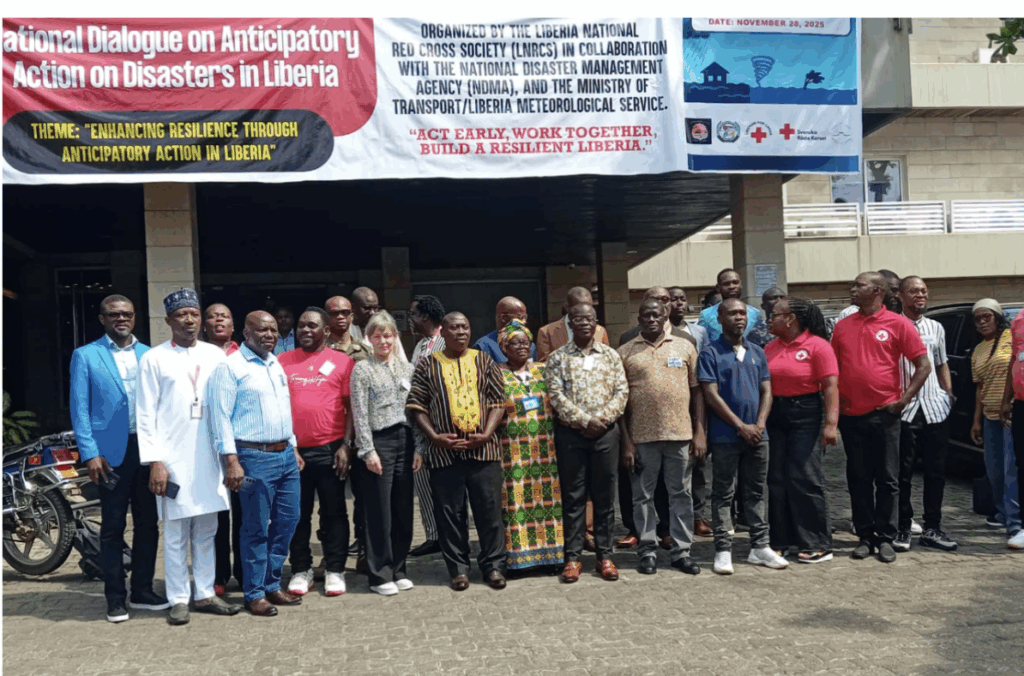
In a major effort to shift from reaction to prevention, the Liberia National Red Cross Society, with support from the Swedish Red Cross, convened a High-Level National Dialogue on Anticipatory Action in collaboration with key government institutions, including the National Disaster Management Agency and the Liberia Meteorological Service.
Held under the theme “Enhancing Resilience through Anticipatory Action in Liberia,” the event brought together the Environmental Protection Agency, Ministry of Agriculture, Ministry of Health, National Public Health Institute of Liberia, Armed Forces of Liberia, UNICEF, Ecobank, and a host of humanitarian and technical partners.
The national dialogue aims to strengthen coordination among institutions, build shared ownership, and develop a National Anticipatory Action Implementation Plan a roadmap that will help Liberia act before disasters strike and align with global best practices in disaster risk management.
Speaking at the opening session held at the Mamba Point Hotel, Red Cross Secretary General Gregory T. Blamoh underscored the need for urgent change. “Early warnings must lead to early actions. Acting before a hazard becomes a crisis is essential if we are to save lives and reduce suffering,” he said.
Blamoh highlighted the outcomes of a newly completed Multi-Risk Feasibility Study, which identifies forecastable hazards, potential early-warning triggers, and the systems Liberia must strengthen to make anticipatory action fully operational. Supported by the Swedish Red Cross and IFRC, the study marks a major step forward for national resilience. He outlined several priorities, including stronger early-warning systems, pre-arranged financing for rapid response, better community preparedness, and improved coordination among national institutions. “Disasters do not respect institutional boundaries neither should our response,” he added.
NDMA Executive Director Ansu Dorley described the dialogue as “a defining moment for Liberia’s disaster preparedness agenda.” He stressed that Liberia must move away from waiting for disasters to occur. Dorley noted that anticipatory action directly supports the government’s ARREST Agenda, and he called for full implementation of the dialogue’s recommendations.
Representing the Swedish Red Cross, Karin Westerberg, Head of Policy and Thematic Support, praised Liberia’s progress and emphasized the need for strong local systems as climate-related disasters rise globally and humanitarian funding tightens. “Anticipatory action works best when rooted in national systems and built for the people most at risk,” she said. During her recent visit to Grand Cape Mount where Red Cross volunteers assisted families affected by a major fire, she said she was inspired by the strength and dedication of local responders. She further commended the partnership between the Liberia National Red Cross and the Liberia Meteorological Service, strengthened earlier this year through a Memorandum of Understanding that enhances early-warning capabilities.
The most meaningful impact of anticipatory action will be felt in disaster-prone communities. The approach promises faster, more reliable early-warning information, allowing families to relocate to safety and protect essential belongings before hazards intensify. By releasing assistance before conditions worsen, anticipatory action reduces both human suffering and economic losses, while empowering community volunteers to take swift, effective action. It also prioritizes protection for vulnerable groups women, children, the elderly, and people with disabilities who often face heightened risks during emergencies.
Stronger national coordination will also reduce duplication, ensure better use of resources, and greatly enhance Liberia’s overall disaster preparedness. The dialogue concluded with a strong, united commitment from all participating institutions to strengthen national systems, deepen collaboration, and ensure that no Liberian is left behind when hazards threaten.
The Red Cross and its partners reaffirmed that anticipatory action is no longer optional it is a critical pathway toward safeguarding communities, protecting development gains, and building a more resilient Liberia.