

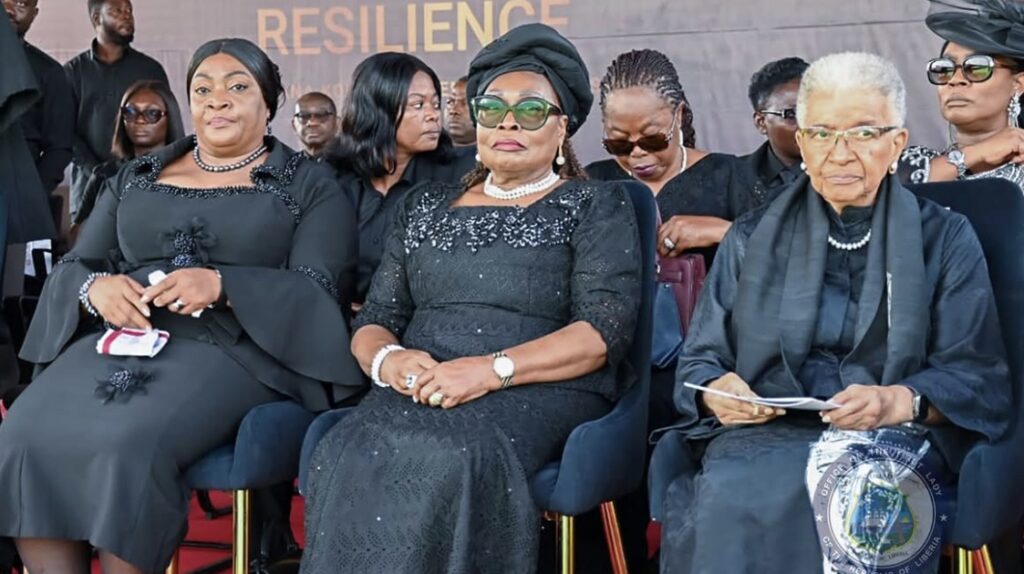
ACCRA, Ghana – Liberia’s former President Ellen Johnson Sirleaf, former Vice President Jewel Howard Taylor, and current First Lady Kartumu Y. Boakai gathered in Accra on Friday, November 28, 2025, to mourn the passing of Ghana’s longest-serving First Lady, Nana Konadu Agyeman-Rawlings. The state funeral, held at the historic Independence Square, drew hundreds of dignitaries and citizens to honor a woman whose influence profoundly shaped West Africa.
Nana Konadu Agyeman-Rawlings, who served as First Lady of Ghana from 1979 and again from 1981 to 2001, was laid to rest in a ceremony reflecting her stature as a national icon. She passed away on October 23, 2025, at the age of 76, leaving behind a legacy of relentless activism and political engagement.
Born on November 17, 1948, in Cape Coast, her leadership journey began in her youth. She attended Achimota School, where she met her future husband, Flight Lieutenant Jerry John Rawlings, a relationship that would place her at the center of Ghana’s political landscape for decades.
Her academic pursuits in art, textiles, and interior design, including studies at the London College of Arts, were complemented by later training in personnel management and development. This diverse educational background equipped her with a unique toolkit for community organization and leadership.
As the wife of a military leader who transitioned to a democratically elected president, Nana Konadu fundamentally redefined the role of First Lady. She moved beyond ceremonial duties to become a driving force for social and political change, establishing herself as a formidable figure in her own right.
In 1982, she founded the 31st December Women’s Movement, an organization that would become her primary vehicle for empowering Ghanaian women at the grassroots level. The movement focused on practical initiatives, teaching women income-generation skills and financial literacy.
The movement tackled deep-seated social issues, launching adult literacy programs to combat illiteracy and advocating against early childhood marriages. It also championed public health initiatives, educating communities on nutrition and immunization.
One of her most significant legal achievements was her crucial role in the adoption of Ghana’s Intestate Succession Law. This legislation protected the inheritance rights of women and children, challenging and reforming traditional customs that often left widows destitute.
Nana Konadu also fiercely advocated for women’s political participation. The 31st December Women’s Movement educated women on the electoral process, encouraging them to run for office. Their efforts bore fruit, contributing to a record 19 women being elected to parliament in the 1992 elections.
Her political ambition was personal as well as organizational. In 2016, she shattered a national barrier by becoming the first woman to run for President of Ghana. This historic bid followed her earlier, unsuccessful challenge for the presidential candidacy of the National Democratic Congress (NDC) in 2011.
At the funeral, former Liberian President Ellen Johnson Sirleaf, Africa’s first elected female head of state, eulogized Nana Konadu as “a consistent champion for African women.” Madam Sirleaf noted her fellow leader was “unapologetically bold, fiercely dedicated, and committed to the liberation of women across Africa.”
Madam Sirleaf added that the late Ghanaian First Lady’s leadership in women’s empowerment resonated powerfully within Liberia. She drew a direct line from Nana Konadu’s work to the ongoing fight for gender equality in Liberia, a nation that has itself produced influential women leaders.
Former Liberian Vice President Jewel Howard Taylor, a longstanding political figure in her own right, also attended the solemn rites. Her presence alongside Madam Sirleaf and First Lady Boakai illustrated a unified Liberian tribute to a pan-African icon of women’s political power.
First Lady Kartumu Y. Boakai personally extended condolences to the Rawlings family at their private residence. She paid tribute to Nana Konadu’s lasting contributions, acknowledging her as a pillar of democratic advocacy and a symbol of resilience for mothers and leaders across the continent.
The state ceremony was graced by Ghanaian President John Dramani Mahama and senior officials, reflecting a national consensus on celebrating a life of service and unwavering courage. The funeral served as a moment of national reflection for Ghana and for the wider West African region.