

– The Inspiring Story of a Couple’s Fight to Feed Their Family
By Shallon S. Gonlor | shallonsgonlor@gmail.com
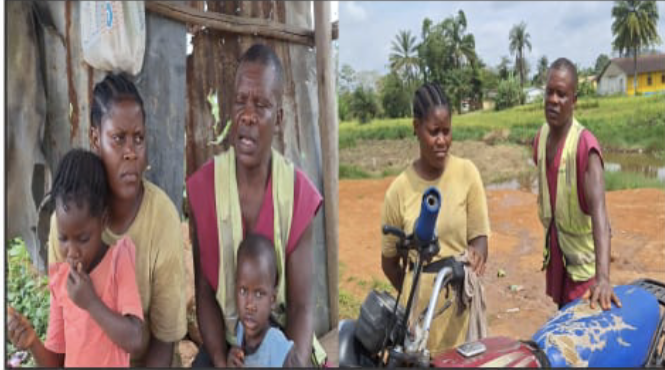
NIMBA COUNTY, Liberia — A couple in Nimba County has shared a moving account of their daily struggle to survive, highlighting both resilience and hardship as they fight to provide for their children after returning from Guinea as refugees in 2021.
Augustin Philip and his wife, Meme, told Women Voices News that their journey back to Liberia has been marked by broken promises and relentless challenges. They accused former Nimba County Superintendent Christian D. Dagadu of contributing to their plight, alleging that he lured them back with the promise of a $200 job but later abandoned them.
From Charcoal to Car Washing
Initially, the Philips sustained themselves through a small charcoal business, managing everything from production to sales. Their fortunes shifted when Spoken Word Ministry, a local church, donated a washing machine. With this support, they launched a car and bike washing business that now sustains their family.
“This shift breathed new life into our efforts to support our three kids, especially keeping one in school,” Philip said with gratitude.
He praised his wife Meme for her unwavering resilience. “For a woman, honestly, it’s a grind. The journey is tough, but there’s no bypass to life’s hurdles,” he reflected.
Philip recalled meeting Meme in Guinea, where she was cutting palm. Despite pressure from her hosts to marry a Guinean, she chose to build a life with him in Liberia. “Defying the odds, she came with me, and the rest is history,” he said.
Daily Struggles, Shared Strength
The couple’s washing venture began modestly, with Philip working alone. As demand grew, Meme joined him and quickly became an expert. Together, they now earn about 2,000 Liberian dollars (LRD) daily during the rainy season, when business peaks, and between 800–900 LRD in the dry months.
Philip’s message to struggling families is one of perseverance:
“Stand strong and vigilant. Overcoming poverty’s nightmare isn’t easy, but there’s no shortcut to success.”
He emphasized that every struggle carries purpose, serving as a test of strength and resolve. “We must not give up, no matter how hard things get,” he added.
Poverty in Liberia: A Wider Context
The Philips’ story reflects the broader reality of poverty in Liberia. According to the World Bank, the national poverty rate stands at 33.8% in 2025, a modest decline from previous years. The UNDP reports that 55.6% of Liberians live in multidimensional poverty, underscoring the depth of deprivation beyond income levels.
The African Development Bank’s 2025 African Economic Outlooknotes that poverty fell slightly from 35.4% in 2022 to 34.2% in 2023. Yet, rural communities remain disproportionately affected, with limited access to education, healthcare, and electricity.
Unemployment, officially recorded at 3.7% in 2023, masks the reality of widespread informal and vulnerable employment, particularly among youth. Poor infrastructure and fragile social systems further compound the challenges.
Electricity access has improved incrementally — from 23.1% in 2019 to 29.8% in 2021 — but most households still lack reliable power, limiting opportunities for inclusive development.
A Story of Hope Amid Hardship
Despite these systemic challenges, the Philips’ determination resonates across their community. Their story is not only about survival but also about resilience, partnership, and the belief that perseverance can overcome adversity.
“We are not alone in this fight,” Philip said. “Together, we can overcome any obstacle that comes our way.”