

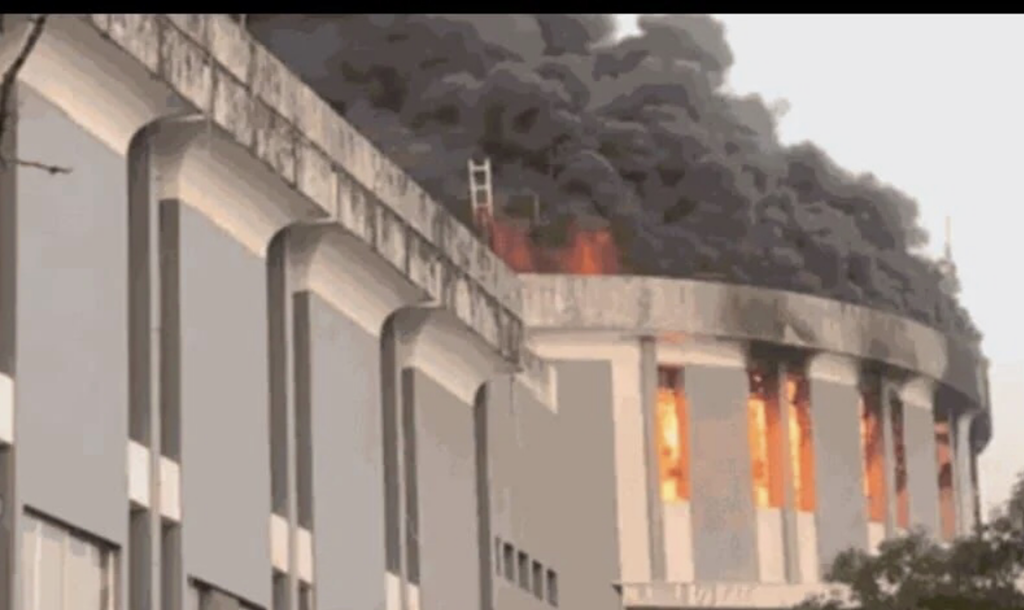
The prosecution’s first witness came under intense pressure during cross-examination as the defense exposed major contradictions between his courtroom testimony, official call-log records, and a forensic report he personally signed, raising serious doubt about the state’s version of events in the Capitol Building arson case.
Presiding Judge openly noted that the witness had not been “properly arranged” by the prosecution after his testimony conflicted with documentary evidence, particularly call-log data showing defendant Thomas Ethridge was not at the Capitol Building at the time the crime was allegedly committed. The inconsistencies, the defense argued, strike at the core of the prosecution’s case and reinforce an alibi defense that makes Ethridge’s involvement physically impossible.
According to the call-log evidence presented in court, Ethridge was at the Liberia Electricity Corporation (LEC) at 5:07 a.m. on December 18, 2024, then moved to the Capitol Bypass at 5:51 a.m., and only later appeared near the Capitol Building around 6:25 a.m. This timeline, the defense emphasized, directly contradicts the prosecution witness’s assertion that Ethridge was inside the Capitol Building as early as 5:00 a.m. during the commission of the alleged crime.
During cross-examination, the defense further questioned the witness about Vehicle 98, which the prosecution had suggested was used in the commission of the arson. The witness testified that the vehicle was initially taken from the Capitol Building to the Liberia National Police headquarters along with Ethridge and other defendants, but was later found not to be linked to the incident, after which Cllr. Massaquoi signed for both the suspects and the vehicle. He then added, inconsistently, that the vehicle was later suspected of transporting individuals and materials allegedly used in the arson and was brought back to the LNP for further investigation.
Defense counsel objected, arguing that the line of testimony was misleading and improperly suggested criminal use of the vehicle without evidence. The defense stressed that the question was germane precisely because it showed the prosecution’s shifting narrative and lack of a clear evidentiary link between the vehicle and the alleged crime.
Central to the defense’s case was the call-log evidence placing Ethridge at LEC at 5:07 a.m. during the time the crime was said to have occurred. Defense counsel argued that this electronic record establishes a classic alibi, demonstrating that Ethridge could not have been at the crime scene when the offense was allegedly committed. Although the witness initially attempted to defer discussion of GPS and call-log interpretation to an “expert,” the defense insisted he address the issue since he had already testified about it. The court overruled the objection and ordered the witness to answer.
In his response, the witness stated that nowhere in his testimony had he said the building was already on fire at 5:07 a.m. He confirmed that Ethridge was around LEC in the Waterside area at 5:07 a.m. and around the Capitol Bypass at 5:51 a.m., adding that the call logs showed Ethridge was communicating with Kevi Bai and other defendants during that period. The defense maintained that this admission further weakened the prosecution’s claim of Ethridge’s presence at the crime scene.
The cross-examination also revealed further contradictions regarding physical evidence allegedly recovered at the scene. The witness testified that an empty chloride bottle was discovered on the morning of December 18, 2024, about 25 feet away from where the Speaker’s vehicle was parked, while a box of matches was found on the second floor of the Capitol Building.
However, the defense confronted the witness with the Special Investigative Report—specifically page four, paragraph five—signed by the same witness in his capacity as Assistant Commissioner of Police for the Crime Services Department. The report, which was read aloud in court by the clerk of Criminal Court “A,” states that the Liberia National Police forensic team lifted an empty chloride bottle with a blue label from the ground of the Capitol Building, precisely around the William R. Tolbert Hall, and also found a box of matches with several sticks on the second floor of the building housing the joint chambers of the Legislature.
The defense argued that these inconsistencies between the witness’s testimony and his own official forensic report further erode the credibility of the prosecution’s case, leaving the jury with reasonable doubt as to both the timeline of events and the alleged involvement of the defendants.