

As Supreme Court Orders Their Corruption Trial to Proceed
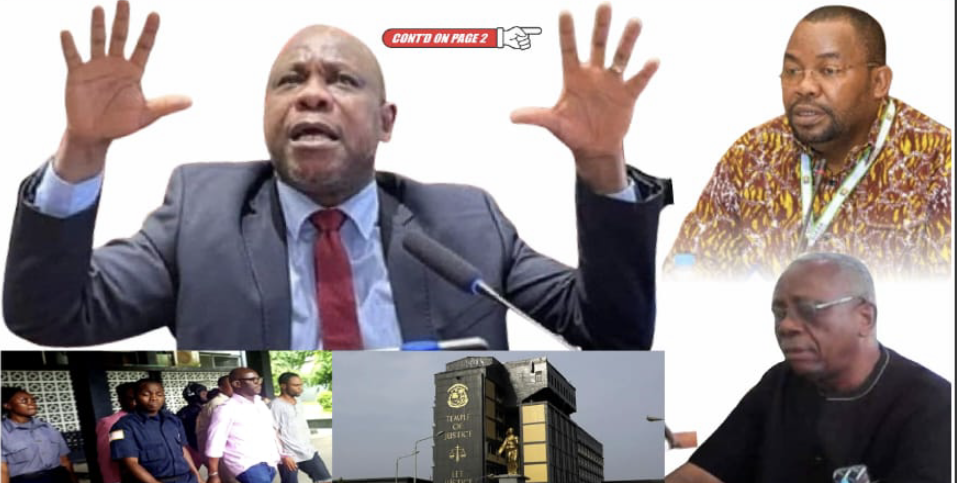
MONROVIA – The Supreme Court of Liberia has cleared the way for the criminal prosecution of several high-ranking former officials, rejecting their claims to immunity under the National Security Council (NSC) Act. The judgment was handed down on Thursday, December 18, 2025.
By Jerromie S. Walters/wjerromie@womenvoicesnewspaper_i2sktp
The petitioners—Samuel D. Tweah, former Minister of Finance; Counsellor Nyenati Tuan, former Acting Minister of Justice; Stanley S. Ford, former Director of the Financial Intelligence Agency (FIA); D. Moses P. Cooper, former Comptroller of the FIA; and Jefferson Karmoh, former National Security Advisor—had sought a writ of prohibition to halt their trial. They argued that their roles in the NSC granted them immunity from prosecution.
The Supreme Court, however, delivered a unanimous decision from the bench, firmly dismissing this argument. The Court held that the NSC Act explicitly names its members and outlines succession for its chairmanship. Since the Acting Minister of Justice and the other petitioners were not expressly named as members or formally co-opted by the President, their claim to statutory immunity was declared “illegal.”
In a pivotal constitutional interpretation, the Court reinforced that personal immunity under Article 61 of the Liberian Constitution is reserved solely for the sitting President and does not extend to other members of the Executive Branch.
The ruling also addressed a procedural contention, affirming that an adverse party may legally make an *ex-parte* application to a clerk or judge without notifying the opposition, as provided by civil and criminal procedure laws.
Consequently, the Supreme Court denied the petition for the writ of prohibition, quashed the alternative writ, and ordered the case remanded to the First Judicial Circuit, Criminal Assizes “C” in Montserrado County. Presiding Judge Roosevelt Willie is commanded to resume jurisdiction and proceed with the trial “in keeping with the law.”
A formal mandate is to be sent to the lower court to enforce the judgment. The full bench of five Justices was reduced by two recusals. Associate Justice Jamesetta H. Wolokolie recused herself due to family ties to one of the parties. Associate Justice Ceaineh D. Clinton Johnson also recused herself, having initially issued the writ in question.
The historic judgment was signed by Chief Justice Yamie Quiqui Gbeisay, Sr., and Associate Justices Yussif D. Kaba and Boakai Kanneh. It represents a significant affirmation of judicial independence and the principle that legal immunities are to be strictly construed, setting a clear precedent for accountability among public officials in Liberia.
The defendants now face the resumption of criminal proceedings brought by the Republic of Liberia through the Ministry of Justice and the Liberia Anti-Corruption Commission (LACC).