

-Defense Challenges Audio Evidence
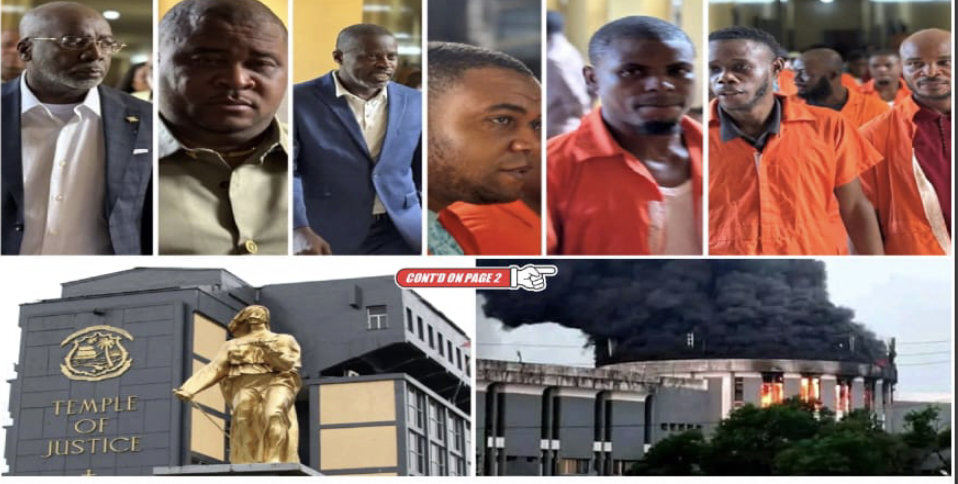
Monrovia: Defense lawyers in Criminal Court “A” on Friday challenged key audio evidence presented by prosecutors, arguing the recordings are not forensically verified and are vulnerable to artificial intelligence (AI) manipulation.
The defense’s position follows testimony from prosecution witness Reafeal Wilson on Thursday, December 18, 2025. Wilson told the court that the defendants claimed the audio recordings in question were fabricated using AI technology.
Seizing on testimony already before the court, Cllr. Johnson explained that AI-generated voices are created by training systems on existing audio samples, allowing fabricated recordings to sound authentic to the untrained ear. His argument came in response to questions from Judge Roosevelt Z. Willie on how artificial intelligence can replicate natural human speech.
In an attempt to demonstrate that risk, proceedings at the Temple of Justice were momentarily disrupted when the defense briefly played an alleged AI-generated audio recording purporting to feature United States President Donald Trump. The audio was used to illustrate how easily voices can be fabricated or manipulated, a central issue in the defense’s challenge to the prosecution’s reliance on audio recordings.
The prosecution immediately objected on several grounds, and Judge Willie sustained the objection, ruling that any audio evidence must be formally disclosed before being presented in court. Despite visible reaction in the courtroom, the defense maintained that the demonstration highlighted the danger of admitting unverified digital evidence.
On Friday, December 19, 2025, the defense sought to reinforce its argument by introducing the alleged Trump audio, which reportedly stated: “Good morning, Liberia. This is your favorite president. I want you to know that Etheridge is completely innocent. The man has not seen a box of matches in his life. To the Justice Department, stop embarrassing the man.”
Judge Willie ruled that the defense should have informed the court before playing the audio. Still, the legal mind argued that the attempt underscored the risk of relying on audio evidence without forensic validation, warning that such material could “sink the prosecution’s case” if admitted.
In a separate exchange, the defense questioned Wilson about the conduct of the Liberia National Police during the House of Representatives leadership impasse. Cllr. Johnson asked whether police actions during the removal of the Speaker’s chair were lawful, referencing a Supreme Court ruling involving former Speaker J. Fonati Koffa and rival Speaker Richard Koon. The prosecution objected, and the court sustained the objection.
The defense further accused the LNP of taking sides during the legislative crisis, alleging that officers assaulted lawmakers aligned with former Speaker Koffa. Johnson claimed that Wilson, acting in his official capacity, supported what the defense described as an “illegal majority bloc” and participated in actions against minority lawmakers.
When questioned about the source of the disputed audio recordings, Wilson testified that the material was obtained from open sources and media platforms. The defense countered that evidence sourced from social media is inadmissible in criminal proceedings unless corroborated by independent investigation and forensic analysis.
The case continues as the court considers the challenges posed by digital evidence, artificial intelligence, and evidentiary standards.
The Arson Attack:
Early on the morning of Wednesday, December 18, 2024, a thick plume of smoke rising from the Capitol Building signaled an attack on the heart of Liberia’s democracy. By approximately 6:00 a.m., fierce flames had engulfed the compound of the nation’s legislative branch. Commuters passing through Monrovia were among the first witnesses, raising the alarm on social media as the fire raged.
The blaze inflicted catastrophic damage. The House of Representatives’ wing and numerous offices were gutted. The intensity of the heat collapsed walls and completely destroyed the historic Joint Chambers—the ceremonial venue for the President’s annual State of the Nation Address.
Emergency response was hampered from the start. While the National Fire Service, the Liberia Water and Sewer Corporation, and the Environmental Protection Agency all mobilized, they were met with a devastating fire and critically limited resources, struggling to contain the inferno.
In June 2025, the Liberia National Police (LNP) concluded its investigation, revealing what it termed a deliberate and coordinated sabotage plot involving multiple suspects, including government officials.
Inspector General Gregory Coleman presented findings detailing charges related to both a prior November 2024 incident and the catastrophic December fire—twin attacks targeting the legislative branch.
The investigation named several individuals alleged to have carried out the attacks: Thomas Isaac Etheridge (alias Tom), Chief of Maintenance for Representative Jonathan Fonati Koffa, was charged with arson, criminal mischief, attempted murder, conspiracy, and related offenses. Authorities allege he damaged the chambers on November 10, 2024, before executing the December 18 arson.
Eric Susay was charged for involvement in the December 17 riot and the subsequent arson, with additional counts of stealing a police firearm and aggravated assault. Steven Broh, a Capitol Building maintenance worker, faces charges including arson and criminal conspiracy for his alleged role in the December 18 attack. Jerry Pokah (alias Tyrese) of New Kru Town was accused of helping to plan and execute the attack, facing a similar suite of serious charges.
Significantly, the LNP announced it had uncovered “credible evidence” implicating several high-profile officials in the plot: Former House Speaker Jonathan Fonati Koffa was charged with criminal conspiracy, with alleged involvement traced to November 2024.
Representatives Abu Kamara and Jacob C. Debee were also implicated. They stand accused of participating in planning meetings and providing logistical support, facing charges that include arson, criminal conspiracy, attempted murder, and reckless endangerment.
However, all of the suspects have since denied the allegation.