

Monrovia — The prosecution’s case against former House Speaker Cllr. Jonathan Fonati Koffa and his co-defendants encountered a major setback Tuesday as jurors at Criminal Court “A” openly questioned the reliability of video evidence presented by the state’s first witness, Assistant Commissioner of Police (ACP) Raphael Wilson.
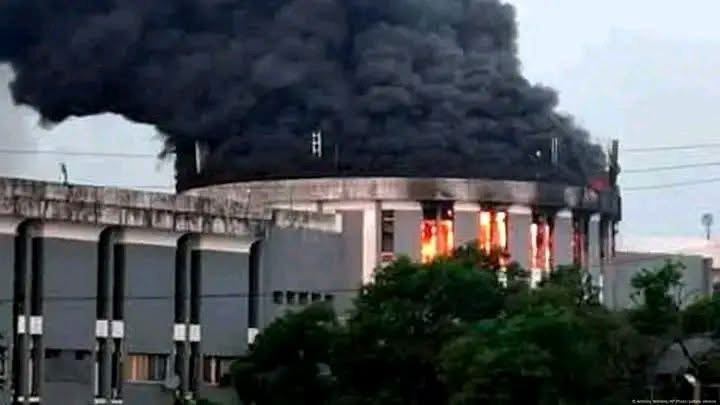
As ACP Wilson concluded his testimony, he relied principally on a video clip and a single photograph allegedly depicting defendant Thomas Etheridge participating in the November 10, 2024 incident at the Capitol Building. However, once the footage was displayed in open court, jurors expressed immediate uncertainty over whether the individual in the video was, in fact, Etheridge.
Jurors pressed ACP Wilson to identify the defendant in the dock and to confirm whether he was the same person captured in the video. Although the witness insisted that the defendant Thomas Etheridge was present in court, jurors remained unconvinced.
In a moment that visibly shifted the tone of the proceedings, one juror directly told the witness that the individual shown in the footage appeared to be “a Chinese man” and not Etheridge. The jurors repeatedly requested that ACP Wilson physically point out Etheridge and reconcile the apparent discrepancy between the defendant’s appearance and the person in the video.
Despite maintaining his position, ACP Wilson’s testimony appeared increasingly strained under juror questioning. The situation was further compounded when the witness admitted that only one photograph was taken from the alleged crime scene, raising concerns about the thoroughness and credibility of the investigation.
Presiding Judge Roosevelt Z. Willie joined the jurors in questioning the witness, particularly regarding inconsistencies in the number of defendants linked to the case. ACP Wilson had earlier referred to 16 defendants, prompting the judge to ask why only 11 are presently before the court.
The witness named Patrick Saah Alie, Representative Priscilla Cooper, and Representative Jerry Yorgbor as additional defendants, noting that while all were mentioned, only Representative Jerry Yorgbor’s case had not yet been forwarded to the prosecution.
Following the conclusion of ACP Wilson’s testimony, Judge Willie ordered the prosecution to produce its second witness. Instead, the prosecution sought a continuance, arguing that the witness was not prepared and not within the court’s immediate jurisdiction.
Defense counsel vehemently opposed the motion, characterizing it as a calculated delay aimed at disadvantaging the defendants. They argued that the prosecution, which claims to have about ten witnesses, should be compelled to proceed without interruption.
Defense lawyers further asserted that the continuance violated the defendants’ constitutional rights to free movement and urged the court to deny the request.
After hearing arguments, Judge Willie granted the prosecution’s motion, citing the Christmas holiday recess, and ordered the trial to resume on Friday, December 26, 2025.
As proceedings continue, the intense scrutiny of ACP Wilson’s testimony and the jurors’ open skepticism toward the prosecution’s key evidence have placed the defense in a strengthened position, raising serious questions about the foundation of the state’s case.