


-Across six counties
By Sampat JMB Kpakimah
Monrovia, Liberia – Florence Geebae, Managing Director of the National Housing Authority (NHA), has announced that the NHA is planning a major 6,000-unit housing initiative across six counties: Nimba, Lofa, Bong, Grand Bassa, Bomi, and Montserrado. She confirmed that the initiative has received the backing of the Speaker of the House of Representatives.
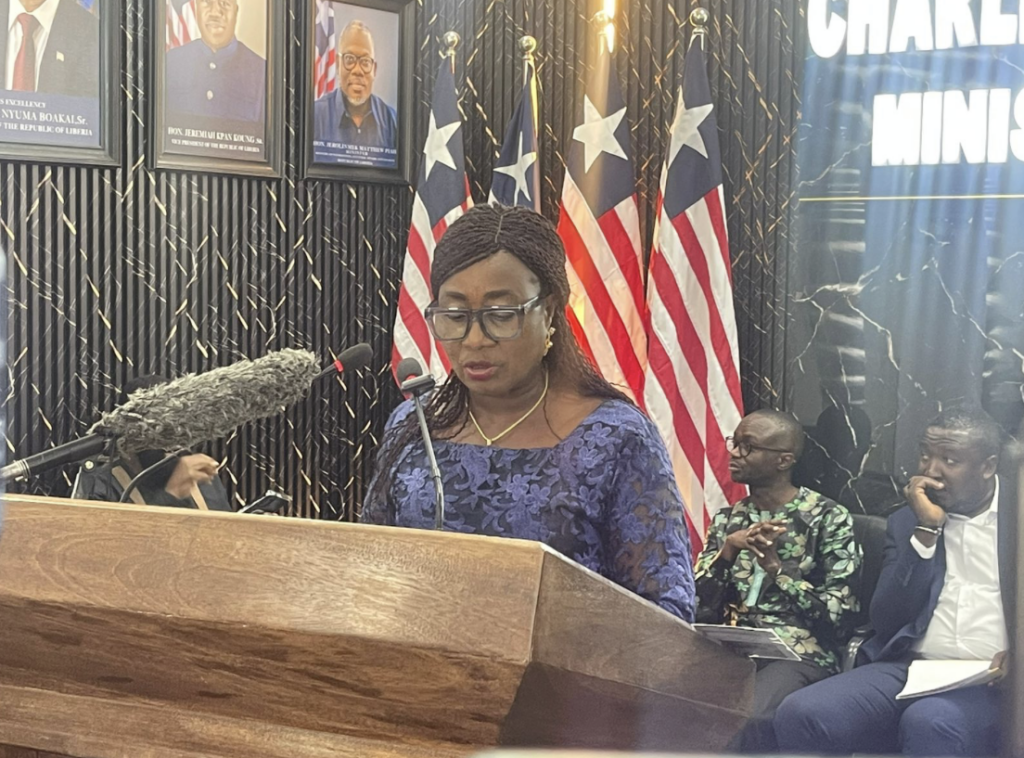
She made the disclosure during the Ministry of Information (MOI) press conference on Thursday, January 22, 2026. Securing pilot land for this project, she stated, is critical to easing urban overcrowding and setting the stage for a coordinated national response to the shelter crisis.
Geebae framed the situation as an “affordability and access emergency,” driven by poverty, rapid urbanization, weak financing systems, and the absence of a comprehensive national housing policy. Monrovia remains the epicenter of the crisis, with unchecked rural-to-urban migration intensifying congestion.
Compounding the problem is Liberia’s annual population growth rate of 4.4 percent, which necessitates the construction of nearly 4,900 housing units each year just to replace old and deteriorating structures—a target far beyond current capacity.
“The irregularities we see today are symptoms of a system that has been allowed to function without firm direction,” Geebae concluded. “Sustainable housing development requires not just plans, but unwavering political commitment.”
However, Geebae identified a persistent lack of political will as a fundamental cause of Liberia’s chronic housing deficits and sector-wide irregularities, undermining decades of development efforts.
She stated that while financing and land shortages are significant challenges, it is the ten-year failure of policy and governance commitment that has crippled systematic progress. This has resulted in uncoordinated land allocation, abandoned projects, and a critical absence of enforceable regulations.
Geebae further explained that since its establishment in 1960 to regulate and guide housing development, successive administrations have failed to fully empower the NHA. This created governance loopholes that have fueled informal settlements, unauthorized construction, and rampant land-use violations, especially in urban centers like Monrovia.
“Without firm political commitment, housing remains treated as a social issue instead of a national development priority,” Geebae warned.
The consequences, she noted, are severe: approximately 70 percent of Liberia’s population now lives in slum communities under unsafe and unhealthy conditions. “Slum proliferation is not accidental, but a direct outcome of weak enforcement and policy inconsistency,” she argued.
The NHA Director detailed how this lack of commitment has stalled the creation of essential institutions, such as a National Housing Trust Fund and a functional mortgage system, depriving ordinary Liberians of a viable path to homeownership.
Furthermore, the consistent depletion of the NHA’s land bank—now completely exhausted—has prevented the Authority from engaging in effective public-private partnerships. This vacuum, Geebae said, allows private developers to operate without clear oversight, contributing to irregular land sales and poorly planned communities.
Geebae issued a direct appeal to the Legislature and the Executive Branch to demonstrate decisive political leadership. She urged fast-tracking critical housing legislation, securing land for planned developments, and ensuring policies are implemented beyond political cycles.
She emphasized that without concrete action—including dedicated budgetary support and institutional strengthening—Liberia’s housing deficit, currently estimated at over 512,000 units, will continue to widen, deepening urban disorder and social inequality.