

-Liberia’s First Lady, Katuma Boakai Rallies Stakeholders, At Major Engagement in Ghana
BY: Shallon S. Gonlor
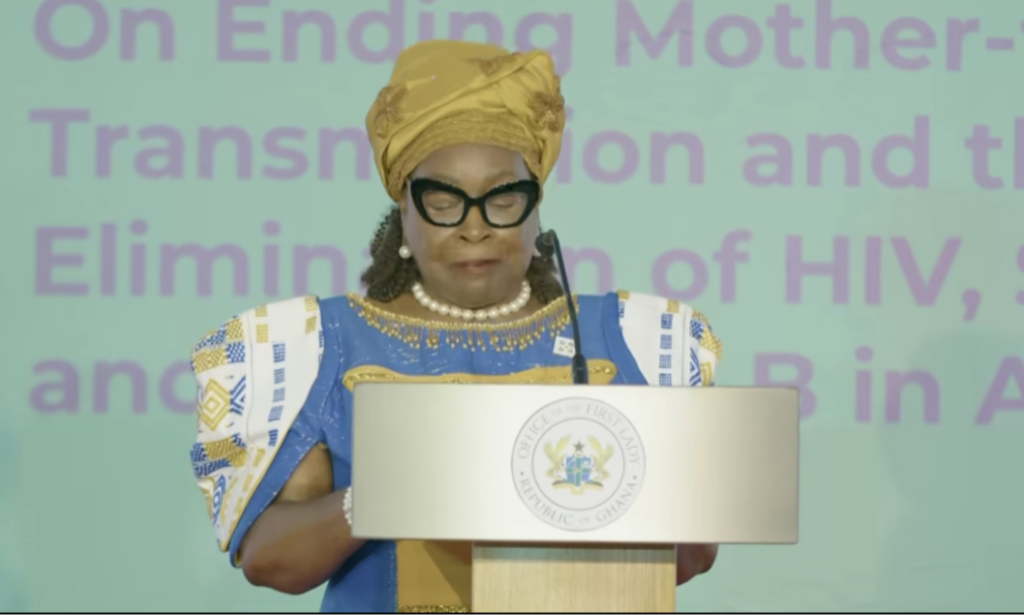
ACCRA, Ghana — Madam Kartumu Yarta Boikai, the First Lady of the Republic of Liberia has urged all first ladies and African heads of state to unite against mother-to-child transmission of HIV, syphilis, and hepatitis B. Speaking in Accra, Ghana, she emphasized the need for innovation and collective action to address the continent’s health transmission crisis, adding that this issue is not just medical, but a matter of justice, human rights, and development.
At the 23rd International Conference on AIDS and Sexually Transmitted Infections in Africa (ICASA) in Accra, Ghana, a high-level meeting for first ladies in Africa, Madam Kartumu made an electrifying remarks, which emphasized on protecting African mothers as a moral responsibility for first ladies and African leaders.
“If Africa could fight for liberation together, Africa can fight for healthy mothers together. If Africa could unite for independence, Africa can unite for an age-free generation,” Madam Kartumu said, urging leaders to safeguard the health of mothers and children, who represent the continent’s future.
The First Lady’s appeal highlights the need for collective action to address health challenges in Africa.
Madam Kartumu also urged African leaders to affirm their collective commitment to speak with one voice and act with one purpose, that no child should be born with HIV. “No child, I repeat, should be born with HIV,” she cautioned.
She clearly said no mother should pass on syphilis unknowingly, no baby should battle hepatitis B from birth, not in Ghana, not in Liberia, not anywhere in Africa. “Mother-to-child transmission of HIV, syphilis, and hepatitis B is evidently not a medical issue alone. It is a justice issue. It is a human rights issue. It is a development issue. And it is definitely a pan-African survival issue,” she boldly declared.
First Lady Boakai said without a shadow of doubt that not one African mother should be betrayed by a system that was supposed to protect her, adding further that not one baby should carry a burden that has been defeated. “I want you to imagine and reflect on this for a moment,” Madam Kartumu told ICASA vent participants in Accra, Ghana.
Narrating a scenario from one of her recent hospital visits in Liberia, Madam Kartumu explained “a seven-year-old boy talked on my dress. He looked up at me with innocent eyes and said, Grandma, when will my little sister stop being sick? His mother stood beside me, tears rolling down her cheeks. She whispered, she was born with what I did not know I carried, HIV.”
Madam issued a call to action to partners and African leaders to act with urgency, pleading that a child should never carry the burden of a system’s silence, while a mother should never carry the guilt of a system’s failure. “This is why, through my advocacy in Liberia, we have aligned our national priorities with the triple elimination goals.”
According Madam Kartumu, her advocacy in Liberia is expanding on prevention of mother-to-child transmission (PMTCT) services to hard-to-reach regions, increasing antenatal testing, counseling, and follow-up; strengthening supply chains to prevent stock-ups; training more midwives, nurses, and community health workers; mobilizing traditional and faith leaders to change harmful narratives; and engaging youth and civil society to break stigma, silence, and shame.
PMTCT: Prevention of Mother-to-Child Transmission services provide comprehensive care for pregnant women, those of reproductive age, and their infants, focusing on preventing HIV, Syphilis, and Hepatitis B transmission, as well as supporting overall maternal and child health through testing, antiretroviral therapy (ART), counseling, and safe infant feeding practices across pregnancy, labor, and breastfeeding. These services aim to achieve zero new infections in children by addressing primary prevention, family planning, transmission interruption, and integrated care for affected families.
First Lady Kartumu told ICASA participants that her commitment is uncompromising, fighting for mother-to-child health infections.
“But we know we cannot do it alone. No country can. And that is why offline leadership is vital, uniting us beyond our borders, beyond our politics, and beyond our limitations,” Liberia’s First Lady pleads with partners and African leaders.
Madam Kartumu underscored the need for stronger collaboration, sustained financing, and united continental leadership, admonishing leaders to remind themselves that beyond every stylistic is a mother with a heartbeat. “Beyond every percentage is a child with potential. When a mother buries her child, she buries a piece of our nation. When a child is infected at birth, a continent’s future is compromised,” she cited.
In her electrifying remarks, Madam Kartumu submitted that in Africa, a mother’s cry is never heard alone – it is a summons to the entire village.
Madam Kartumu quoted an African proverb as saying, “When the roots are diseased, the branches cannot flourish,” emphasizing that if Africans and their leaders failed to unite in protection for the health of women and children, they cannot expect the prosperity of nations. “Let us declare wholly and with all apology, the womb must never be a war zone. The birth of a child must never be a death sentence.” She added: “We cannot eliminate poverty if we fail to eliminate the disease that deepens it.”
Mrs. Boakai encouraged women with influence, compassion, and courage to face and address the reality, saying if they cannot carry the scaffold, they must carry the story or if they cannot hold the microscope, they should hold the microphone to protect and amplify women’s health. “Our voices must disturb complacency and awaken accountability.,” she noted. History has shown that when African first ladies speak, nations listen; when African first ladies advocate, systems shift; and when African first ladies unite, the world pays attention.
Madam Kartumu warned that mothers should not negotiate when it comes to the safety of their children, echoing her voice in the historic ICASA gathering in Accra, Ghana. Madam Kartumu’s message was amplified with a slogan that declars enough is enough, hoping that by 2030, Africa will deliver an AIDS-free generation, not by chance, but by choice, not by hope, but by action because when Africa decides, Africa delivers.
“Any mother-to-child transition may seem difficult, but so did freedom, so did independence, so did democracy. And yet, Africa accomplished them. Madam Kartumu challenged the gathering with a hope of a standing ovation in a defining moment of history to take decisive measures and an aggressive approach to ending mother-to-child transmission, and the elimination of HIV, Syphilis, and Hepatitis-B in Africa.
A promise that every child born in Africa will begin life healthy, whole, and free; a promise that no mother’s joy will be replaced by grief because of diseases they already know how to prevent. Madam Kartumu closed with a declaration worthy of mothers, daughters, and Africa, every first lady determined to build. “Let it be recorded that when the future asks who protected Africa’s children, history will answer it was the mothers of Africa, the first ladies.
The International Conference on AIDS and Sexually Transmitted Infections in Africa (ICASA) is Africa’s leading biennial gathering, addressing HIV/AIDS, STIs, TB, malaria, and broader health system challenges. Since 1989, the Society for AIDS in Africa (SAA) has organized ICASA, uniting scientists, activists, policymakers, and communities to drive progress against these epidemics. The 23rd ICASA conference (ICASA 2025) in Accra, Ghana, focused on integrated, sustainable responses, fostering research, community action, and policy through scientific exchange, advocacy, and innovative solutions.