

-On Single Currency
Liberia is set to host a high-level Economic Community of West African States (ECOWAS) statutory meeting aimed at deepening monetary policy coordination, strengthening regional economic integration, and assessing progress toward the long-anticipated adoption of a single West African currency by 2027.
The meeting, which will officially begin on February 4, 2026, at the Central Bank of Liberia (CBL), will bring together more than 100 participants, including central bank governors, senior policymakers, and technical experts from across the ECOWAS region. It is expected to run through February 14, featuring intensive technical and policy-level deliberations.
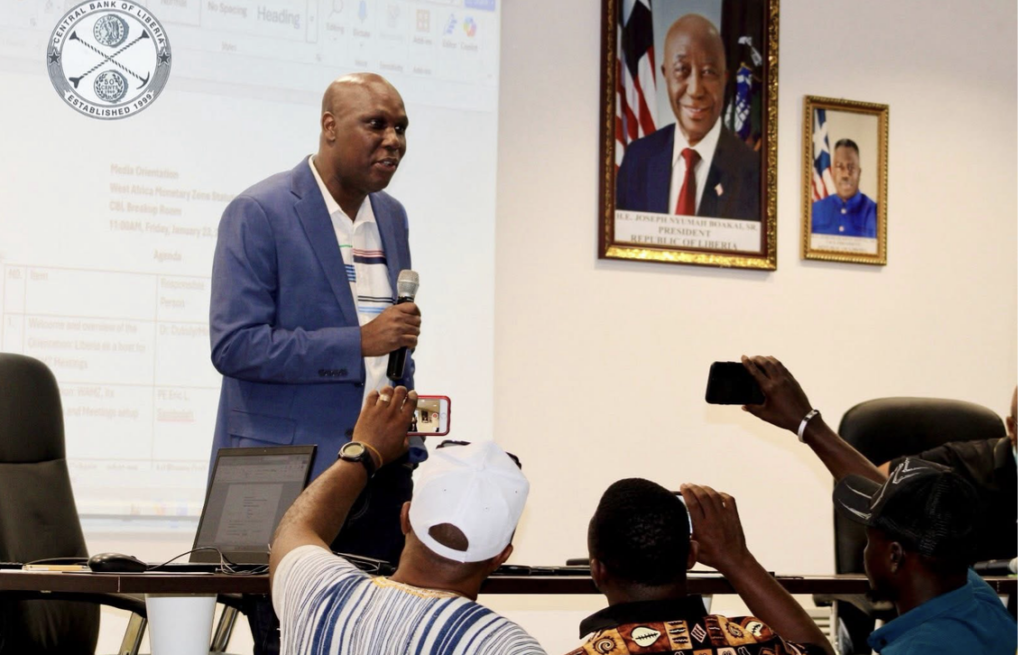
Speaking during a media engagement at the CBL ahead of the meeting, Dr. Musa Dukuly, Deputy Governor for Economic Policy said Liberia’s hosting of the statutory sessions underscores the country’s growing role in regional monetary cooperation and reflects ongoing collaboration between the Central Bank and the media to promote public understanding of monetary policy issues.
“This engagement with the media is intended to provide accurate information on the Central Bank’s monetary policy operations and the broader implications of Liberia hosting the ECOWAS statutory meeting,” Deputy Governor Dukuly said, noting that the gathering will also spotlight Liberia’s recent macroeconomic performance.
According to the Central Bank Deputy Governor for Economic Policy, the statutory meeting will provide a platform for member states to share experiences on macroeconomic challenges, assess progress toward monetary integration, and examine the extent of policy harmonization across the region.
He averred that a key component of the gathering will be technical discussions, including meetings of the College of Supervisors, where central bank officials will exchange views on financial sector stability, non-performing loans, climate-related financial risks, and other vulnerabilities affecting banking systems across member states. “These discussions will allow Liberia to learn from other countries’ experiences and also share its own strategies, particularly in areas where we have made notable progress.”
He disclosed that Liberia’s economy has attracted attention from regional peers, with countries such as Ghana seeking to understand how Liberia has managed to sustain relative macroeconomic stability amid global and regional economic pressures.
Dr. Dukuly asserted that the meeting will also review progress made under the WAMZ framework, including advancements in cross-border payment systems, the creation of a second monetary zone to fast-track integration, and the introduction of unique bank identification systems to expand access to financial services.
In addition, WAMZ institutions have conducted extensive research on trade and macroeconomic issues to inform policy decisions and promote stability across member states.
Liberia’s recent transition from exchange-rate targeting to an interest rate-based monetary policy framework was cited as a significant step toward harmonization, aligning the country’s policy approach with that of other WAMZ members. By contrast, WAEMU countries continue to operate under a fixed exchange-rate regime, with their currency pegged to the euro.
Despite these gains, the Deputy Governor for Economic Policy acknowledged persistent challenges, particularly in meeting the macroeconomic convergence criteria required for full monetary integration. These include four primary benchmarks—such as maintaining inflation below 5 percent—and two secondary criteria.
Many ECOWAS countries, including Liberia, have struggled to consistently meet the inflation target, largely due to heavy public investment in infrastructure and other critical sectors. While progress has been made in limiting central bank financing of government operations, other benchmarks—such as maintaining at least three months of import cover in foreign reserves—remain difficult to achieve.
“For Liberia, preliminary indicators suggest we may meet two of the primary criteria and two others, but the final assessment will determine our exact standing,” He said.
The Deputy Governor continued by revealing that policy harmonization has also been slowed by legislative requirements and concerns over political sovereignty, as some reforms, such as adopting the ECOWAS Common External Tariff—carry implications for prices, labor stability, and domestic political considerations. As a result, many countries have opted for a gradual approach to convergence.
Meanwhile, he intimated the statutory meeting, participants are expected to produce a comprehensive report with country-specific recommendations, outlining steps Liberia and other member states should take to advance the integration process.
The Deputy Governor for Economic Policy stressed that the outcomes of the meeting will be crucial in determining whether ECOWAS is prepared to move toward the adoption of a single regional currency in 2027, a date identified in regional protocols as a key milestone.
“This is a very important meeting—not only for ECOWAS but for Liberia,” the official emphasized. “It offers us the opportunity to shape regional policy discussions and better understand what is required of us as we move toward deeper monetary integration.”
The ECOWAS statutory meeting traces its roots to the ECOWAS Monetary Cooperation Programme, initiated in 1987 to foster monetary integration and facilitate trade among member states. While early efforts focused on harmonization, structural differences among member countries prompted a more forward-looking approach, leading to the establishment of distinct monetary zones.
Today, ECOWAS operates under two major zones: the West African Economic and Monetary Union (WAEMU)—commonly referred to as UEMOA—comprising mainly Francophone countries that use the CFA franc, and the West African Monetary Zone (WAMZ), established in 2000 to bring together non-CFA countries under a convergence framework.
The WAMZ was created to set common macroeconomic benchmarks—known as convergence criteria—against which member states’ economic performance could be assessed, while also promoting trade and policy harmonization. To operationalize the zone, the West African Monetary Institute (WAMI) was established in 2001 and now coordinates WAMZ activities.
Member countries of the WAMZ include Liberia, Ghana, Nigeria, Sierra Leone, The Gambia, and Guinea—the only Francophone country within the zone.