

–As They Demand Tangible Progress
By Jerromie S. Walters & Sampat JMB Kpakimah
Monrovia – Liberians are delivering a starkly divided assessment of the nation’s direction, with urgent calls for investment in people and infrastructure following President Joseph Nyuma Boakai’s 3rd State of the Nation Address (SONA) on Monday, January 6, 2026.
President Joseph Nyuma Boakai delivered his third State of the Nation Address on January 26, 2026, two years after his January 2024, inauguration. Article 58 of Liberia’s Constitution requires the President to present the administration’s legislative program and a report on the Republic on the fourth working Monday of January. He noted that Liberia is in a better state than it was a year ago, with tangible progress made despite inherited challenges and limited resources.
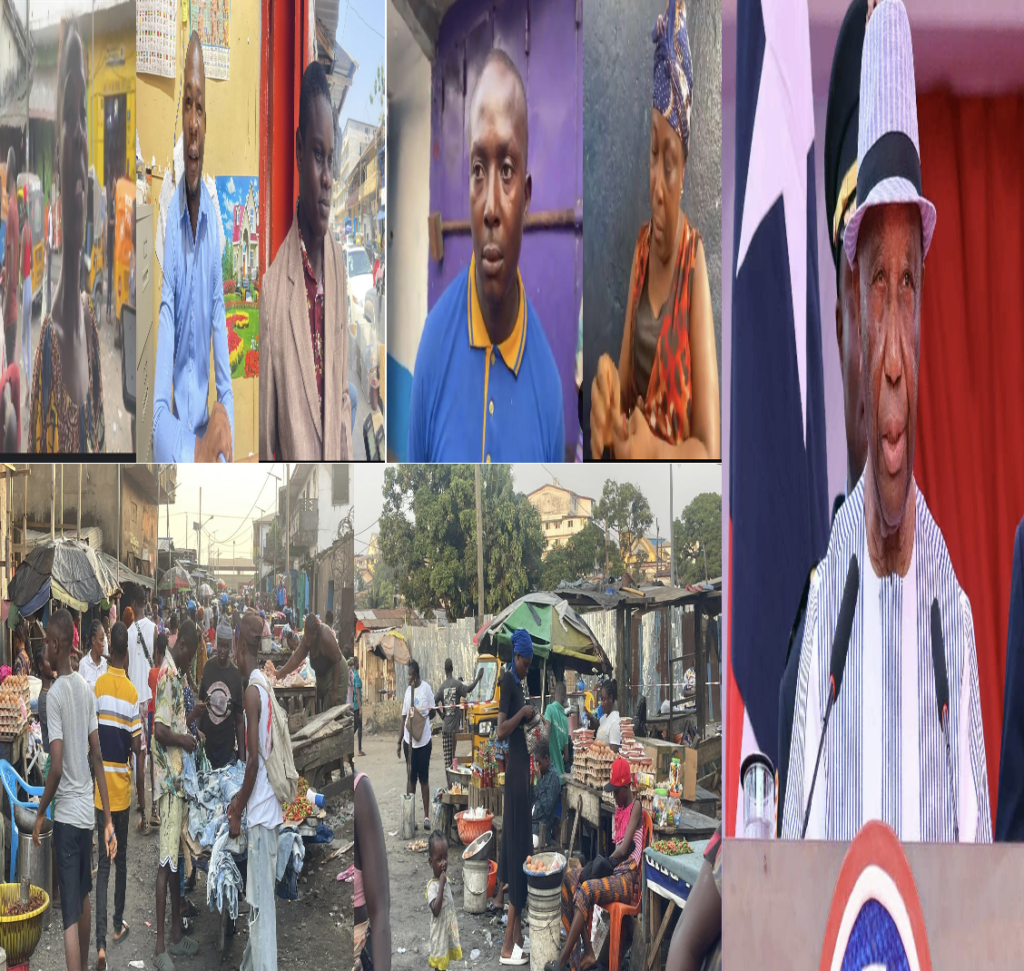
On the streets of Monrovia, however, frustration over daily hardships is palpable. Alex Paye, a commercial kehkeh (tricycle) rider, vehemently disagreed with claims of improved road connectivity, arguing that conditions in Monrovia have worsened. “We have seen governments come and go. When former President Ellen Johnson Sirleaf took over in 2005, we saw visible road connectivity in central Monrovia.”
He added, “But under this so-called rescue government, people are just moving around without real progress.” Paye expressed embarrassment navigating the city and criticized the Liberia Traffic Management-LTM for what he described as unfair ticketing of kehkeh riders. Paye questioned the role of police officers stationed at the Gabriel Tucker Bridge in Vai Town, where traffic congestion remains severe.
“As a traffic operator, when traffic flows faster, you make more money,” he explained. “The President should engage Inspector General Gregory Coleman to find better ways to manage traffic around the Vai Town bridge, especially since market sellers occupy the roadside. If you accidentally damage someone’s goods, the money you earn for the day ends up being spent at the police station.”
This sentiment of economic strain is echoed in the markets. Evelyn Tweh, a potato, lime, and plantain seller, lamented the decline in business activity, stating that customers are no longer buying as before.
“I’ve been in this market for three weeks now, and some of my goods are already getting rotten,” Tweh said. “My money is tied up in spoiled goods. Before, I used to sell up to eight bags of potatoes a day, but now I can’t even finish selling one bag.”
She added that supplies are no longer coming into the market as quickly as they once did. Evan White, a fish monger, pointed to market manipulation, accusing foreign merchants, particularly Lebanese traders, of dominating profits in the fish business. He explained that the popular 20–25 kilogram fish cartons previously sold on the market are no longer available.
“Now, they weigh fish in 10-kilogram portions, and one original carton can be divided into four, increasing their profit,” White said. He noted that the rising cost of fish has pushed many customers to purchase from cold storage facilities instead. Amid the criticism, some voices offer support. George Dabige, a student, gave a more positive assessment of the Boakai administration.
He stated that the government’s first two years have outperformed the six years of former President George Weah’s administration. “During the past regime, people struggled to find gasoline, rice, and other basic commodities,” Dabige said. “Now, we are seeing transformation.” He praised the Liberia National Police-LNP for protecting citizens during the festive season, especially in marketplaces.
“Under the previous administration, market people were treated roughly, but this time, we saw better protection,” he added. However, Dabige also emphasized that the government must place stronger focus on addressing drug abuse across the country—a concern that unites him with the academic’s earlier warning.
In a direct appeal to the President, Henry Ajavon, Lecturer and Chairperson of the Language Arts Department at the United Methodist University, argued that Liberia’s future hinges on human capital. He called for prioritizing human capacity development, stressing that Liberia’s progress depends largely on investing in its people.
According to Ajavon, sustained investment in young people particularly through international study opportunities will help prepare a skilled workforce for national development. He also urged Liberians serving under the current administration to demonstrate patriotism, emphasizing that public service should benefit ordinary citizens rather than personal interests.
Ajavon further identified drug abuse as a major concern, noting that young people need proper nurturing through clear policy guidelines, discipline, and enforcement of government regulations. He added that education reform must remain a central focus of the administration.
The SONA:
In his third State of the Nation Address (SONA), President Joseph Nyuma Boakai presented a report on his administration’s ARREST Agenda, framing it as both a record of milestones achieved and a blueprint for accelerated delivery in 2026. The address highlighted progress and plans across economic stability, legislative action, infrastructure, and nationwide development.
President Boakai commended the Legislature for passing key bills, such as the Ministry of Local Government Act and the Liberia National Tourism Authority Act. He urgently called for action on pending legislation—including the Presidential Transition Act, the Civil Service Commission bill, and amendments to the ArcelorMittal Mineral Development Agreement—warning that delays would stall reforms.
To strengthen anti-corruption efforts, he submitted four amendments to existing laws, targeting illicit enrichment and removing statutes of limitations on graft. He also announced forthcoming bills for 2026 to establish a National Planning Commission, a specialized property court, a National Road Authority, and a universal health insurance program.
The President reported significant macroeconomic gains: GDP growth reached 5.1% in 2025, exceeding forecasts; inflation fell to 4%—a two-decade low—and gross international reserves surged to $576 million. Exports grew by 31.5%, fueled by a 17% expansion in mining, while the Liberian dollar appreciated by at least 3% against the U.S. dollar.
He addressed a major 2025 challenge—an abrupt slash in donor support—by implementing tighter fiscal controls, protecting social spending, and intensifying domestic revenue collection. This resulted in a historic milestone: domestic revenue reached a record $847.7 million, funding over 96% of the national budget and enabling the first supplemental budget submission in years.
Strategic investments were emphasized, with approximately $4 billion in commitments from agreements with Ivanhoe for the Yekepa–Buchanan rail corridor and an amended ArcelorMittal deal. The reactivation of the Putu Iron Ore Mine and eight new petroleum agreements, expected to bring in $800 million, were also announced.
On affordability, Boakai noted tangible relief: the price of a 25kg bag of rice fell to $14.50, and fuel stabilized around $4 per gallon. He credited new infrastructure, including a fuel storage tank and testing laboratory, for improved energy security and warned businesses against price exploitation.
Infrastructure development was a centerpiece. Paved roads increased from under 12% to at least 20% of the network, with over 780 km of major routes maintained. Key projects like the Ganta-Saclepea and Sanniquellie-Logatuo roads are advancing, 285 maintenance machines are en route to counties, and the Pavifort concession roads will soon break ground.
In energy, over 63,000 new connections were established in 2025, bringing power to 17,000 households and 124 villages for the first time. Tariffs were reduced, and Mount Coffee Hydropower sales rose by 24%. Plans for 2026 include 100,000 new connections and a 250MW gas-to-power plant, aiming to add over 700MW of generation capacity.
In agriculture, support for over 198,000 farmers and 166 km of new feeder roads helped move 33,755 Liberians from food insecurity to security. Education reforms saw over 1,000 “ghost” workers removed, 2,000 qualified teachers hired, and 26,000 desks supplied via the “One Child, One Chair” initiative.
Health sector improvements included a drop in maternal deaths and childhood immunization coverage reaching 88%. The government launched Liberia’s first National Anti-Drug Action Plan, enrolling over 800 at-risk youth in recovery programs, and reported significant construction progress on hospitals in Bensonville and Bong County.
The President highlighted accountability measures: the Liberia Anti-Corruption Commission secured 11 indictments and two convictions, while the General Auditing Commission completed 94 audits and rejected over $704 million in unsupported debt claims. Compliance with audit recommendations rose from 13% to 37%.
All 15 counties now have operational County Service Centers, serving over 32,000 citizens. A National Assembly of Chiefs was convened, and the public land sale moratorium was lifted after establishing a standardized national deeding system.
Internationally, Liberia’s restored standing was underscored by its election to a UN Security Council non-permanent seat for 2026–2027 with 181 votes. Boakai linked this to a foreign policy shift from aid dependence to trade and investment, engaging over 50 foreign and diaspora investors.
Boakai renewed his call for national reconciliation, citing the dignified reburial of former Presidents Tolbert and Doe and a formal state apology as necessary steps. He reported that the Office for the War and Economic Crimes Court has completed draft laws for legislative review, affirming that “true reconciliation must include justice.”
A central and contentious assertion in the address was that the administration had created “more than 70,000 short and medium-term jobs” across infrastructure, agriculture, social protection, and small business sectors. Rather than inspiring confidence, the claim triggered widespread public skepticism and demands for evidence.
Critics argue the figure seems disconnected from Liberia’s reality, where the World Bank reports roughly 78% of workers are in vulnerable informal employment. Prominent voices challenged the claim directly. Former administration supporter Martin K. N. Kollie called it a “LIE” on social media, while Nimba County Representative Taa Wongbe accused speechwriters of including “factually untrue” statements.