

By: Shallon S. Gonlor |
shallonsgonlor@gmail.com
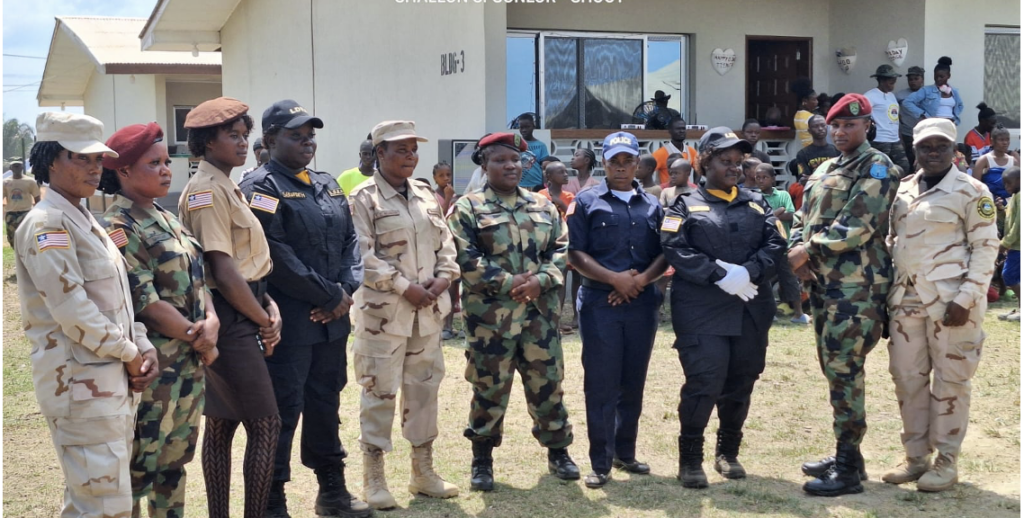
NIMBA COUNTY, Liberia — In Sanniquellie, the capital city of Nimba County, the 69th day of the Armed Forces of Liberia (AFL) was observed, witnessing a moment of pride and reflection for women serving in the army and other security agencies across the county.
The Armed Forces Day was celebrated this year under the theme “Securing Liberia Together, Strengthening Inter-Agency Cooperation against Drug Trafficking and Security Threats.” This national holiday, observed on February 11th, honors the brave men and women who have served the nation since 1909, safeguarding its territorial integrity and protecting its freedoms.
The day recognizes the sacrifices and heroism of Liberian soldiers, past and present. It’s a moment to reflect on the country’s security challenges and the importance of collaboration between agencies to tackle threats like drug trafficking. Speaking with WomenVoices Newspaper at a celebration organized by Camp Grant Military Barracks in Nimba County, several female officers highlighted the progress made in increasing women’s participation in national security, but also pointed out the obstacles that remain.
“We have broken barriers and proved ourselves in a traditionally male-dominated field,” said one officer. “But we still face issues like inadequate facilities, limited promotions, and societal expectations.”
Despite these challenges, the women expressed pride in their work and commitment to serving their country. “Being part of the AFL, LNP, LDEA, LIS among others, is not just a job, it is a calling. “We are proud to wear the uniform and contribute to Liberia’s peace and security,” the women said.
The dedicated service women in Liberia’s striving security sector are truly making waves. Protecting Liberia, defending national sovereignty, and ensuring internal security – these women are proving themselves capable, paving the way for future generations.
From patrol officers to top commanders, the service women are making their mark in Liberia’s security sectors, taking on roles that were once off-limits and excelling.
Private – Pvt. Verous K. Essel, a dedicated female soldier of the Armed Forces of Liberia assigned to Camp Grant Military Barracks in Nimba County, shared her powerful story. With four years of service under her belt, she overcomes challenges that would make many doubt her path – physical strength tests, tough training, and societal pressure. “I had to push past the fear and negative thoughts about joining the army,” she said. “But I have found that in the AFL, it’s a win-win for everyone involved. We get equal treatment and power sharing based on training and exceptional performance.”
Essel emphasized that in the Armed Forces of Liberia, everyone is treated equally, regardless of position or rank. “It’s not about being a man or woman; it’s about capability and dedication,” she said. Her experience has motivated her to encourage more women to join the AFL and other security sectors. “Women can make a huge difference in crucial security roles,” she stressed. “We are not just participants; we are contributors, and we are proving ourselves every day.”
Pvt – Essel’s story is a testament to the impact women can have in the military, and her enthusiasm is inspiring others to follow in her footsteps. A new project, supported by UN Women and funded by the Elsie Initiative Fund, is underway to address barriers hindering women’s participation. The initiative includes nationwide recruitment campaigns, awareness drives, and specialized training to ensure female soldiers are mission-ready.
This effort aligns with Liberia’s commitments to international agreements on women’s rights, peace, and security. The goal is to create a more inclusive and professional AFL, with women playing a more significant role in peacekeeping operations.
LDEA Agent Rita M. Cheaston:
Agent Rita M. Cheaston of the Liberia Drug Enforcement Agency (LDEA) is breaking barriers and proving doubters wrong. Two years ago, Rita joined the LDEA with no prior security experience, but she brought passion and perseverance to the table. She faced criticism from society due to her body size, with people saying she would struggle in the field. But Rita’s proving them wrong.
“The job of LDEA is not just about physical strength, running behind substance users” she said. “It requires skills and competence, and I’m capable in all aspects.”
As a field officer, Rita’s experience has been inspiring, with support from colleagues and bosses. However, she outlined the challenges, particularly with youth-led drug intake. Rita’s story highlights the importance of inclusivity and diversity in security agencies.
Her success is a testament to the fact that women can excel in demanding roles, and their contributions are invaluable. The LDEA is benefiting from her skills and dedication, and her journey is motivating others to join the force. Based on operational data reported in November 2025, a total of 55 female officers are currently serving in the Liberia Drug Enforcement Agency (LDEA).
The LDEA is meanwhile working to increase women’s representation, with a target of 15%, though it is not there yet. Efforts include recruitment campaigns and specialized training. The agency has also seen success with initiatives like the Women Drug Enforcers (DEAWA), which promotes unity and equality within law enforcement.
Liberia Immigration Service (LIS):
Sarah Gemison and Princess N. Mantor, two trailblazing officers of the Liberia Immigration Service (LIS), are celebrating a milestone – one year of dedicated service. As newcomers, they are loving every moment, with a vision to serve their nation with excellence.
Their experiences so far have been phenomenal, and they are committed to going above and beyond. When asked for a message to young Liberian females, they encouraged their fellow females not to be afraid to break barriers and shatter glass ceilings. “Do not be afraid. We can thrive in roles traditionally dominated by men. Believe in yourself, work hard, and serve with passion and purpose.”
Sarah and Princess are proud to be part of the LIS team, contributing to national security and development. Their enthusiasm is infectious, inspiring others to join the force and make a difference.
Unfortunately, the exact number of women currently serving in the Liberia Immigration Service (LIS) is not publicly available. The LIS is working to strengthen its capacity, having trained 1,278 officers (including 288 women) between 2019 and 2024 as part of a UNDP-supported project.