

-Inducts New Members
By: Sampat JMB Kpakimah
The Liberia Charter of Lions Club International has conducted a day-long symposium for its junior wing, the LEO Club. The initial is part of the body’s continued effort to strengthen youth leadership and broaden its community outreach.
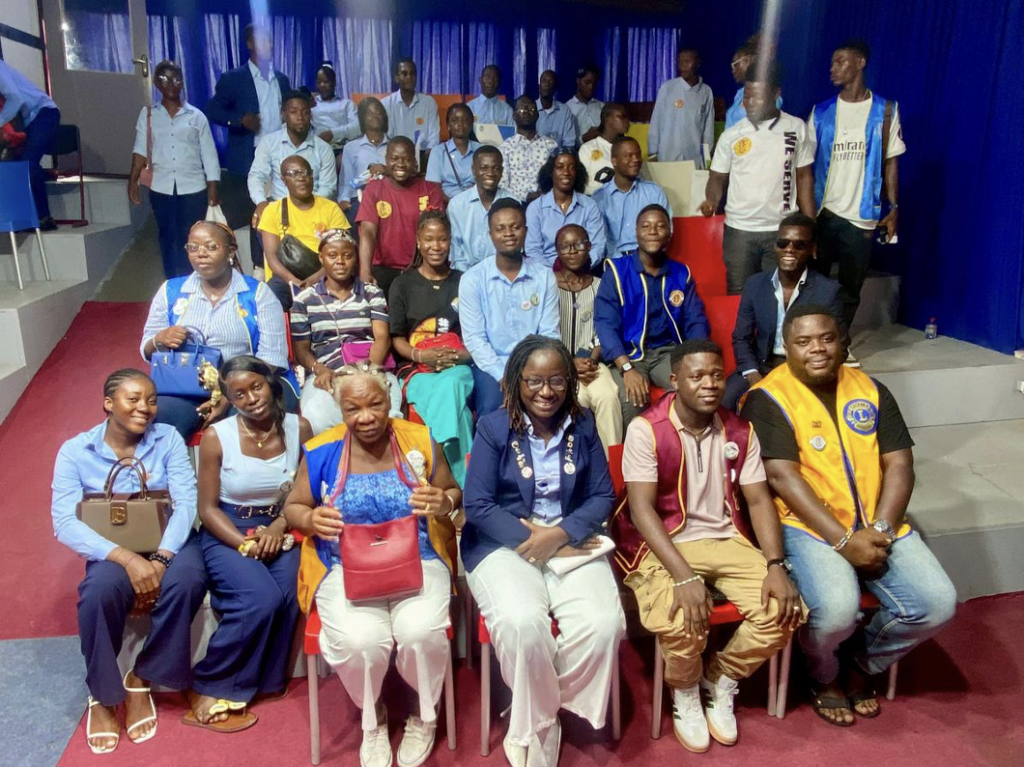
The symposium was held on Saturday at the NVTI Vocational Training Center in Oldest Congo Town, the event convened 33 LEO members from various chapters across the country. It aimed to deepen the members’ understanding of the organization’s principles, history, and strategic growth initiatives.
Facilitators led sessions on a range of topics, including the Fundamentals of LEO Development, presented by Lion Moses B. Jackson; the Evolution of Lions Club in Liberia, delivered by Lion Eric Cassell; and Leadership and Innovation for Mission 1.5, presented by Lion Caroline Caranda.
Speaking on the objective of the gathering, Lion Alfred Bicaise explained that the symposium was designed to help young members gain a deeper comprehension of the club’s mission and operations. He urged participants to look beyond the perception that membership is primarily about travel opportunities, emphasizing that the organization’s core mandate is service to communities.
“The goal is to make an impact in the community and the country at large,” Lion Bicaise said. He encouraged the LEOs to actively engage in the sessions, noting that group interactions would be used to identify and address challenges facing the club.
A key highlight of the event was the induction of five new LEO members, officiated by Lion Eric Cassell under the theme “Mission 1.5.” The initiative is a global membership campaign aimed at expanding the organization’s reach and deepening its impact through increased enrollment.
In his address, Lion Cassell stressed the weight of responsibility that comes with membership. “A LEO who is not properly mentored can become part of the problem that already exists,” he warned. He urged the inductees to value the guidance of their senior Lions, noting that the LEO Club operates under the mentorship of its parent body. “Accept correction and guidance as part of your leadership journey,” he advised.
Turning to the broader issue of youth empowerment, Lion Cassell noted that while many young people lament the scarcity of jobs, opportunities remain for those who actively build their capacity. “I have ten slots to empower young people, but many lack the capacity because they are not using the internet to develop skills or create income,” he said. He urged members to take advantage of digital tools to research, acquire marketable skills, and prepare themselves for a competitive economy.
He also raised concerns about LEOs transitioning into the Lions Club without stable livelihoods, cautioning that today’s world is data-driven and requires practical income-generating skills. While acknowledging the enthusiasm of young people to serve, he reminded them that service often requires financial commitment, as members are expected to contribute to community projects.
Lion Caroline Caranda, speaking on the Mission 1.5 initiative, described it as a “one bring one” strategy that calls on each member to recruit at least one new person into the fold. “This whole club is LEO-driven because they are young people. Their leadership ability and conduct will attract more young people to join,” she said.
She noted that with widespread needs across communities, expanding membership is essential to increasing the organization’s footprint. “More members, more impact. They are the bedrock of the organization,” Caranda added.
She also highlighted the importance of paying dues, explaining that contributions support Lions Clubs International’s global humanitarian efforts, particularly for victims of disasters and other crises.
In a significant revelation, Lion Caranda disclosed that Liberia is advocating to become a standalone district within Lions Clubs International. Achieving that status would require at least 17 clubs and 400 members nationwide. She noted that neighboring Ivory Coast is expected to attain district status next year after completing its required benchmarks, and called on LEOs to remain united and support their leadership in pursuit of this goal.
Lions Clubs International was founded in 1917 by Melvin Jones in Chicago, Illinois, and has since grown into one of the world’s largest service organizations, with a focus on humanitarian aid and community development.
In Liberia, LEO Clubs have been active since the early 1980s, evolving into a nationwide network of young leaders committed to service in health, education, and social development. Among them is the Omega LEO Club, a sub-club of the Paynesville Boulevard Lions Club, comprising young professionals aged 18 to 30. The group focuses on environmental initiatives and adult literacy programs, working collectively to identify community needs and implement practical solutions.