

By Jessica Cox
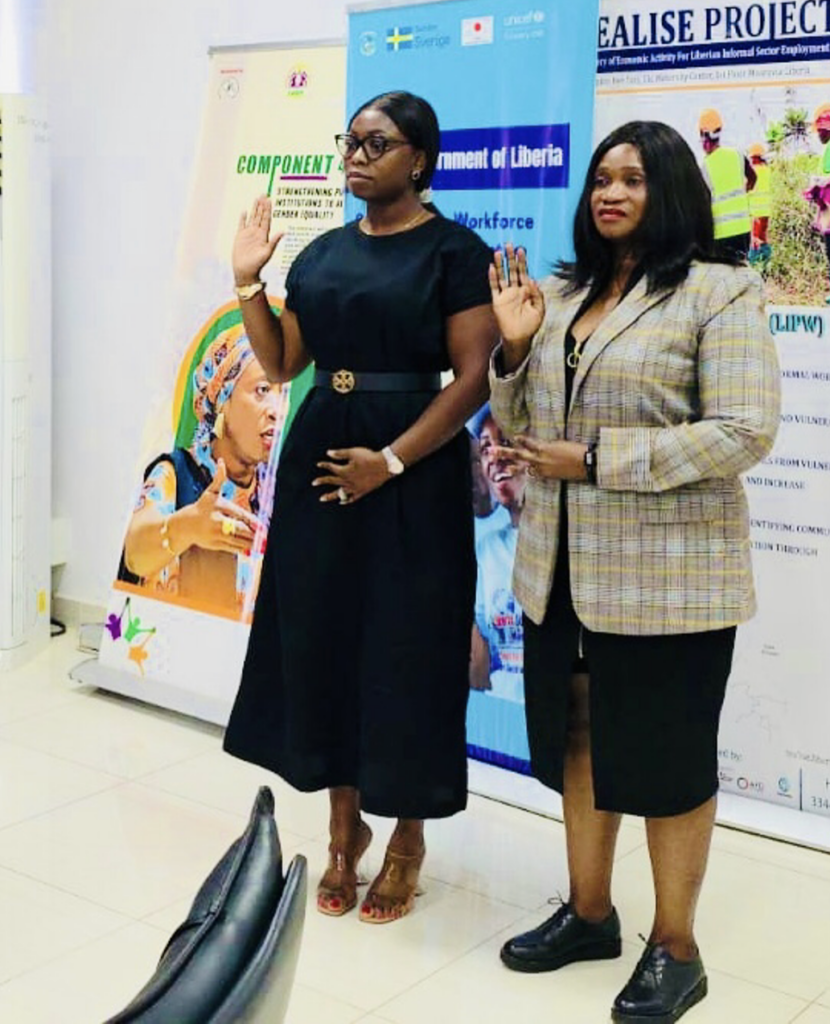
Monrovia, Liberia: The Liberia chapter of the Network of Peace and Security Women in ECOWAS (NOPSWECO) has ushered in a new leadership following a formal turnover ceremony that transmitted authority to Naomi Tulay Solanke as the President and Esther David Yango as the Vice President.
The event was held at the Ministry of Gender, Children, and Social Protection (MoGCSP) in Congo Town, on Thursday, March 12, 2026. It brought together representatives of the Liberian government, civil society organizations, members of the diplomatic corps, development partners, traditional leaders, youth representatives, and officials from the Economic Community of West African States (ECOWAS).
Taking the mantle of leadership, the newly inducted president Naomi Tulay Solanke pledged to lead the network with humility, transparency, and inclusiveness.
In her acceptance speech, Solanke paid tribute to the legacy of Liberian women peacebuilders, including Nobel Peace Prize laureate Leymah Gbowee, whose leadership during Liberia’s civil war helped mobilize women to advocate for peace.
She stressed that women are not merely victims of conflict but key actors in building sustainable peace across communities and the region. As part of her address, Madam Solanke outlined key priorities that will guide her leadership of NOPSWECO Liberia.
Firstly, she emphasized strengthening women’s participation and leadership in peace and security decision-making, noting that women must have a seat at the table in national, community, and regional discussions on peacebuilding and governance.
Solanke highlighted the need for stronger efforts to prevent and respond to sexual and gender-based violence, including improving awareness, strengthening survivor support systems, and collaborating with government and security institutions to ensure justice and protection. She stressed the importance of strengthening early warning systems and community-based conflict prevention, explaining that local communities must play an active role in identifying early signs of tension and responding before conflicts escalate.
Additionally, Solanke called for evidence-based advocacy and policy engagement, emphasizing the need for research, documentation, and data to strengthen advocacy and ensure that policies addressing women, peace, and security reflect the realities faced by women across Liberia.
She also underscored the importance of building strong partnerships and mobilizing resources, noting that collaboration with government institutions, ECOWAS, development partners, traditional leaders, and civil society organizations will be essential to advancing the network’s work.
At the same time, Solanke announced that within the first three months of her administration, the network plans to convene a national consultative forum to update its strategic plan, launch leadership training programs for community women leaders, and establish a multi-stakeholder task group to coordinate responses to sexual and gender-based violence.
“Our region continues to face complex threats ranging from electoral tensions and violent extremism to transnational crime and sexual and gender-based violence. These challenges require coordinated, gender-responsive solutions,” Solanke said.
She called on government institutions, regional bodies, development partners, and civil society organizations to collaborate with the network to strengthen peace and security efforts. “Peace is not merely the absence of war; it is the presence of justice, opportunity, and dignity for every woman, man, and child,” she added.
In her farewell remarks, Cllr. Joah highlighted the significant progress made by the organization during her tenure, noting that the network succeeded in mobilizing women across Liberia and strengthening the visibility of women’s peacebuilding initiatives.
According to her, the organization implemented several programs aimed at promoting peace, gender equality, and community security, including outreach efforts in border communities where citizens were encouraged to play an active role in safeguarding national stability.
She explained that while formal security structures may sometimes be limited in remote areas, local communities often serve as the first line of defense in protecting the country and maintaining peace.
During her administration, NOPSWECO Liberia also advocated against drug trafficking, human trafficking, and other transnational crimes, while working to address violence against women and promote gender equality. The network further participated in initiatives aimed at promoting free, fair, and inclusive elections, including efforts to monitor and respond to violence against women in politics through collaborative civil society platforms.
Cllr. Joah noted that while the organization maintained constructive engagement with government institutions, it also remained committed to holding authorities accountable when necessary in line with the broader women, peace, and security agenda.
“As we transition to new leadership, the work we have started will continue and even grow stronger as new ideas and perspectives emerge,” she said, thanking members and partners for their years of support.
Also speaking at the ceremony, renowned women’s rights advocate and cultural activist Deddeh “KweKwe” Freeman praised the outgoing leadership for its dedication to advancing women’s rights and peacebuilding efforts in Liberia.
Freeman stressed the importance of mentoring younger women to take up leadership roles, noting that the sustainability of the women’s movement depends on empowering the next generation.
She explained that many veteran activists who have dedicated years to the women’s movement are gradually stepping back, making it necessary for younger women to continue the work. “Women’s work must continue,” she emphasized. “The older generation has played its role, and now young women must rise and carry the torch forward.”
Freeman also pointed out that women involved in politics and public leadership often face intimidation or discouragement, particularly during election periods. She urged the new leadership to remain resilient and committed to promoting peace and security in Liberia.
She further highlighted that the work of peace and security goes beyond advocacy and requires continuous engagement in preventing violence, protecting women, and creating opportunities for women’s development.
The Network of Peace and Security Women in ECOWAS works to advance the implementation of the women, peace, and security agenda across West Africa, including the framework of United Nations Security Council Resolution 1325, which promotes women’s participation in conflict prevention, peacebuilding, and post-conflict recovery.