

-French Ambassador Warns, Backs Diplomatic Resolution to Liberia-Guinea Border Dispute
By Jerromie S. Walters
Monrovia– As tensions along the Liberia-Guinea border near its third week, France has signaled its readiness to support a diplomatic resolution to the escalating dispute, with its ambassador in Monrovia underscoring Liberia’s deep-seated desire for peace following decades of civil conflict.
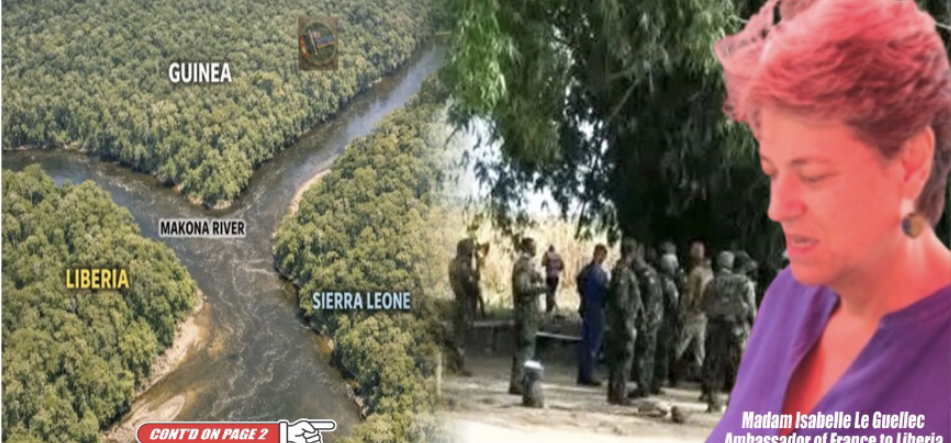
Ambassador of France to Liberia, Madam Isabelle Le Guellec, addressed the matter during a press conference on Tuesday, March 24, 2026, held at the French Embassy on UN Drive in Mamba Point. The event marked the launch of Francophonie Week, but attention was placed on the growing security concerns crisis along Liberia’s northern frontier.
When asked about France’s position on the border dispute, Le Guellec refrained from offering extensive commentary, noting recent reports that President Joseph Nyuma Boakai had engaged directly with French President Emmanuel Macron on the matter. However, she affirmed France’s willingness to assist in de-escalating the situation, either through the African Union (AU) or the Economic Community of West African States (ECOWAS).
“I think Liberia has had enough of war, so we want to support this desire for peace and a diplomatic issue,” Le Guellec said. France maintains a historically complex relationship with Guinea, which gained independence from French colonial rule on October 2, 1958, becoming the first French-speaking African colony to do so under the leadership of Ahmed Sékou Touré. The colonial legacy continues to shape modern diplomatic and economic ties between the two nations.
Le Guellec’s remarks come as Liberia confronts a security crisis that has already displaced scores of civilians. Liberia endured two successive civil wars between 1989 and 2003, which resulted in an estimated 150,000 to 250,000 deaths and displaced more than half the population. Residents of border communities along the Makona River in northern Liberia remain in a state of heightened fear and uncertainty, despite assurances from visiting lawmakers that no armed conflict exists in the area.
Families have fled their homes and abandoned their farms, describing the situation as a humanitarian emergency and urging the national government to intervene before lives are lost. A delegation led by House Speaker Richard N. Koon traveled to Foya District over the weekend to engage with affected residents, urging calm and encouraging displaced families to return. Lawmakers assured citizens that diplomatic efforts were underway and that there was no active conflict.
For residents who have witnessed armed soldiers occupy their land, the message provided little reassurance. What began earlier this month as a cross-border incursion by Guinean soldiers has rapidly evolved into a full-blown humanitarian and security crisis. With diplomatic efforts struggling to match the pace of events on the ground, citizens are calling on the government to take swift action to prevent further escalation.
Meanwhile, the Government of Liberia issued a warning Tuesday against individuals and groups seeking to inflame tensions along the country’s northern border, declaring that statements intended to undermine ongoing diplomatic efforts “will not be tolerated” as authorities move to consolidate calm in the wake of recent developments in Lofa County.
Delivering a statement at the Ministry of Information on Capitol Hill, Attorney General and Minister of Justice Cllr. N. Oswald Tweh cautioned that inflammatory comments circulating on social and print media carry “the dangerous propensity of inciting fear, panic and chaos within our communities,” warning that such provocations could jeopardize the government’s constructive approach to resolving the situation.
Displacement and Fear Grip Border Communities:
The dispute, centered in the Sorlumba Clan along the Makona River, entered its second week on Tuesday, March 17, with reports of internal displacement across multiple communities. Despite a high-level emergency summit held the previous week in Conakry involving the presidents of Liberia, Guinea, and Sierra Leone, Guinean troops remained present in the contested area, leaving border communities in a state of fear.
Residents reported last week that the threat of further violence had emptied entire villages. A resident identified four communities—Ma, Baladu, Solunma, and Lepalu—as being either completely or nearly abandoned. “Our people are displaced. Ma, nobody is there. Baladu, nobody. Solunma is almost empty. Lepalu is almost empty. This will cause real hunger in the next few weeks,” the resident said. Local journalists confirmed that each of these areas is home to dozens of individuals.
The current crisis was ignited when Guinean soldiers crossed the Makona River—long regarded as the natural boundary—and seized equipment from a Liberian sand-mining operation. The troops raised a Guinean flag on Liberian soil, asserting territorial claims. Although residents confronted the intruders and re-hoisted the Liberian flag, the situation turned violent days later when Guinean forces returned and opened fire, wounding a Liberian man.
Lofa County Superintendent J. Lavelah Massaquoi, who has been assessing the situation on the ground, confirmed the severe impact on civilian life. He stressed that the crisis extends beyond immediate security threats, undermining the foundations of daily life. “Nobody is going to make farm this year. No school will be there,” Massaquoi said. “We got to take into consideration all of these issues right now.”
The deteriorating conditions in Lofa stand in contrast to the message of unity and reconciliation conveyed by President Boakai upon his return to Monrovia on Monday evening. Following the emergency summit in Conakry with Guinea’s transitional leader, President Mamadi Doumbouya, and Sierra Leone’s President Julius Maada Bio, Boakai struck an optimistic tone.
“We all realized that we are the same people… we have been working together for years and we have nothing to gain from war and that we shouldn’t waste time on war,” Boakai said upon arrival at Roberts International Airport. The trilateral meeting, convened under the framework of the Mano River Union (MRU), produced a joint communiqué outlining a 12-point roadmap for peace.
The agreement includes commitments to restore the status quo ante along the borders, enhance security cooperation through joint patrols, and pursue dialogue to prevent future incidents. However, the continued presence of Guinean soldiers on disputed ground less than 24 hours after the summit’s conclusion left many Liberians questioning the effectiveness of the diplomatic breakthrough.
A key concern among citizens in Lofa, and increasingly among the broader public, is the lack of clarity on the fundamental issue of land ownership along the border. Residents have long understood the Makona River to serve as the natural dividing line between Liberia and Guinea, with each nation holding territory up to the median line of the waterway. The current encroachment, they say, represents a unilateral attempt by Guinean authorities to redraw that boundary.
It has also been reported that at the Sefudu Border in Quardu Gbondi District, Guinean security personnel ordered their Liberian counterparts to move the Liberian flag approximately half a kilometer from the swampy borderline in 2025. That incident marked the first known instance of Guinea’s attempted encroachment into Liberian territory, suggesting that the current crisis may be part of a broader pattern of gradual territorial expansion by Guinean forces along the shared frontier.
The Makona River, also known as the Moa, is an international waterway shared by Liberia, Guinea, and Sierra Leone. International watercourse laws typically treat such rivers as shared resources, but conflicting claims have emerged from colonial-era treaties. Guinean authorities cite the 1907 Franco-Liberian Convention and a 1911 refinement, which they interpret as placing the border along the Liberian bank of the river rather than the middle, or thalweg.
They also invoke a regional principle—historically associated with the Organization of African Unity—suggesting that a border river belongs to the country where it originates, which in this case is Guinea.
Conversely, Liberian local leaders and residents maintain that the river has historically served as a recognized shared boundary, with Liberian territory and rights extending to at least the middle of the river.
In an address to the nation last Wednesday, President Boakai reassured Liberians that his administration is managing the security situation along the border through “peaceful and diplomatic means,” emphasizing that the nation’s hard-won stability will not be jeopardized. Delivering a “Message to the Nation” from the Executive Mansion, the President confirmed developments near the border in the Sorlumba area of Foyah District, Lofa County.
While acknowledging that the situation had “understandably attracted the attention” of the public, he sought to project calm, stating that the government was “fully engaged” and acting with “determination.”
“Let me be clear to every Liberian: Our pursuit of a peaceful resolution is not a sign of weakness, but rather a demonstration of strength,” Boakai said. “It is easy to fight, break down, and destroy. As our own journey has taught us, it is more difficult to recover and build.”
The President, in his capacity as Commander in Chief, detailed the immediate steps taken to de-escalate the matter. He confirmed that direct diplomatic engagement with Conakry had been initiated and that Liberia had worked closely with Sierra Leone under the Mano River Union framework to foster dialogue. He framed the current approach as a necessary measure to protect the peace forged through “sacrifice, reconciliation, and the determination to reverse the past after many years of hardship.”
“That peace is precious, and this government will do everything within its power to protect and preserve it,” he affirmed. Boakai assured the nation that security institutions, including the Armed Forces of Liberia and the Liberia National Police, remain “vigilant and professional,” working in coordination with local authorities in border regions to maintain calm. He also extended gratitude to regional and international partners, including ECOWAS and the AU, for their messages of support, noting that their solidarity “reaffirms Liberia’s standing in the community of nations.”