


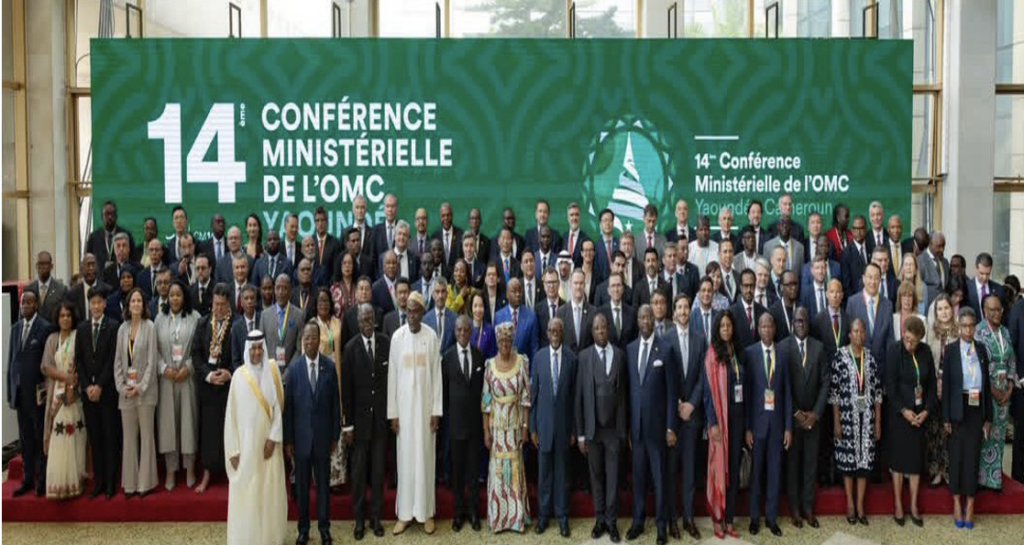
YAOUNDÉ, Cameroon – Liberia’s Minister of Commerce and Industry, Magdalene Ellen Dagoseh, declared on Wednesday that WTO accession has failed to translate into jobs or export diversification for most African economies, warning that membership remains a “foundation” rather than a solution unless it is paired with industrial policy, infrastructure, and productive capacity.
Speaking at the 14th China Round Table on WTO Accessions on the sidelines of the WTO’s 14th Ministerial Conference in Yaoundé, the Minister delivered a blunt assessment from a nation that joined the global trade body in 2016 after emerging from civil war: market access and trade preferences mean little when countries lack competitive industries and functioning standards infrastructure.
“Many of our countries have market access, but we do not yet have sufficient productive capacity,” she told an audience that included the WTO Director-General and trade ministers from across Africa and beyond. “Many of our countries have trade preferences, but we do not yet have competitive industries. Many of our countries have trade agreements, but our small businesses and farmers are not yet fully integrated into regional and global markets.”
Minister Magdalene Ellen Dagoseh’s intervention marked a rare moment of candor from a Least Developed Country (LDC) that has faithfully implemented WTO obligations, including the establishment of a National Trade Facilitation Committee, modernized customs procedures, and a new Liberia Standards Authority. Yet she argued that these reforms, while necessary, have not produced the economic transformation that accession was meant to unlock.
“WTO accession is not the destination; it is the foundation,” she said. “The real challenge starts after accession. The challenge is how to translate WTO membership into economic transformation, export diversification, private sector development, and job creation.” That challenge, she stressed, is not unique to Liberia but is shared by most African economies that joined the multilateral trading system over the past two decades.
In a critique of conventional trade policy, Minister Magdalene Ellen Dagoseh argued that liberalization alone is incapable of restructuring an economy. “Trade policy alone cannot transform an economy; it must be accompanied by industrial policy, private sector development, and regional integration,” she said. The statement implicitly challenged the technocratic focus of many WTO accession negotiations, which often prioritize legal harmonization over productive capacity building.
Turning to the African Continental Free Trade Area (AfCFTA), the Minister rejected any notion that the continental framework competes with WTO obligations. “WTO membership and the AfCFTA are not competing frameworks; they are complementary,” she said. Minister Dagoseh described the WTO as the provider of global rules and dispute resolution, while the AfCFTA offers the regional market scale that African industries need to grow before facing global competition.
She called for a unified development strategy that links WTO membership, regional integration, industrial development, and private sector growth into a single coherent policy package. “The future for African economies lies in linking all four,” she said, warning that treating them separately has produced the current impasse of unused market access and stagnant export baskets.
At the same time, the Commerce Minister proposed a new metric for judging the success of WTO accessions. “Success should not be measured by how quickly a country joins the WTO,” she said, “but by how accession contributes to structural transformation, economic diversification, job creation, and poverty reduction.” The comment directly challenged the WTO Secretariat and donor partners to shift focus from procedural milestones to tangible development outcomes.
Liberia’s own experience illustrates the gap between accession and transformation. Since joining in 2016, the country has undertaken significant reforms to align trade policies, laws, and institutions with WTO rules, including strengthening transparency and predictability in trade policy. Yet the Minister acknowledged that productive capacity remains weak, export diversification is limited, and job creation is insufficient.
To bridge that gap, Minister Magdalene Ellen Dagoseh made a clear demand to wealthier WTO members and international financial institutions: accession must be supported by capacity building, infrastructure development, productive capacity development, and targeted support for small and medium-sized enterprises. “The benefits of trade must be felt by our people,” she said, warning that without such support, WTO membership risks becoming a procedural achievement with no popular legitimacy.
Despite her sober assessment, the Minister reaffirmed Liberia’s continued commitment to the rules-based multilateral trading system. She described WTO accession as an important pathway for African countries to modernize their economies and strengthen institutions, provided that the pathway does not end at the accession ceremony. “For Liberia, WTO accession was not just about joining an international organization,” she recalled.
“It was about reforming our economy, modernizing our trade regime, and positioning our country to integrate regionally and globally.” Minister Magdalene Ellen Dagoseh concluded with a call for collective action. “Let us continue to work together to ensure that WTO accession and the multilateral trading system work for development, for Africa, and for our people.”