

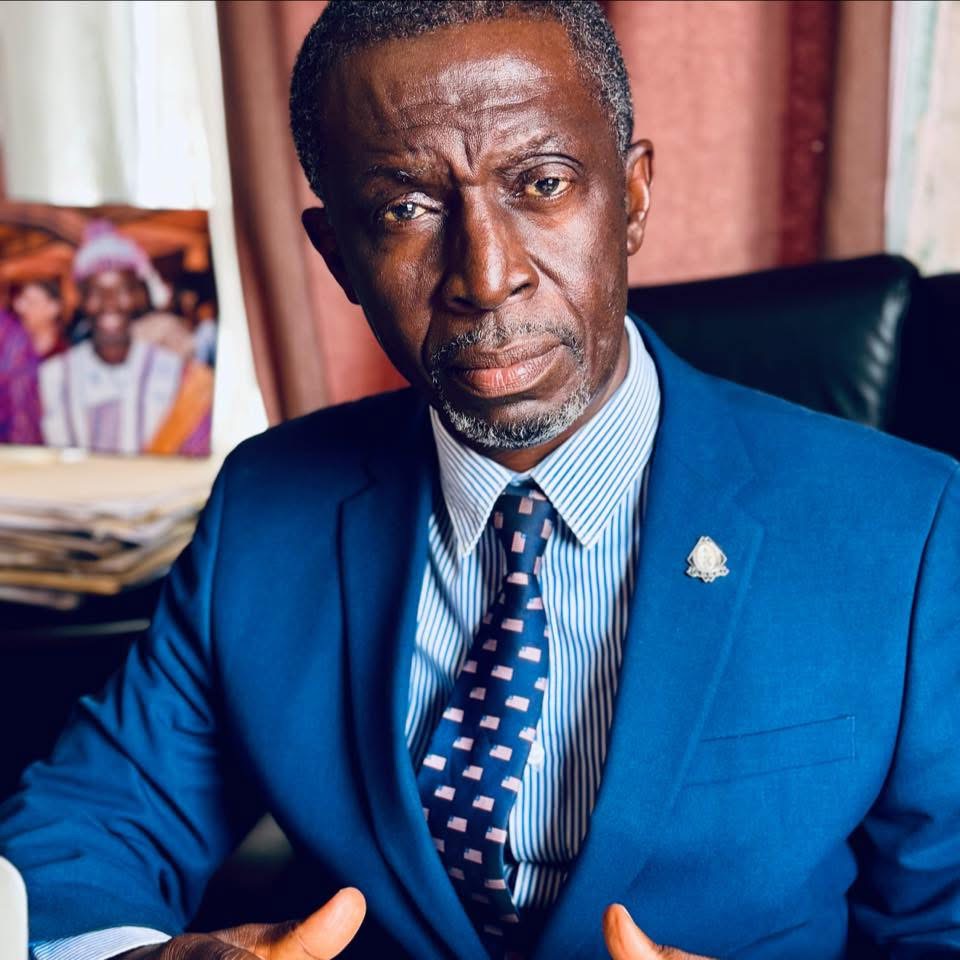
By Tiawan Saye Gongloe
Human Rights Lawyer, Presidential Aspirant and Assistant Professor of Law
In Celebration of International Women’s Day and the Close of Women’s History Month 2026
This commentary is presented to mark the end of Women’s History Month 2026, in recognition of the enduring strength, sacrifice, and contribution of Liberian women, and in reflection of this year’s International Women’s Day theme: “Give to Gain.”
There is perhaps no country to which this theme applies more truthfully than Liberia. For generations, Liberian women have given—quietly, consistently, and sacrificially. They have given their labor, their dignity, their resilience, and their leadership, often without recognition, protection, or reward. Yet through that giving, Liberia has gained survival, stability, and hope.
History will record that the Republic of Liberia was not sustained by power, wealth, or political elites, but by the quiet, unyielding strength of its women. For more than a century after independence in 1847, Liberian women were denied the right to vote. A nation that proclaimed liberty withheld political voice from half of its population. Yet even in exclusion, women did not abandon the nation. They tilled the soil, raised the children, and held families together while the state struggled to find its moral direction.
They were often the second choice for education most families—if they were educated at all. In countless homes, the boy was sent to school while the girl was sent to the market, the farm, or the kitchen. Still, many of those same girls grew into women of wisdom, discipline, and resilience, shaping generations without formal recognition.
Liberian women have borne a disproportionate burden of agricultural and domestic labor. They have fed this nation, clothed it, and sustained it—often without land ownership, without access to credit, and without policy support. During the dark years of military rule and the fourteen-year civil conflict, they suffered some of the most unspeakable violations. Rape and sexual violence were used as weapons of war, leaving scars—physical, emotional, and psychological—that no official system has ever fully healed.
Even in times of peace, injustice has persisted. Too many women have been subjected to sexual exploitation by those in positions of power—government officials, corporate executives, and financially dominant men who turned opportunity into a condition of submission. Too many have been drawn into cohabitation without legal or traditional protection, only to be abandoned when they are no longer convenient. Too many continue to endure domestic violence in silence, caught between cultural expectations and weak enforcement of the law.
And yet, despite all this, Liberian women have not broken. They have struggled, endured, and fought—step by step—for every gain they have made. It must be said clearly and without hesitation: Liberian women have gotten nothing free.
Yet today, they are not only surviving—they are excelling.Across Liberia and beyond, women are transforming the economic landscape. From local markets to cross-border trade routes stretching into Guinea, Sierra Leone, and Côte d’Ivoire, Liberian women are the backbone of commerce and the engine of family survival.
In education, the story is changing powerfully. Girls are now leading—topping their classes, winning academic honors, and demonstrating discipline and commitment that signal a new Liberia. Increasingly, young women show greater enthusiasm for education than their male peers, while too many young men drift away from school into short-term survival paths, including commercial motorbike riding.
Within families, a quiet but profound shift is taking place. Women are increasingly becoming the primary providers—the stabilizers and backbone of the household. Across Liberia, one now hears fathers say, “My girls are doing far better than my boys. My girls are taking care of me and my wife. I don’t even hear from my boys.” This is not merely a lament—it is a powerful acknowledgment of the rising strength, responsibility, and commitment of Liberian daughters.
The story of Liberia cannot be told without honoring Angie Brooks Randolph, who became the second woman in the world to serve as President of the United Nations General Assembly—following Vijaya Lakshmi Pandit—and the first woman from Africa to occupy that distinguished position, serving as President of the 24th United Nations General Assembly (1969–1970).
It cannot be told without Mary Antoinette Brown Sherman, the first female President of the University of Liberia, who helped shape the intellectual future of the nation.
It cannot be told without the judicial leadership of Frances Johnson Morris,(now Allison) Gloria Musu Scott, and Sie-A-Nyene G. Yuoh, whose tenures as Chief Justices came during challenging political periods in Liberia’s history. Yet history will record that they passed the test of courage and upheld the independence of the judiciary. A unique moment of historic importance occurred under the Yuoh Bench, when women formed a majority of the Court—three female justices to two male justices.
The nation’s history was further illuminated in 2011 by Ellen Johnson Sirleaf and Leymah Gbowee, who made history as the first two women from the same African country to win the Nobel Peace Prize, bringing pride and honor to Liberia and demonstrating to the world the power of women in peacebuilding.
It cannot be told without Jewel Howard-Taylor, the first female Vice President in Liberian history, and Nyonblee Karnga-Lawrence, the first woman to serve as President Pro-Tempore of the Liberian Senate.
The legal profession also reflects this progress through Cllr. F. Juah Lawson, Assistant Professor of Law, the first female President of the Liberia National Bar Association since its establishment in 1907. Today, more women are entering law school than ever before—a development of profound importance for Liberia. Women as lawyers and judges bring lived experience and deeper understanding of the challenges women face, thereby strengthening the justice system and contributing to more just and practical solutions.
Even at the founding of the Republic, women left an indelible mark. The Liberian flag—the enduring symbol of national identity—was designed and made by Liberian women led by Susannah Lewis. From the very beginning, women were builders of the Liberian nation-state.
These achievements are not accidents of history—they are the result of struggle. And yet, despite this progress, the journey is not complete. Women remain under-represented in the Legislature, and structural barriers continue to limit their full participation in governance, business, and access to justice. The law must evolve to reflect the lived realities of Liberian women.
As we close Women’s History Month 2026, this must not be a mere ceremonial reflection, but a national awakening. The theme “Give to Gain” reminds us of a profound truth: Liberian women have already given—immensely, sacrificially, and consistently. The time has now come for Liberia to give back—by ensuring equal opportunity, legal protection, fair representation in governance, and the dignity that has long been denied.
To the women of Liberia, this is both a tribute and a commitment. You have been a positive force in building this nation-state. You have carried Liberia through its darkest hours. You have struggled for every gain you now hold. You are now leading in business, excelling in education, and sustaining families across this land.
As a lawyer, a human rights advocate, and a servant of the Liberian people, I state with conviction that Liberia’s future depends on the empowerment of its women—not as a matter of charity, not as a matter of favor, but as a matter of justice.
Because when women rise, nations rise.
And Liberia—through its women—will rise even higher because a better is possible!!