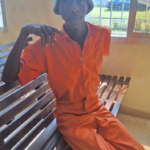



The Assigned Circuit Judge for the 3RD Judicial Circuit Court of Sinoe County, His Honor Wesseh Alphonsus Wesseh, has sentenced a 32-year-old man, Princes Deyowon, to 30 years in prison, for rapping a four-year-old child, in Dortroken, Jaedae, Sinoe County, on Saturday evening, August 23, 2025.
Defendant Deyowon was indicted by the Grand Juror for Sinoe County, in August A.D. 2025 term of Court on allegation that he raped a four(4) years old child, in a tent, in Dortroken, Jaedae, Sinoe County, on August 23, 2025, during the evening hours, the mother left the child and the defendant, along with two other children, of the same age, watching movies, on her phone as she left her tent to attend to her customer who had brought used clothes for sale and that when she returned to the tent, she and her daughter left the area and while they were on their way to their house to sleep, the minor child began to draw her mother’s attention to what the defendant did to her.
The indictment further alleged that when the mother checked the minor’s genital, she noticed that she was bleeding profusely and then complained to the town chief about the conduct of the defendant, before the defendant escaped to the town of Fortiagbo, where he was arrested on August 24, 2025. However, considering the distance and time it took to report the case, the child was received at Francis J. Grante Hospital, in Greenville, on September 8, 2025, where medical test conducted and determined that the child’s hymen was broken with bruises, tenderness, and redness seen at diverse parts of the child’s vagina wall.
When Defendant Deyowon was arraigned, on Wednesday, March 4, 2026, during the 26th day of jury sitting, he pleaded NOT GUILTY; thereby joining issues with the Prosecution and he subsequently opted for a bench trial.
Prior to the taking of evidence and giving the child’s tender age, Judge Wesseh conducted a suitability test, in line with the case: Gartargar versus Republic of Liberia, as recorded in 4LLR70(1934), sly. 2; which says” if a child of tender years is offered as a witness in a case, the real test is not his age, but his ability to give an account of the nature and obligation of an oath “; and then the court determined that the child was unsuitable to mount the witness’s stand and testify in camera.
During the trial, that spanned some three weeks, the child’s mother, Marthaline Quayee, testified in open court how she left her daughter and the defendant under, alone with two other minors, under a tent, watching videos on her phone, and went out to attend to her customer; but as soon as she returned, to the tent, the defendant had already left the scene, before she noticed that her daughter was bleeding profusely from her vagina and then she reported the case to the town chief who sent information to nearby towns before the defendant was arrested in the town of Fortiagbo.
However, the defendant, who claimed that he is a gold boy, rejected the allegation and told the court that he was only in Fortiagbo to hustle, as a god boy; but admitted that the child was left with him under the tent, watching videos and only left the tent when her mother returned.
Also testifying for the State were the attending nurse, Mr. Kulubah Zawu, and Police Officer Anthony Kumeh. Mr. Zawu, testified that when the child was admitted to the Francis Grante Hospital in Greenville, she came down with malaria and had low blood, and he said further assessment on the child’s genital wall showed that her hymen was broken; with tenderness, redness, and bruises seen in her vagina wall.
During his ruling Judge Wesseh drawn the significant of circumstantial evidence in exposing crime as quoted a “Supreme Court of Libera 2023 opinion in “Kollie Buway versus Republic, Supreme Court of Liberia”, says” people do not always commit offenses publicly in open day, but often commit them in secret, or at night, and if circumstantial evidence were excluded, all secrete offenses might be committed with impunity. Circumstantial or presumptive evidence therefore is allowed in all cases where direct and positive evidence of the prisons’ guilt cannot be procured; and it is often satisfactory as direct or positive evidence when it is so connected as to positively connect one element within another for a chain of evidence sufficient to lead a mind irresistibly to the conclusion that the accused is the guilty party”.
Also, during his ruling, Judge Wesseh drawn parallel when the defendant’s lawyer argued that Defendant Deyowon was entitled to an acquittal verdict, like the recently concluded case: Republic of Liberia vs. Abednego Moore; in which Judge Wesseh acquitted Defendant Moore of the Crime of Statute Rape, since the government was unable to present a DNA testing report and or forensic testing results to link Defendant Deyowon to the crime. Judge Wesseh indicated that “this court sees it differently, even though, the Moore’s trial was a bench hearing, like this one”. He went on and said”, in the Moore case, the 12 years old alleged victim told the police investigators, as was indicated in the police charged sheet, that Moore had sexual intercourse with her, in her anus, in her parent’s bathroom, in Seebay, Greenville, Sinoe County”. Judge Wesseh then pointed out that” when the alleged victim appeared for medical examinations, she told the attending nurse that the defendant had sexual intercourse with her in her annus; which allegation was supported by count One of the prosecution’s indictment, which among other things stated that the defendant had sexual intercourse with the alleged victim in her anus.
Judge Wesseh continued and said that, during the trial, the alleged victim testified, in camera, and said that the defendant had sexual intercourse with her in her vagina. Also, the WACPS’s officer, testified in court, during that trial and crowned these inconsistencies, when he said that Defendant Moore had sexual intercourse with the alleged victim in her vagina, which the court deemed a complete aberration from the records before it”.
While passing on the issues of DNA or forensic testing in the Moore case, Judge Wesseh said” in as much as rape do occur when a penetration occurs in a victim’s anus, vagina, or other bodily office; the ambivalent evidence presented by the prosecution clearly shows broken linages, as such, this court is reluctant to convict this defendant on the charge of statutory rape, without a DNA testing or forensic exanimation, on her hymen, to scientifically ascertain as to whether her hymen was broken by the defendant’s conduct.
While rendering his judgment, on Wednesday, April 1, 2026, Judge Wesseh said “rape is a felony of the first degree, wherein the victim is less than 18 years of age, at the time of the offense; and the actor is 18 years or older and said that the maximum sentence for a first degree rape is life imprisonment, with a minimum of ten years”’ he then said “this court therefore says that the act of the defendant is graded as a first degree rape”, since he was above eighteen while the child is of a tender age of four.
He also said that “This court also takes note of the general sentencing regime, as provided for in section 50.5(a); (sentence to death or imprisonment); which says” a person who has been convicted of a felony of the first degree may be sentenced as follows; “for a felony of the first degree to life or life imprisonment where such penalty is specified by statute; or where not specified to a definite term of imprisonment to be fixed by the court, the maximum shall be ten years”.
Judge Wesseh also continued and said” that given the facts and circumstances attending this case, wherein the child being a minor of a tender age of 4 years, and where in Defendant Deyowon, age 31, was left in care of the child, when her mother went out; is considered by this court as a dereliction of his fiduciary to the child, as such his lack of duty of care to the minor, at that instance, is considered by this court as an aggravating circumstance that warrant a tougher sanction.
Judge Wesseh concluded and said that “we, therefore hold no doubt that the court’s verdict returned against the defendant, on Monday, March 30, 2026, shall remain permanent and continue to exist perpetually until reversed by the final arbiter of justice.”’ He then upheld, confirmed, and affirmed his verdict and sentenced Defendant Prince Deyowon to Thirty (30) years to be served.