

-As April 22nd Memorial Group Holds Film Screening and Memorial Ceremony Today
By Jerromie S. Walters
PAYNESVILLE, Liberia – Forty-six years after the bloody coup that shattered a century of Americo-Liberian rule, Liberia will pause to remember the life and violent death of President William R. Tolbert Jr. through a day of film, fellowship, and solemn reflection.
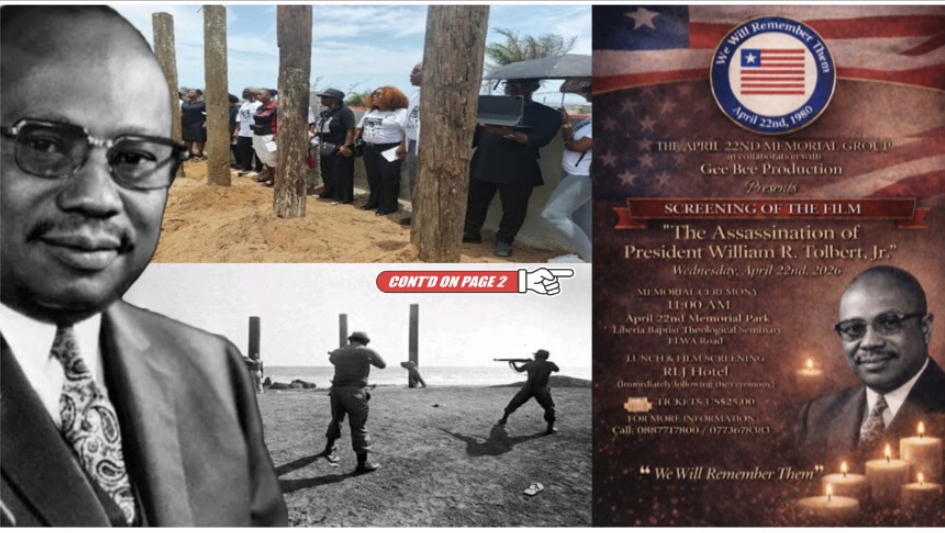
The April 22nd Memorial Group, in partnership with Gee Bee Production, will present a special screening of the documentary “The Assassination of President William R. Tolbert, Jr.” on Wednesday, April 22, 2026. The observance begins with a Memorial Ceremony at 11:00 AM at the April 22nd Memorial Park, located on the grounds of the Liberia Baptist Theological Seminary along ELWA Road in Paynesville City. Immediately following the ceremony, attendees will gather for a “Lunch & Lit Morning” at the RJ Hotel.
The date carries profound historical weight. On April 22, 1980—ten days after the coup that killed Tolbert—13 senior officials of his administration were executed by firing squad on a Monrovia beach. Their bodies, along with Tolbert’s, were initially dumped into a mass grave at Palm Grove Cemetery.
In the early hours of April 12, 1980, a group of 17 low-ranking soldiers led by Master Sergeant Samuel Doe stormed the Executive Mansion in Monrovia. Tolbert was shot three times in the head, reportedly in his bed. Twenty-six supporters died alongside him. The coup ended 133 years of unbroken rule by the True Whig Party, which had been dominated by the Americo-Liberian elite—descendants of free and formerly enslaved Black Americans who founded Liberia in 1822. Power shifted abruptly to an indigenous military junta, the People’s Redemption Council.
Born in Bensonville, Liberia, in 1913, Tolbert came from one of the nation’s most influential Americo-Liberian families. His grandfather, Daniel Frank Tolbert, was formerly enslaved in South Carolina and emigrated to Liberia aboard the barque Azor in 1878 as part of the Liberian exodus.
A trained civil servant and Baptist minister, Tolbert earned a Bachelor of Arts from the University of Liberia in 1934. He entered the House of Representatives in 1943 and was elected vice president in 1951, serving under William V.S. Tubman. Tolbert became the first African president of the Baptist World Alliance in 1965 and was also a Grand Master of the Masonic Order of Liberia.
He assumed the presidency upon Tubman’s death in 1971. To the outside world, the peaceful transfer signaled stability in a continent gripped by turmoil. But domestically, Liberia remained a one-party state with deep economic and social divisions between the Americo-Liberian minority and indigenous majority.
Tolbert sought to bridge the country’s racial and class divides. He was only the second Liberian president to speak an indigenous language (Kpelle) and promoted policies to bring more indigenous people into government. Yet his efforts satisfied neither side: indigenous Liberians found the changes too slow, while many Americo-Liberians accused him of “letting the peasants into the kitchen.”
Abandoning Tubman’s staunch pro-West stance, Tolbert established diplomatic relations with the Soviet Union, China, Cuba, and Eastern Bloc nations—though he continued to support the United States on the Vietnam War. He severed ties with Israel during the 1973 Yom Kippur War and spoke in favor of Palestinian national rights. In July 1979, he became chairman of the Organisation of African Unity, a post he held until his death.
Economically, Tolbert pushed a model he called “Humanistic Capitalism”—a blend of free enterprise, African altruism, and Christian morals. He audited foreign companies like Firestone, forcing them to pay millions in back taxes, and helped establish the Economic Community of West African States (ECOWAS) in 1975.
But falling global rubber prices strained the economy. By the late 1970s, unemployment and inflation soared. On April 14, 1979, a peaceful protest against a proposed rice price increase—from $22 to $26 per 100-pound bag—exploded into the deadly “Rice Riots.” More than 10,000 demonstrators joined the march; widespread looting caused over $40 million in damage, and at least 41 protesters were killed. Tolbert’s credibility never recovered.
In March 1980, he banned the opposition Progressive Alliance of Liberia and arrested its leader, Gabriel Baccus Matthews, on treason charges. Less than a month later, Doe’s soldiers struck.
The coup unleashed decades of instability. Doe’s military rule grew increasingly brutal, culminating in the First Liberian Civil War (1989–1997), which claimed over 200,000 lives. Tolbert’s body was initially thrown into a mass grave with 27 other victims. It was later moved to Palm Grove Cemetery, not far from where Rice Riot victims lay.
For 45 years, no formal state funeral was held. That changed in July 2025, when President Joseph Boakai’s administration conducted a symbolic state burial for Tolbert and the executed officials, establishing a memorial site as part of a national reconciliation effort. Among the few cabinet members who survived the coup and its aftermath was Tolbert’s minister of finance, Ellen Johnson Sirleaf, who would later become Africa’s first elected female head of state.
The April 22, 2026, events aim to ensure that history is neither forgotten nor repeated. Organizers say the film screening and memorial ceremony will honor not only Tolbert but all victims of the 1980 coup and its bloody aftermath.
“This is not about reopening old wounds,” said a spokesperson for the April 22nd Memorial Group. “It is about understanding where we came from so that we never return there. Tolbert was a flawed leader, but he was murdered alongside his constitutional government. That day changed Liberia forever.”
The public is invited to attend both the 11:00 AM memorial at the Liberia Baptist Theological Seminary and the Lunch & Lit Morning at RJ Hotel. The film screening will follow the ceremony, offering a detailed account of the coup, the executions, and Tolbert’s complex legacy.