

-To House Tolbert-Era Documents, Photographs, Speeches
By Jerromie S. Walters
PAYNESVILLE, Liberia – Families of 13 senior officials executed following the 1980 coup have announced plans for a research center to preserve the legacy of the administration of President William R. Tolbert Jr.
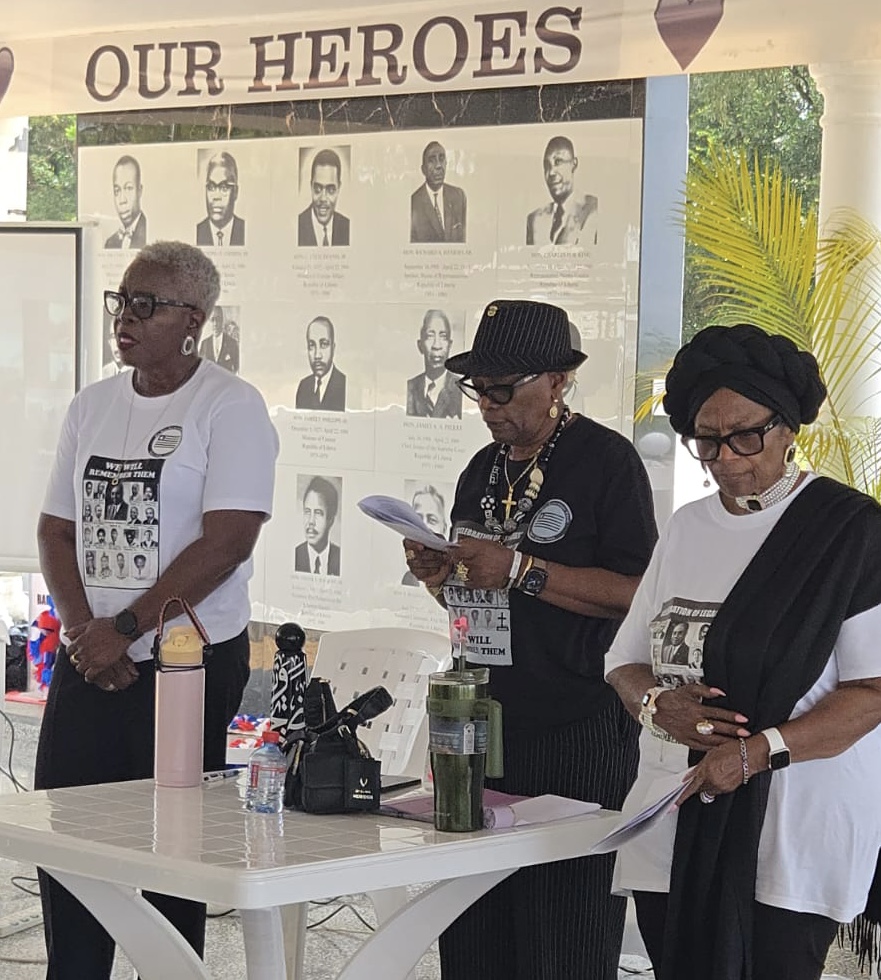
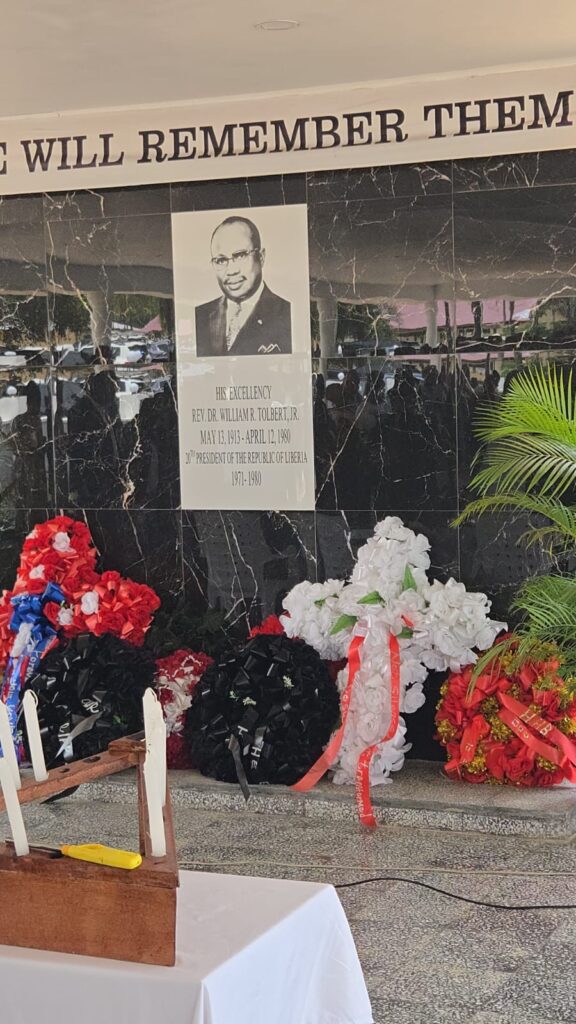
The disclosure was made on Wednesday, April 22, 2026, by Cllr. Dr. Yvette Chesson-Wureh, during a memorial service held for the deceased officials where the families dedicated a memorial park.
According to the group, the April 22nd Memorial Group Research Center will contain a library and archive that will house historical documents, writings, photographs, speeches, and published works related to Tolbert, his Cabinet, and his security detail. “Upon completion, this Library and Research Center will serve as a living archive preserving the legacy, voices, and contributions of William R. Tolbert Jr., alongside members of his Cabinet and security detail,” Cllr. Dr. Yvette Chesson-Wureh said in a statement delivered on behalf of the April 22nd Memorial Group on the grounds of the Liberia Baptist Theological Seminary along ELWA Road.
The initiative, which the April 22nd Memorial Group considers as its vision, will house historical documents, writings, photographs, speeches, and published works ensuring that future generations of Liberians and scholars can access the truth of Liberia’s history.
“More than a repository, it will be a place of reflection, learning, and national consciousness, a place where memory is transformed into knowledge, and knowledge into purpose. Because we believe that a nation that remembers, learns. And a nation that learns, grows,” Cllr. Dr. Yvette Chesson-Wureh noted.
However, the families say the vault prepared to receive the remains of their deceased relatives (13 senior officials executed following the 1980 coup) remains empty, because the bodies have not yet been fully recovered, identified, and laid to rest. “This emptiness is our pain but it is also our resolve,” Cllr. Dr. Yvette Chesson-Wureh said. She noted that the group continues to search, dig, and conduct DNA testing. “We continue to search. We continue to dig. We continue DNA testing. And we will not stop until each of them is found, honored, and properly laid to rest. This is our duty. This is our promise,” she said.
Cllr. Chesson-Wureh believes that the 13 men were denied their constitutional rights to legal representation and due process before being tied to poles and shot on a Monrovia beach on April 22, 1980. According to her, the families have chosen forgiveness and have chosen to transform pain into purpose. She described the executed men as patriots.
Cllr. Wureh cited the Truth and Reconciliation Commission, which found that the executions constituted “a gross violation of human rights and an egregious abuse of power” and “summary execution carried out without due process.”
She thanked the Liberia Baptist Theological Seminary for providing the land for the memorial and thanked all individuals, institutions, and partners who have contributed to the park. Following the ceremony, the April 22nd Memorial Group, in partnership with Gee Bee Production, held a screening of the documentary “The Assassination of President William R. Tolbert Jr.” at the RJ Hotel, along with a “Lunch & Lit Morning” gathering.
In the early hours of April 12, 1980, a group of 17 low-ranking soldiers led by Master Sergeant Samuel Doe stormed the Executive Mansion in Monrovia. Tolbert was shot three times in the head, reportedly in his bed. Twenty-six supporters died alongside him. The coup ended 133 years of unbroken rule by the True Whig Party, which had been dominated by the Americo-Liberian elite—descendants of free and formerly enslaved Black Americans who founded Liberia in 1822.
Power shifted abruptly to an indigenous military junta, the People’s Redemption Council. Born in Bensonville, Liberia, in 1913, Tolbert came from one of the nation’s most influential Americo-Liberian families. His grandfather, Daniel Frank Tolbert, was formerly enslaved in South Carolina and emigrated to Liberia aboard the barque Azor in 1878 as part of the Liberian exodus.
A trained civil servant and Baptist minister, Tolbert earned a Bachelor of Arts from the University of Liberia in 1934. He entered the House of Representatives in 1943 and was elected vice president in 1951, serving under William V.S. Tubman. Tolbert became the first African president of the Baptist World Alliance in 1965 and was also a Grand Master of the Masonic Order of Liberia.
He assumed the presidency upon Tubman’s death in 1971. To the outside world, the peaceful transfer signaled stability in a continent gripped by turmoil. But domestically, Liberia remained a one-party state with deep economic and social divisions between the Americo-Liberian minority and the indigenous majority.
Tolbert sought to bridge the country’s racial and class divides. He was only the second Liberian president to speak an indigenous language (Kpelle) and promoted policies to bring more indigenous people into government. Yet his efforts satisfied neither side: indigenous Liberians found the changes too slow, while many Americo-Liberians accused him of “letting the peasants into the kitchen.”
Abandoning Tubman’s staunch pro-West stance, Tolbert established diplomatic relations with the Soviet Union, China, Cuba, and Eastern Bloc nations—though he continued to support the United States on the Vietnam War. He severed ties with Israel during the 1973 Yom Kippur War and spoke in favor of Palestinian national rights. In July 1979, he became chairman of the Organisation of African Unity, a post he held until his death.
Economically, Tolbert pushed a model he called “Humanistic Capitalism”—a blend of free enterprise, African altruism, and Christian morals. He audited foreign companies like Firestone, forcing them to pay millions in back taxes, and helped establish the Economic Community of West African States (ECOWAS) in 1975.
But falling global rubber prices strained the economy. By the late 1970s, unemployment and inflation soared. On April 14, 1979, a peaceful protest against a proposed rice price increase—from $22 to $26 per 100-pound bag—exploded into the deadly “Rice Riots.” More than 10,000 demonstrators joined the march; widespread looting caused over $40 million in damage, and at least 41 protesters were killed. Tolbert’s credibility never recovered.
In March 1980, he banned the opposition Progressive Alliance of Liberia and arrested its leader, Gabriel Baccus Matthews, on treason charges. Less than a month later, Doe’s soldiers struck. The coup unleashed decades of instability. Doe’s military rule grew increasingly brutal, culminating in the First Liberian Civil War (1989–1997), which claimed over 200,000 lives. Tolbert’s body was initially thrown into a mass grave with 27 other victims. It was later moved to Palm Grove Cemetery, not far from where the Rice Riot victims lay.
For 45 years, no formal state funeral was held. That changed in July 2025, when President Joseph Boakai’s administration conducted a symbolic state burial for Tolbert and the executed officials, establishing a memorial site as part of a national reconciliation effort. Among the few cabinet members who survived the coup and its aftermath was Tolbert’s minister of finance, Ellen Johnson Sirleaf, who would later become Africa’s first elected female head of state.