

-As Public Records Show Liberia’s Military Strength
By Jerromie S. Walters
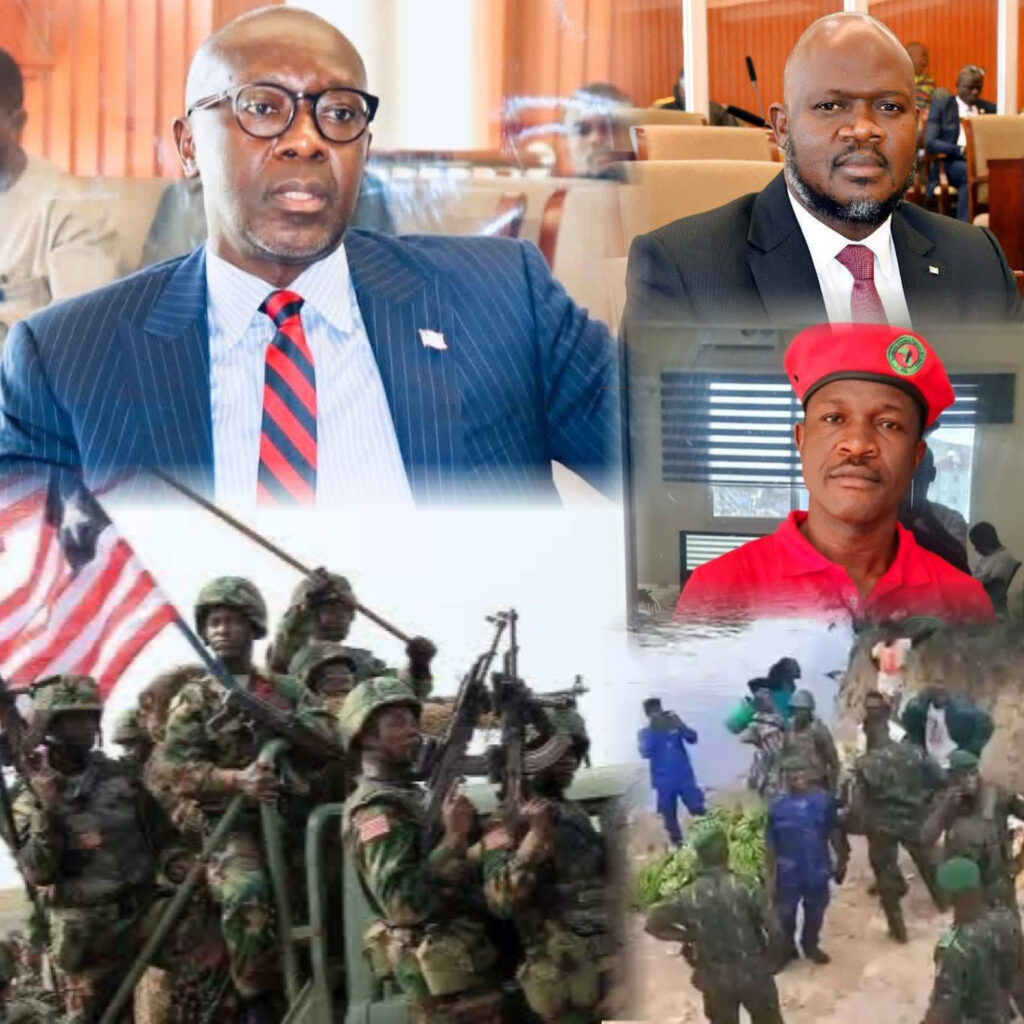
MONROVIA – Gbarpolu County Senator Amara Konneh has denied allegations that he disclosed privileged national security information on the Senate floor, while also denying claims that he praised the Guinean military during recent budget debates. The controversy stems from comments Konneh made before the passage of the 2026 supplementary budget late Thursday, April 23, 2026.
During the Senate debate, Konneh revealed the total number of personnel in the Armed Forces of Liberia (AFL) and highlighted the disparity in equipment between Liberia and Guinea. Konneh stated that Liberia maintains approximately 2,000 personnel with minimal equipment, while Guinea possesses anti-tank weapons, naval capabilities, and aircraft, making its military significantly better equipped. The senator made the remarks while advocating for increased budgetary allocations to the Ministry of National Defense.
In a statement released early Friday following criticism from some Liberians and his colleague, Konneh directly addressed what he described as two specific claims made by Nimba County Senator Nya D. Twayen Jr.
“Regarding the allegation that I ‘praised the Guinea Army’: My public statement on March 19, 2026, praised President Joseph Boakai’s diplomatic leadership in addressing the border crisis and called for the revival of Mano River Union coordination mechanisms, drawing on my direct experience managing Liberia’s MRU engagement from 2008 to 2016 under President Sirleaf,” Konneh said.
He added: “At no point did I praise, reference, or endorse any foreign military force. The statement remains publicly available for verification. My mention of the Guinean military’s size and strength during yesterday’s debate, which is public information, was to emphasize the need to pay attention to our military funding.”
Addressing the classified information allegation, Konneh stated: “I have not attended any meeting where I was given official classified details about our military strength. I did not reveal any content from President Boakai’s meeting with the Senate. Every piece of information I referenced on the Senate floor yesterday is unclassified and publicly accessible.”
Senator Twayen Calls for Investigation
Senator Twayen, who represents Nimba County, expressed concern over Konneh’s comments and suggested the matter warrants formal investigation. According to Twayen, the information Konneh disclosed is privileged and not easily accessible to the general public.
Like him, Emmanuel Gonquoi of the Economic Freedom Fighters of Liberia (EFFL), also criticized Konneh’s remarks. “The reckless behavior of some current and former leaders of our country in the name of speaking out is troubling. Where is the sense of nationalism?” Gonquoi said. “Senator Konneh, you know that you are my guy, but you did not do well for our country as a whole. One cannot say everything they see.”
However, open-source research indicates that the Armed Forces of Liberia is a small, professional volunteer force of roughly 2,000 to 2,100 active personnel focused on national security, border control, and peacekeeping. Rebuilt after the civil war with United States assistance, the AFL lacks heavy equipment, including tanks, combat aircraft, and significant naval assets. It is considered one of the smallest militaries in West Africa.
House Expels Kolubah Over Border Comments
The controversy over Liberia-Guinea border issues has already claimed one legislative seat. The House of Representatives expelled Montserrado County District Number 10 Representative Yekeh Y. Kolubah following a vote on Friday, April 17, 2026. The decision came after the House Committee on Rules, Order, and Administration submitted an investigative report detailing allegations of gross misconduct and violations of the lawmaker’s oath of office, including comments regarding the Liberia-Guinea border dispute in which Kolubah stated, “The land belongs to Guinea.”
The investigative report was triggered by complaints filed against Kolubah by Montserrado County District Number 3 Representative Sumo K. Mulbah and others. The complaint specifically sought Kolubah’s expulsion on allegations of misconduct in office, violation of his oath of office, and violation of the House’s Rules and Procedures. Mulbah further accused Kolubah of consistently bringing the House and the Legislature into public disrepute.
Inspector General of the Liberia National Police Gregory O. W. Coleman also raised concerns about national security, public safety, and national stability in connection with Kolubah’s statements. Despite the expulsion, Guinean soldiers remain on the Liberian side of the border.
Border Dispute
For days, residents of border communities along the Makona River in northern Liberia have been in a state of heightened fear and uncertainty, as the territorial dispute with Guinea entered its second week on Tuesday, March 17, 2026.
The dispute was ignited when Guinean soldiers crossed the Makona River—long regarded as the natural boundary—and seized equipment from a Liberian sand-mining operation. The troops raised a Guinean flag on Liberian soil, asserting territorial claims. Although residents confronted the intruders and re-hoisted the Liberian flag, the situation turned violent days later when Guinean forces returned and opened fire, wounding a Liberian man.
Despite a high-level emergency summit held the previous week in Conakry involving the presidents of Liberia, Guinea, and Sierra Leone, Guinean troops remained present in the contested area. Following the trilateral meeting convened under the Mano River Union framework, President Boakai struck an optimistic tone: “We all realized that we are the same people. We have been working together for years and we have nothing to gain from war.”
The summit produced a joint communiqué outlining a 12-point roadmap for peace, including commitments to restore the status quo ante and enhance security cooperation through joint patrols. However, the continued presence of Guinean soldiers on disputed ground has left many Liberians questioning the effectiveness of the diplomatic breakthrough.
Reports also indicate that at the Sefudu Border in Quardu Gbondi District, Guinean security personnel ordered their Liberian counterparts to move the Liberian flag approximately half a kilometer from the swampy borderline in 2025—the first known instance of attempted encroachment, suggesting a broader pattern of gradual territorial expansion.
The Makona River, also known as the Moa, is an international waterway shared by Liberia, Guinea, and Sierra Leone. Guinean authorities cite the 1907 Franco-Liberian Convention and a 1911 refinement, which they interpret as placing the border along the Liberian bank rather than the middle. They also invoke a regional principle suggesting that a border river belongs to the country where it originates—in this case, Guinea. Conversely, Liberian local leaders and residents maintain that the river has historically served as a recognized shared boundary, with Liberian territory extending to at least the middle of the river.
Konneh Calls for Increased Military Funding
Konneh concluded his statement early Friday by thanking the President Pro Tempore and his colleagues, including Senator Twayen, for what he described as their commitment to national security and regional stability. He noted that the marginal increase in the AFL budget in the approved supplemental budget reflects this commitment.
“The real issue is this: The incident at our border with Guinea marks the first major external threat to our sovereignty at a time when the United Nations has proven increasingly unable to guarantee international peace and security,” Konneh said.
He pledged to continue working with colleagues to prioritize increased budgetary support for the AFL in future budgets to facilitate modernizing equipment, improving military welfare, and the targeted expansion of Liberia’s force strength to meet national and regional security challenges.