

-As Court-ordered Eviction Enforcement Turns Chaotic
By Jerromie S. Walters
Monrovia: On Saturday, July 18, 2026, violent clashes erupted between some Stockton Creek Community residents and the Liberia National Police (LNP) during a court-ordered eviction enforcement along the Japan Freeway in Monrovia, Liberia.
The clash involves a longstanding dispute over approximately 85 to 88 acres of land in the Stockton Creek / Battery Factory area.
Longtime residents claim they have legally lived on and developed the land for decades.
Armed police officers and a court sheriff arrived as early as 4:00 AM to enforce a Civil Law Court eviction order in favor of a separate private claimant.
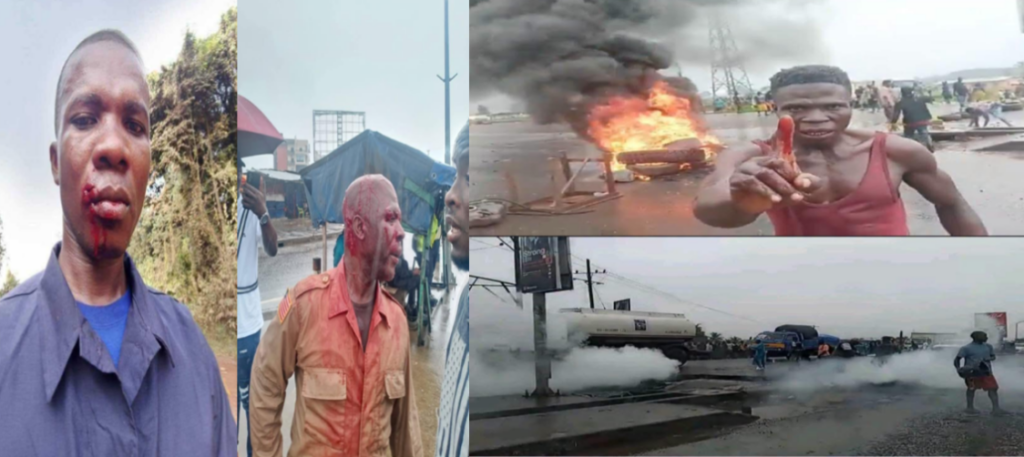
LNP officers fired several rounds of teargas to disperse the community and clear the area. [1]
Aggrieved community members retaliated by setting up roadblocks and throwing thousands of stones at the advancing forces.
Scores of individuals were injured or arrested, including residents, a court sheriff, LNP officers, and random passersby.
This confrontation follows months of escalating tensions. Residents had previously petitioned the House of Representatives regarding police brutality and alleged corruption surrounding the tract of land. A court sheriff was seen with blood on his face and mouth. A Police Support Unit officer had his head bandaged and one eye covered. Another officer sustained a head wound, his uniform soaked in blood under the rain.
Former President Ellen Johnson Sirleaf has strongly addressed Liberia’s escalating land crisis multiple times in 2026, offering critical evaluations of the situation, backing presidential mandates, and lecturing the national legislature on systemic flaws.
In February 2026, speaking on ELBC Radio’s Changing Minds, Changing Attitudes program, Sirleaf explicitly endorsed President Joseph Boakai’s proposed moratorium on public land transactions. She called the moratorium a valid and “necessary intervention” to confront the unchecked growth of illegal settlements and overlapping transactions.
Sirleaf cautioned the administration that mere policy declarations are not enough. She noted that public land will remain exposed to abuse and encroachment if the government does not take swift, bold steps to physically secure and safeguard properties. She urged ordinary citizens and private landowners to actively develop their lands, stating that leaving land idle makes it an easy target for illegal squatting.
On March 5, 2026, during an unprecedented historical invitation to address the plenary of the House of Representatives, Sirleafchallenged lawmakers to confront the structural flaws in land governance. She emphasized that despite the passage of the landmark 2018 Land Rights Act (which occurred after her presidency), land conflicts remain one of Liberia’s most volatile and persistent sources of local tension.
She connected the land issue to urban renewal, warning the House that rapid population growth is putting dangerous pressure on Monrovia’s public space, urban planning, and sanitation. In late April 2026, Sirleaf further weighed in on the institutional mechanics driving the crisis.
She called for a far more robust, fast-acting, and transparent judicial system to settle ownership overlapping, noting that sluggish and corrupt court processes are fueling community tensions. She explicitly noted that the national army does not need to hold onto vast amounts of land, suggesting state land redistribution or relinquishment could alleviate local strains.