

Gbarnga, Bong County – The County Attorney for Bong County, Cllr. Jonathan N. Flomo, has described the Ministry of Justice’s Workplace Safeguard Policy and Gender Sensitive Communication Strategy as two critical instruments for strengthening the institution’s commitment to justice, fairness, equality, and professionalism.
Delivering closing remarks at the conclusion of a six-day working session on the two policy documents, Cllr. Flomo emphasized that both frameworks are central to reinforcing the Ministry’s shared vision of building an institution whose internal culture reflects the principles of justice, fairness, and equality that its officials and workforce are constitutionally mandated to uphold.
“The Workplace Safeguard Policy represents the Ministry’s collective commitment to ensuring that every employee works in an environment characterized by dignity, mutual respect, fairness, accountability, and zero tolerance for harassment, discrimination, intimidation, retaliation, abuse of authority, and every other form of workplace misconduct,” Cllr. Flomo stated.
He further noted that the Gender Sensitive Communication Strategy serves as a practical roadmap for fostering equality, inclusiveness, respect, and professionalism in all forms of communication, both within the Ministry and in its engagement with the public.
According to the Bong County Attorney, the successful implementation of the two policy frameworks will contribute significantly to creating a safe, inclusive, and respectful workplace while enhancing public confidence in the Ministry of Justice as an institution that practices the values it is entrusted to enforce.
Cllr. Flomo also commended the participants for their unwavering commitment, professionalism, and active engagement throughout the six-day deliberations. The participants included county justice officials, representatives of civil society organizations, and directors from the Ministry of Justice.
He encouraged all stakeholders to champion the effective implementation of the Workplace Safeguard Policy and the Gender Sensitive Communication Strategy, stressing that their success will depend on the collective responsibility of every member of the Ministry to uphold the highest standards of integrity, accountability, respect, and inclusion.
He however commended the Minister of Justice and Attorney General of Liberia, Cllr. Natu Oswald Tweh and the Development Partners including UN Women- Liberia through its Country Representative, Mr. Abul Hasnat Monjurul Kabir for the unwavering support to the Gender Social Inclusion Unit to actualize the two instruments.
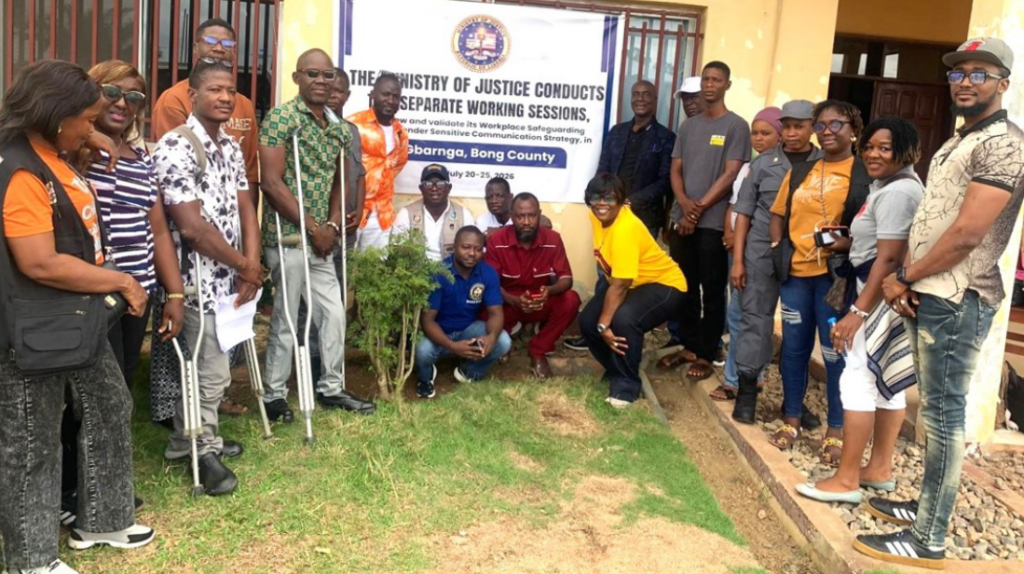
The exercise, which took place from July 20-25, 2026, at the Regional Hub in Gbarnga, Bong County, brought together local County Authorities, stakeholders, justice actors, and directors of various sections within the Ministry of Justice, among others.
The six-day working session formed part of the Ministry of Justice’s ongoing efforts to strengthen institutional governance, promote gender-responsive practices, and cultivate a workplace culture that embodies the principles of justice and human dignity.
For his part, the Assistant Director of the Gender Social Inclusion Unit at the Ministry of Justice, expressed gratitude to the County Authorities for affording the team the opportunity to technically review and validate both the workplace safeguarding policy document and the Gender Sensitive Communication Strategy, which he said, is aimed at strengthening basic outputs of gender equality communication, sensitive language, and workplace conduct.
Laward also commended the Minister of Justice and Attorney General, Cllr. N. Oswald Tweh, for his steadfast leadership and commitment to advancing gender equality and social inclusion within the Ministry. He also acknowledged the Ministry’s development partners including the United Nations Women-Liberia, for their continued technical and financial support in developing the policy.
According to Mr. Laward, the two major documents reviewed and validated—and now awaiting approval, will promote decent work ethics and professionalism, safeguard employees from workplace provocation, and promote workplace accountability. He added that the policy document and the gender-sensitive communication strategy will introduce a unified message across all gender pathways in the Ministry of Justice, using inclusive representation, gender-inclusive language, visibility and empowerment, alongside awareness and social change.
He further stated that the drafting of this instrument considered numerous national and international protocols that provide support and align with international standards.
The review and validation of the two strategic documents was conducted in two separate sessions of three days each, allowing participants to form three groups to actively engage in self-reading of the documents and provide meaningful inputs and recommendations to the final approving committee.
The Gender Social Inclusion Unit, is currently partnering with UN Women- Liberia to conduct a Gender-Responsive Prison Assessment in three major counties including, Bong, Lofa, and Nimba. The exercise aims to address gaps in how correctional facilities serve women, particularly pregnant detainees and mothers with infants, persons with disabilities, and vulnerable male detainees, while aligning prison practices with Liberia’s obligations under CEDAW, UNSCR 1325, and the National Action Plan on Women, Peace and Security.
This phase of the new project will also evaluate prison infrastructure, health services, rehabilitation, and protection through a gender lens, identify systemic policy and practice gaps affecting different detainee groups, and build institutional accountability through evidence-based findings that advance inclusive justice reforms tied to Liberia’s international commitments.
By evaluating prison infrastructure, health services, rehabilitation programs, and protection protocols through a gender lens, the assessment will also generate evidence-based findings to strengthen institutional accountability.