


By Jessica Cox
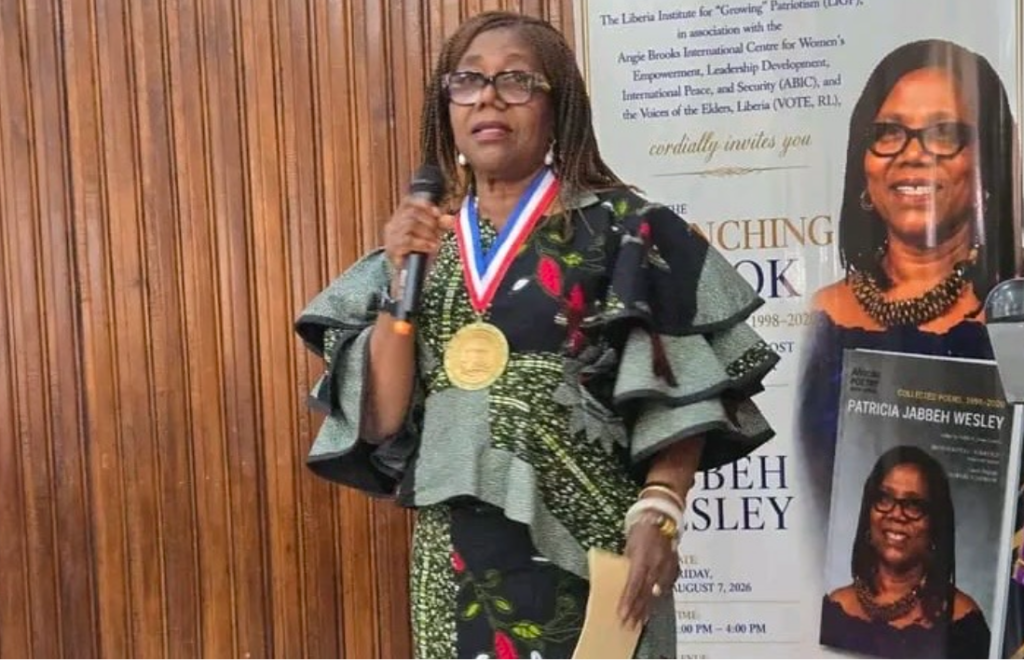
Liberian poet and writer Dr. Patricia Jabbeh Wesley has been celebrated for using poetry to preserve Liberia’s history, culture, and identity while projecting the country’s story to audiences around the world.
The commendation came during the official launch of her Collected Poems, 1998–2020, a major compilation bringing together more than two decades of her poetic work and exploring themes including war, displacement, motherhood, loss, identity, survival and hope.
The ceremony brought together government officials, members of the diplomatic community, literary figures, academics, cultural advocates and other prominent Liberians.
The event was organized by the Liberian Institute for “Growing” Patriotism (LIGP) in collaboration with the Angie Brooks International Centre for Women’s Empowerment, Leadership Development, International Peace and Security (ABIC) and the Voices of the Elders (VOTE).
Speaking on behalf of Foreign Affairs Minister Sara Beysolow Nyanti, Ambassador Ethel Davis extended congratulations and appreciation to Wesley for her remarkable contribution to Liberian literature and poetic excellence.
Davis said the Ministry of Foreign Affairs recognizes Wesley’s decades of literary work for taking Liberia’s literature and cultural heritage to the global stage while preserving important aspects of the country’s history and identity.
She described Wesley as one of Liberia’s finest “poetic ambassadors,” noting that her works have crossed national borders and contributed to greater international appreciation of Liberia and its people.
According to Davis, diplomacy extends beyond international relations, treaties and official engagements, as it also involves promoting a nation’s culture, history, language, values and achievements.
“Literature is one of the most powerful expressions of a people,” Davis said, emphasizing the role writers and poets play in telling the stories of their countries and preserving those experiences for future generations.
She thanked Wesley for helping to project Liberia through her literary works, describing her contribution as an important component of the country’s cultural diplomacy.
Davis further stressed the importance of preserving Liberia’s history and cultural heritage through the arts and literature, particularly as the country continues efforts toward national unity, reconciliation and the strengthening of democratic institutions.
In her remarks, Wesley took the audience through some of the experiences that have shaped her writing, particularly her memories of Liberia’s civil war and the impact of conflict on ordinary people.
She recalled scenes of children playing and running barefoot before their lives were interrupted by the sound of gunfire and destruction.
Those memories became part of the stories she carried with her throughout her life and eventually took to audiences beyond Liberia.
Wesley reflected on Liberians who were forced to leave their homeland during the war and now live in places such as London, Manchester and New York, while still carrying memories of the country they left behind.
Her remarks repeatedly returned to the experiences of women and mothers, portraying motherhood as a source of protection, sacrifice, memory and hope amid the devastation of war.
She also read from her 2020 collection, Praise Song for My Children, which she dedicated to all children.
The work reflects on motherhood against the backdrop of war, displacement and loss, while expressing a mother’s desire to protect her children and pass hope to the next generation.
During the reading, Wesley repeatedly invoked the image of a mother carrying hope to her children, connecting the personal experience of motherhood with Liberia’s broader history of conflict and survival.
Wesley also reflected on the international recognition she received for Praise Song for My Children, recalling her surprise when she learned that the book had won a major literary award carrying a US$10,000 prize.
She said the recognition was meaningful because it demonstrated that the experiences of Liberians and the African continent could make a significant contribution to literature beyond the continent.
Her newly published Collected Poems, 1998–2020 brings together six earlier collections, including Before the Palm Could Bloom, Becoming Ebony, The River Is Rising, Where the Road Turns, When the Wanderers Come Home and Praise Song for My Children. The collection was published by the University of Nebraska Press as part of the African Poetry Book series.
Former Chief Justice of Liberia Gloria Musu Scott, who served as the launcher of the book, praised Wesley for using her literary talent to preserve aspects of Liberia’s culture, history and identity.
Scott said Wesley’s contribution goes beyond poetry, arguing that her works provide readers with a window into the experiences and traditions of Liberians and the historical circumstances surrounding them.
She encouraged readers to consider Wesley’s poems alongside Liberia’s history to better appreciate the context and experiences reflected in the works.
Scott said Wesley had demonstrated the gifts and talents given to her by God and had used them to create a lasting record of who Liberians are and what they have experienced.
She also emphasized the role of elders and ancestors in preserving the country’s history and culture before formally launching the book.
In a symbolic cultural gesture, Scott invoked Liberia’s forebears and those who contributed to the country’s history, asking that the work be blessed and that Wesley’s contribution continue to serve generations to come.
The collaborating organizations also used the occasion to highlight the broader national significance of Wesley’s literary achievement.
Olubanke King-Akerele, Executive Director of the Liberian Institute for “Growing” Patriotism and Chairperson of the Board of ABIC, has long promoted patriotism, citizenship and nation-building through LIGP. The institute was established to encourage pride in Liberia and strengthen understanding of what it means to be a Liberian and a patriot.
In that spirit, the organizers described Wesley’s work as an example of patriotism through literature using talent and creativity to preserve the Liberian experience and tell the country’s story to the world.
King-Akerele’s involvement also reflects the connection between patriotism and cultural preservation, particularly the importance of celebrating Liberians whose contributions strengthen the country’s identity.
Cllr. Dr. Yvette Chesson-Gibson, Executive Director and Establishment Coordinator of ABIC, represents an institution whose mandate focuses on women’s empowerment, leadership development, peace and security. ABIC was established as a legacy of the 2009 International Colloquium on Women’s Empowerment, Leadership Development, International Peace and Security.
The organization’s participation highlighted the strong connection between Wesley’s literary work and the experiences of women, families and communities affected by conflict.
Chesson-Gibson has also been recognized internationally for her work in women’s peacebuilding and for initiating the Women’s Situation Room, an early-warning and rapid-response mechanism aimed at preventing electoral violence.
For Voices of the Elders, veteran educator Sister Mary Laurene Browne represents the organization’s emphasis on the wisdom and contribution of Liberia’s older generation. Recent reporting identifies Browne as a leader of VOTE and notes her continued advocacy for education and young Liberians.
The participation of VOTE therefore added an intergenerational dimension to the celebration, linking Wesley’s literary record of Liberia’s past with the responsibility of elders to preserve history and pass knowledge to younger generations.
The launch underscored the growing importance of literature as an instrument for cultural diplomacy, historical preservation and national identity.
Wesley’s collection documents experiences that might otherwise have been forgotten, including the lives of Liberians affected by the country’s fourteen-year civil war, displacement and migration. The publishers describe the collection as spanning two decades of work and drawing on Wesley’s experiences as a refugee, mother, wife and African woman, while also incorporating elements of Grebo oral tradition.
For Liberia’s diplomatic and cultural community, her literary achievements represent another avenue through which the country can tell its own story to the world.
The celebration of Wesley’s work therefore extended beyond the launch of a book. It was a recognition of the role of Liberian literature in preserving the nation’s memory, strengthening cultural identity and presenting Liberia to the world through the voices of its own people.
With Collected Poems, 1998–2020, Wesley’s literary journey stands as a record of more than two decades of poetry a body of work connecting Liberia’s painful past with its present and its hopes for the future.