


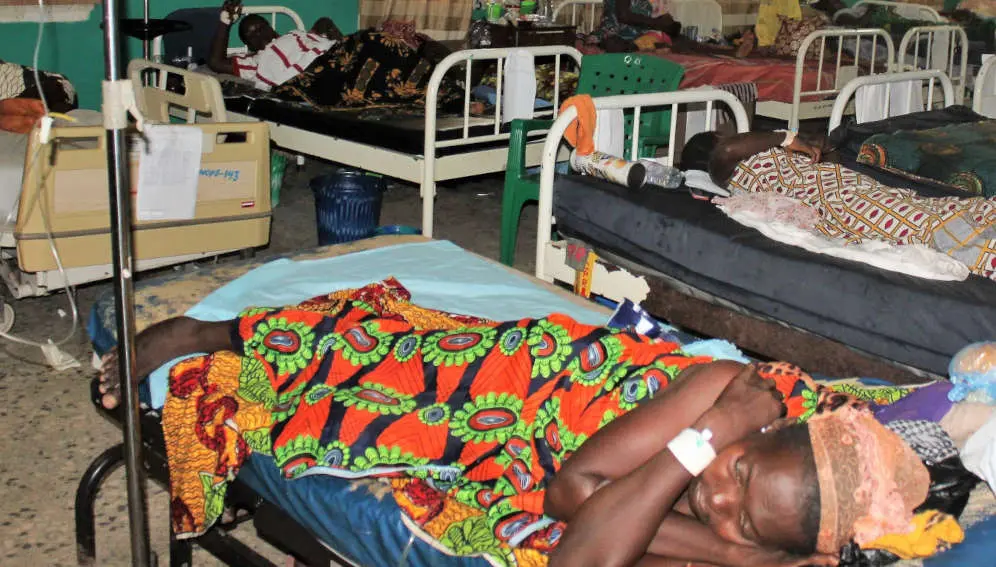
Women in a hospital ward. An estimated half a million women and girls are living with obstetric fistula globally. Copyright: Courtesy of UNFPA Liberia.
By Tina S. Mehnpaine
This story was supported by the Pulitzer Center
For more than a year now, three Liberian doctors have been far from home, hunched over operating tables at the St. Paul’s Hospital Millennium Medical College in Addis Ababa, Ethiopia, learning surgical procedures that most hospitals in their country cannot perform.
The doctors, Dr. Issatu S. Komara-Keita, Dr. Alexander F. Willicor, and Dr. Numeine Ernest Enders, are undergoing two years of advanced fellowship training in urogynecology and pelvic floor reconstruction, a surgical specialty that treats the bladder, reproductive system, and rectum, including pelvic floor disorders.
Their studies are part of an effort by the Government of Liberia, the Economic Community of West African States (ECOWAS), and the United Nations Population Fund (UNFPA) to reduce the country’s dependence on foreign surgeons to tackle the growing number of fistula cases, one of the world’s most devastating childbirth injuries.
ECOWAS provided US$245,000.
“Based on the Minister of Health’s request to UNFPA and the ECOWAS Gender Office, both institutions agreed to sponsor the doctors.
UNFPA sponsored one doctor, while the others are being supported through funds provided by the ECOWAS Gender Office in Dakar, Senegal,” Dr. Nowaih Gorpu-Dolo Dennis, Fistula Focus Person at the Ministry of Health, said in an email.
In Liberia, the lives of fistula survivors are marred by high costs for treatment and a lack of trained surgeons, forcing many to rely on foreign visiting doctors who provide annual treatment. The country has only three urologists—Dr. Ayun Cassell III, Dr. Lavela B. Kortimai, and Dr. Solomane Konneh—all based at the John F. Kennedy Medical Center’s (JFK) urology clinic.
Dr. Ayun K. Cassell III, a consultant urologist at the John F. Kennedy Medical Hospital, said these hurdles have left many women waiting months for free surgeries provided by foreign doctors or even years, worsening their condition by the time help comes.
“We have three urologists; we are hoping that we’ll have more urologists, and we have doctors who have been sent out for studies,” said Dr. Cassell, who is also the head of the Liberia Medical and Dental Council.
The ongoing initiative, he said, will strengthen surgical services, improve continuity of care, and create opportunities for mentorship and knowledge transfer, helping Liberia build a permanent pool of fistula specialists capable of providing sustained treatment across the country.
The hidden burden of fistula in Liberia
Across the country, the Ministry of Health estimates that about 100 women develop obstetric fistula every year in Liberia, although health experts say the true number may be significantly higher than reported. The condition, which is one of the most serious childbirth-related injuries affecting women in low-resource settings, develops after a woman experiences prolonged obstructed labor, often lasting several days, without access to emergency medical intervention, such as a cesarean section.
During prolonged labor, pressure from the baby’s head can damage surrounding tissues, creating an abnormal opening between the birth canal and the bladder or rectum and leading to uncontrollable, continuous leakage of urine or feces, or both. While the physical injury can often be repaired through surgery, the main drawbacks for survivors are rejection by spouses and the stigma associated with the condition.
For survivors in rural areas, the challenges are unending. They must travel to Monrovia whenever a free campaign treatment is announced on the radio. This journey is costly, forcing them to endure terrible roads, sleepless nights, and hours sitting on motorbikes. Sometimes, before they even arrive, the campaign has ended.
A 2024 LIGISL gender policy brief, drawing on the country’s 2022 population and housing census, found that women aged 15 and older had experienced fistula, with the proportion rising to 1% in rural areas compared with 0.8% in towns and cities. Similarly, the country’s health strategy, citing a 2018 national assessment, found that health facilities had only 56% of the general capacity needed to provide services, including emergency obstetric care.
According to the WHO, Liberia has made gains in improving the quality of healthcare services, but the country’s maternal mortality ratio is still among the highest in the world due to limited access to quality obstetric care. A 2022 study in BMC Pregnancy and Childbirth found that 78% of recorded births in Liberia occurred in facilities that did not meet the basic emergency-readiness standard.
Dr. Tarmay K. Yekeh-Saa, deputy director for the Family Health Unit at the Ministry of Health, noted that when the Ministry conducts surveys to determine the ages and backgrounds of women affected by fistula, it often finds that many of them are young, with young people accounting for nearly two-thirds of the women affected.
Dr. Saa, who is an Obstetrician and Gynecologist (OBGYN), said that while the cost of fistula surgery remains out of reach for many women, the greater problem with the country’s fistula program has been the limited number of surgeons with the specialized skills needed to repair fistula.
“For the last five to seven years in Liberia, we really don’t have the surgeons that are able to correct it,” Dr. Yekeh-Saa said in remarks earlier this year at a World Fistula Day event (May 22) held at the Ministry of Health. “Based on whenever we run a campaign, the number of persons that come forth; we believe that approximately 100 persons every year is [are] affected in Liberia.”
A survivor’s burden
For decades, women suffering from obstetric fistula have had to wait months, sometimes years, for visiting international surgical teams to repair their injuries. These campaigns have been associated with high rates of relapse and the breakdown of surgical scars. Beyond the return of the three doctors, the Ministry of Health intends to train a cohort of OB/GYNs and urogynecologists assigned to various health facilities in Liberia.
With support from UNFPA, the ministry has also integrated obstetric fistula into the Health Management Information System (HMIS), as it has done with maternal mortality.
“This will upgrade fistula as one of the key indicators for maternal care,” Dr. Dennis said. “This will follow the creation of the first specialized fistula treatment unit in Liberia and the development of the National Obstetric Fistula Strategy.”
Woseh Gobeh-Weah, a UNFPA sexual and reproductive health specialist, said surgical equipment and medical supplies have been donated to John F. Kennedy Hospital to complement the doctors’ work when they return. “So the idea is that once they return, the operating theater will have the requisite equipment and supplies for them to start repairing cases,” she said.
Ms. Weah noted that, as part of UNFPA’s support to the government, investments will be made in obstetric fistula treatment, including the training of more doctors, and midwives.
UNFPA’s support for Liberia’s fistula response predates the current fellowship program. For more than 15 years, with US$3.5 million in funding from Zonta International, the agency has funded the Ministry of Health-led Liberia Fistula Project, which combined prevention with free treatment, rehabilitation, and social reintegration.
By 2017, UNFPA reported that the project had treated more than 1,500 fistula survivors and provided rehabilitation support to more than 400. At the Fistula Rehabilitation and Reintegration Center in Phebe, Bong County, survivors received counseling, life skills education, and training in income-generating activities. More recently, UNFPA’s support has focused on placing fistula care within national policy and routine health services.
“This is again another attempt for UNFPA to train specialized surgeons,” Ms. Weah said, highlighting the agency’s past work in training nurses and surgeons, including Dr. John Mulbah, Liberia and West Africa renowned fistula surgeon who once led the country’s postwar fistula program. He was recalled from this position in 2018.
Dr. Keita, an OBGYN and the lone female among the three trainees, has seen firsthand the lived experiences of women suffering from fistula. BShe hopes their return will bring a solution to one of the most pressing challenges that has crippled fistula treatment in the country. “This opportunity represents not only my personal and professional growth but also a commitment to improving the lives of women and girls suffering from pelvic floor disorders,” Dr. Komara-Keita said during a WhatsApp interview from Ethiopia.
As a child during the civil war, she began her education at a refugee school in Guinea before moving to Ghana for secondary school. She later returned to earn her undergraduate degree in biology and chemistry from African Methodist Episcopal Zion University (AMEZU), eventually graduating from the A.M. Dogliotti College of Medicine in 2016.
The return of Dr. Komara-Keita and her colleagues is precious to thirty-two-year-old Pauline, who has been battling fistula for three years without repair, despite incurring high medical costs in her quest for a solution.
Like many other survivors, Pauline went into labor expecting to become a mother within hours but lost her baby and developed obstetric fistula after prolonged labor.
“My child died, and then I have to wear Pampers like a baby. Two times more pain,” she says. “When I was discharged, no one informed me that I had developed a fistula.”
“Left with constant daily leakages, I go from one hospital to hospital seeking answers, using income from my cassava farm and financial support from family members, but I have found no relief,” she noted.
Experts say Pauline’s battle for treatment is a glaring example of the challenge survivors has been facing. Many hospitals and clinics in Liberia do not have the treatment facilities and surgeons needed to detect and treat fistulas, leaving countless women waiting for treatment for a condition that is treatable and preventable.
According to Dr. Philderald Pratt, secretary-general of the Liberia College of Physicians and Surgeons (LCPS), addressing this crisis requires strengthening the country’s local medical workforce. LCPS was established in 2012 with just four core faculties: Internal Medicine, Pediatrics, General Surgery, and OBGYN. It has since expanded to 10 faculties aimed at producing homegrown specialists.
To date, he says the college has trained 25 OBGYN who are distributed across Liberia. While all OBGYNs trained through the program receive basic preparation to handle simple fistula cases, complex cases require advanced specialists, such as urologists and urogynecologists.
In the past, Liberia’s fistula response relied heavily on periodic surgical campaigns supported by international partners like UNFPA and local institutions like St. Joseph Catholic Hospital. While these outreach efforts provided care, Dr. Pratt notes that once visiting specialists leave after a campaign, local health facilities often lack the resident workforce required for long-term follow-up care or to manage complex postoperative complications.
Nearly all doctors entering LCPS are Ministry of Health employees bound by service contracts. Upon graduation, they are redeployed by the government. Although LCPS has succeeded in ensuring that every county now has at least one medical specialist, a complete multidisciplinary team of specialists in every county remains an unfulfilled goal.
“Even if you have six, and all six are based in Monrovia, only those who can reach the capital will be able to access services,” Dr. Pratt noted. “The idea is to ensure services are distributed regionally so women in rural areas don’t have to travel all the way to Monrovia for care.”
Precious Rue Becomes LDEA Deputy Operations Chief
Monrovia, Liberia – President Joseph Nyuma Boakai, Sr. has appointed Ms. Precious Rue as Deputy Director General for Operations of the Liberia Drug Enforcement Agency (LDEA), positioning the security veteran at the frontline of the Administration’s intensified offensive against narcotics trafficking.
Rue, whose appointment is pending Senate confirmation, will serve as the agency’s operational architect—tasked with leading enforcement actions, intelligence coordination, and tactical strikes against drug networks. He assumes duties immediately in an acting capacity alongside newly appointed Director General Major General (Retired) Daniel Dee Ziankahn, Jr. and Deputy Director General for Administration Prince Mulbah.
The appointment signals the President’s strategic emphasis on bolstering LDEA’s operational capacity at a critical moment. Rue’s background in security and enforcement is expected to bring renewed vigor to field operations, interagency coordination, and intelligence-led interventions.
Her role places her at the center of Liberia’s zero-tolerance policy toward drug trafficking, organized crime, and corruption—a policy that has gained urgency following recent high-profile cocaine seizures and international scrutiny over Liberia’s role as a transit point for illicit drugs.
Broader Leadership Overhaul
The appointments follow the submission of the Ministry of Justice’s investigative report to the President and form part of a broader strategy to strengthen Liberia’s institutional response to narcotics threats. Major General Ziankahn, a former Chief of Staff of the Armed Forces and Minister of National Defense, will oversee the agency while reporting directly to the President. Mulbah takes charge of administrative operations.
Mr. Ernest Tarpeh, who served as Deputy LDEA Director General, returns to his previous assignment at the National Security Agency.
In a related action, President Boakai indefinitely suspended former LDEA Officer in Charge Fitzgerald Biago from the Liberia National Police over ethical concerns identified in the Ministry of Justice’s report. While the report did not establish Biago’s involvement in drug trafficking, it flagged issues warranting further investigation.
Following a marathon National Security Council meeting, President Boakai emphasized that no public official would be exempt from accountability where integrity questions arise.
The President called on the new LDEA leadership—particularly Rue in his operations role—to work closely with the Joint Security, the Ministry of Justice, and international partners to dismantle trafficking networks, strengthen border security, and protect Liberia’s youth and communities.
“Our fight against drugs is a fight for the future of Liberia,” the President declared. “We will continue to strengthen our institutions, hold public officials to the highest ethical standards, and pursue those who seek to poison our communities. There will be no safe haven for drug traffickers or those who aid and abet them.”
Gov’t Invests US$1M in School Science Labs
By Jessica Cox
MONROVIA, The Ministry of Education says the government has purchased more than US$1 million worth of science equipment for schools across Liberia, as part of efforts to strengthen science, technology, engineering and mathematics (STEM) education.
Education Minister Dr. Jarso Maley Jallah said the equipment is ready for deployment, with county education officers receiving the supplies for distribution to schools.
She said the investment goes beyond the provision of equipment, noting that the government is also retrofitting science laboratories to ensure schools have the facilities needed for practical science education.
“We are retrofitting science labs,” Minister Jallah said, adding that the Ministry has purchased more than US$1 million worth of science equipment that is ready for deployment.
The equipment includes materials needed to support practical laboratory activities, with the Minister referencing burners and other science equipment being distributed through the county education structures.
The latest investment builds on an ongoing Ministry program to strengthen STEM education across the country.
In July, the Ministry announced the nationwide distribution of STEM laboratory materials to 50 schools across Liberia’s 16 educational counties. The initiative is expected to benefit more than 25,000 students.
The Ministry said the selected schools are being equipped with laboratory materials, including microscopes, glassware, test tubes, dissection kits, anatomical models, science charts, chemicals and microbiology kits.
The laboratories for Chemistry, Biology and Physics at the selected schools are also being retrofitted, while STEM teachers are expected to receive specialized training on the safe and effective use of the equipment.
The Ministry has described the selected schools as STEM demonstration centers, with students from surrounding schools expected to benefit from access to practical science learning.
Minister Jallah said the government’s focus is to ensure that students have opportunities to learn science through practical activities rather than relying solely on classroom instruction.
The investment comes as the Ministry continues to implement broader reforms aimed at improving learning conditions and strengthening the education system.
Meanwhile, Minister Jallah has clarified that the government’s no-registration-fee policy applies specifically to public schools.
She said the policy does not apply to private schools.
The Ministry has announced that beginning with the 2026/2027 academic year, parents and guardians will no longer be required to pay registration fees for children attending public schools from kindergarten through Grade 6 anywhere in Liberia.
The Ministry has urged parents to report any public school that demands registration fees.
Minister Jallah also said the Ministry is continuing its geographic mapping of schools across Liberia.
She explained that the number of private schools previously reported by the Ministry is not final because teams are still moving from county to county to physically map schools.
“We’re geomapping now all of the schools,” she said, noting that the exercise has already been completed in some counties and is continuing in others.
The ongoing mapping exercise is expected to give the Ministry more accurate information on the location and status of schools and strengthen education planning and monitoring.
The Ministry is also recruiting youth field-monitoring interns to support school monitoring, geo-mapping, school quality assessments and other education activities across the country.
For STEM education, however, the immediate focus remains on getting laboratory equipment into schools and ensuring that the facilities and teachers are prepared to use them.
With the latest procurement and distribution efforts, the Education Ministry says it is seeking to give more Liberian students access to practical science education while simultaneously addressing broader challenges in school access, monitoring and learning conditions.
U.S. Revokes Over 175,000 Visas
The United States Department of State has revoked more than 175,000 visas from foreign nationals who violated the terms of their visas, committed crimes, called for violence against U.S. citizens, defrauded Americans, abused our immigration system, or endangered national security.
The majority of these visas were revoked due to law enforcement encounters for a range of criminal activity, with assault, driving under the influence, theft, and drug crimes being the leading causes. A significant share of visas was revoked for reckless driving, sexual assault, child abuse, fraud and embezzlement, and other crimes.
The revocations come as a result of the State Department’s continuous vetting operations, which ensure that visa recipients abide by the terms of their visa and do not endanger Americans.
Visa Revocations and Deportability Determinations
The State Department has revoked visas from criminals who posed a danger to American citizens, endorsed violence against Americans, arranged illegal birth tourism schemes, or engaged in fraud, including:
- A foreign national who was charged with felony rape and sexual battery – including of a victim who was mentally disabled.
- A foreign national charged with felony kidnapping, human trafficking, and sexual exploitation of a minor.
- A foreign national arrested for disorderly conduct, resisting arrest with violence, drunk driving, and domestic violence.
- A U.S. embassy in North Africa revoked over 100 visas for “birth tourist” parents who came to the United States primarily to give birth so their children would get U.S. citizenship.
- A foreign national charged with sodomy of a child and aggravated sexual battery.
- A foreign national charged with over a dozen counts of possessing child sexual abuse material.
- A foreign national was arrested for driving with heroin and a blood alcohol level more than 3x the legal limit.
- Multiple foreign nationals who celebrated the assassination of Charlie Kirk, including one who stated, “when fascists die, democrats don’t complain” and another who said he “died too late.”
- A foreign national who claimed to operate a legitimate business helping vulnerable patients access healthcare helped orchestrate a massive Medicaid scam – billing for over $5 million of fake services.
- A foreign national built a company on lies – faking revenue and fooling investors to swindle millions of dollars from clients. The foreign national used the false claims and forged letters to fraudulently secure a visa.
- A foreign national who came to the U.S. to teach young students and was then arrested for sexually assaulting one.
- Secretary of State Marco Rubio has determined that numerous foreign nationals are deportable on foreign policy grounds, including a Cuban national connected to a Cuban communist regime influence operation, Iranian nationals with connections to the Iranian regime, a Laotian child sex offender pardoned by Minnesota Governor Tim Walz, and a Kuwaiti national who wished for violence against the President of the United States and called Americans his “enemy.”
Under President Trump and Secretary Rubio’s leadership, the State Department will continue to identify, investigate, and revoke the visas of foreign nationals who threaten the safety of the American people.
A U.S. visa is a privilege, not a right. The Department remains committed to using every tool available to protect our communities from those who abuse it.
Liberians Weigh Prophet Key Pending Release
By: Sampat JMB Kpakimah
Residents of Monrovia remain sharply divided as Justin Oldpa Yeazehn—better known as Prophet Key—prepares for release from prison this month, with some defending his punishment and others questioning the severity of his sentence.
The Supreme Court jailed Yeazehn on February 13, 2026, for criminal contempt after he publicly accused Chief Justice Yamie Quiqui Gbeisay and the entire judiciary of corruption. He also directed abusive and derogatory language at the Chief Justice, including insults against her mother. The court handed down a six-month sentence and ordered a public apology.
Media reports place his release on August 13, barring any legal changes. In a vox pop conducted Thursday at Duala Market, citizens voiced opposing views on the case.
Richard Tokoah condemned the Prophet’s actions and praised the court’s decision. “He insulted the Chief Justice and his mother—that cannot go unpunished,” Tokoah said. “The judiciary acted correctly. If he repeats such behavior after release, authorities must hold him accountable again.”
Josephine Henney agreed. “You do not insult anyone’s mother. He made a grave error, and now he faces the consequences. Let him serve his time and learn from it.”
But not everyone shares that view. James Varney called the treatment unfair and expressed disappointment that the Prophet’s voice on Liberia’s drug crisis fell silent behind bars. “He could have helped intervene in the drug problem,” Varney said. “I welcome his release.”
Morris Massaley struck a balanced tone, saying he believes Yeazehn has reformed. “I trust that he has changed. They jailed him for a reason—he was not punished for nothing. But now, let him go,” Massaley said.
Another resident, who identified himself only as Mr. Good, urged the judiciary to apply the law evenly. “Let Prophet Key serve only what the court ordered, but if anyone else commits the same offense, jail them too. Justice must treat everyone the same.”
Chief Justice Gbeisay Debuts Nimba Labor Court
By SHALLON S. GONLOR |
shallonsgonlor@gmail.com
NIMBA COUNTY, Liberia — Liberia’s Chief Justice, His Honor Yamie Quiqui Gbeisay, has urged workers, employers, and residents of Nimba County to utilize the newly established Labor Court as a legitimate avenue for resolving workplace disputes.
Chief Justice Gbeisay made the call Monday during ceremonies marking the opening of the August Term of Nimba County’s 8th Judicial Circuit Court and the formal seating of Cllr. Tarlo N. Wehyee as Resident Judge of the Nimba County Labor Court.
The Chief Justice described the establishment of the specialized Labor Court as a significant step toward expanding access to justice for thousands of workers and employers across Nimba, particularly amid the county’s growing mining, agricultural, construction, commercial, and private-sector activities.
He urged workers who believe their labor rights have been violated by companies or employers to seek legal redress through the court rather than resorting to confrontation or other unlawful means.
“To the workers of Nimba County, I ask you to use this court, know your rights, and also know your responsibilities to your employers. To the employers, I ask you to respect the law. Don’t disregard the rights of your employees. Your right is the human right,” Chief Justice Gbeisay said.
Chief Justice Gbeisay said the Labor Court is intended to provide a specialized judicial forum where employment-related grievances can be heard and resolved in a timely, fair, and dignified manner.
He noted that Nimba’s expanding economic activities and the increasing number of workers employed by major companies make the establishment of a dedicated labor court particularly important.
Among the major companies and institutions operating in Nimba are ArcelorMittal Liberia, Cocoa Rubber Plantation, AFCONS Infrastructure Limited, SEGAL, and other private businesses and commercial enterprises.
According to the Chief Justice, the growth of these companies has created employment opportunities for residents but has also heightened the need for an effective judicial mechanism capable of addressing disputes between employers and employees.
He said workers—including miners, plantation workers, teachers, professionals, laborers, and other employees—deserve a credible institution where complaints concerning wages, employment contracts, dismissals, working conditions, benefits, and other labor-related matters can be addressed under the law.
“For many, there is law for crime, law for justice, but for many others, there is no justice at all,” Chief Justice Gbeisay said, emphasizing the importance of ensuring that every citizen has access to a forum where legitimate grievances can be fairly adjudicated.
He said the establishment of the Nimba Labor Court was made possible through cooperation among the three branches of government—the Executive, Legislature, and Judiciary.
“With the support of the Executive, the Legislature, and the Judiciary, we have succeeded in establishing the Nimba County Labor Court,” he said.
The Chief Justice explained that the decision to establish the specialized court forms part of broader efforts to strengthen Liberia’s judiciary and expand access to justice beyond Monrovia.
He said the court is expected to serve workers and employers not only in Sanniquellie City but also in other growing communities across Nimba, including Ganta, Saclepea, Bahn, Karnplay, and surrounding areas.
Chief Justice Gbeisay stressed that access to labor justice should not be viewed as a privilege granted to workers or employers but as a right protected under the law.
“This court is not a gift; it is a right,” he declared. “The right of every Nimbaian worker to a dignified working environment. The right of every employer to a standard of credible, legal revenue.”
He encouraged workers and employers to familiarize themselves with Liberia’s labor laws and understand their respective rights and responsibilities.
The Chief Justice warned employers against violating workers’ rights, emphasizing that compliance with labor laws is essential to maintaining peaceful, productive, and respectful workplaces.
At the same time, he reminded employees that they also have responsibilities to their employers and must comply with legitimate workplace rules and contractual obligations.
Formally seating Judge Wehyee, Chief Justice Gbeisay challenged the new Labor Court Judge to administer justice with fairness, compassion, efficiency, and independence.
He urged Judge Wehyee to balance the application of the law with compassion while ensuring that due process is respected in every case brought before the court.
“I challenge you to be compassionate and knowledgeable of the labor laws of our country and to be swift. But perhaps most importantly, I charge you to be a judge of integrity and a judge without fear of anyone—without fear of anyone besides God,” Chief Justice Gbeisay told Judge Wehyee.
He further urged the judge to ensure that the Labor Court becomes known for fairness, truth, accountability, and timely justice rather than unnecessary technicalities and delays.
“Let this court be known not for illegal technicalities, but for the truth; not for delay, but for dignity,” he said.
Judge Wehyee Pledges Impartial Labor Justice
For his part, newly seated Labor Court Judge Tarlo N. Wehyee reaffirmed his commitment to dispensing justice impartially and fairly, guided by the Constitution of Liberia, the rule of law, and the country’s Decent Work Act.
Judge Wehyee said the Labor Court under his leadership will remain committed to ensuring that workers and employers who appear before it receive equal treatment and that labor-related disputes are resolved through due process and strict adherence to applicable laws.
He emphasized that the court will not serve as an instrument for either workers or employers, but as an independent judicial forum where legitimate grievances can be presented, heard, and determined based on evidence and the law.
Judge Wehyee pledged to approach each case with impartiality, professionalism, integrity, and respect for the rights of all parties, stressing that justice must not be influenced by social status, political affiliation, financial capacity, corporate power, or personal relationships.
He said the establishment of the court comes at an important time for Nimba County, where expanding mining, agricultural, construction, commercial, and private-sector activities continue to create employment opportunities for thousands of residents.
With major companies and institutions operating across the county, Judge Wehyee noted that disputes involving employment contracts, wages and benefits, termination, workplace conditions, and workers’ rights require a specialized judicial institution capable of providing timely and credible remedies.
He urged both employers and employees to familiarize themselves with Liberia’s labor laws and recognize that the protection of workers’ rights must go hand in hand with the fulfillment of workers’ responsibilities.
Judge Wehyee said employers have a responsibility to provide lawful, safe, and dignified working environments, while employees must honor their contractual obligations and comply with legitimate workplace regulations.
He stressed that the Decent Work Act provides an important legal framework for promoting fairness and dignity in employment relationships and assured residents of Nimba that the Labor Court will operate within its legal mandate.
Commitment to Fair and Timely Justice
Judge Wehyee also called on lawyers, labor representatives, employers, workers, and other stakeholders to support the court by pursuing lawful mechanisms for resolving disputes rather than resorting to confrontation, intimidation, or other forms of self-help.
He pledged to build public confidence in the new court by ensuring that cases are handled efficiently and that litigants are treated with dignity and respect.
The judge said his administration of justice will prioritize fairness, transparency, accountability, due process, integrity, and the timely resolution of cases.
He further expressed appreciation for the confidence placed in him by the Executive, Legislature, and Judiciary and pledged to use the opportunity to contribute to strengthening Liberia’s justice system.
Judge Wehyee said the court must become a place where workers who believe their rights have been violated can seek redress and where employers can also receive fair consideration when faced with legitimate labor disputes.
The establishment of the Nimba County Labor Court marks a significant development in the county’s judicial landscape, particularly as Nimba continues to experience increased economic activity, infrastructure development, mining operations, agricultural production, and private-sector investment.
The specialized court is expected to provide workers and employers with a structured and lawful mechanism for resolving employment disputes while promoting compliance with Liberia’s labor laws and strengthening public confidence in the justice system.
Chief Justice Gbeisay called on all stakeholders—including workers, employers, lawyers, judges, labor representatives, and government institutions—to support the new court and ensure that it fulfills its mandate.
He said the ultimate objective is to build a labor justice system in Nimba that protects workers’ rights, respects employers’ legitimate interests, promotes industrial harmony, and reinforces the rule of law.
Rep. Briggs-Mensah Attends Gender Equality Mission in India
By Vaye Abel Lepolu
MONROVIA, Liberia — Representative Moima Dabah Briggs Mensah of Salala Electoral District #6, Bong County, has joined a Liberian delegation in New Delhi, India, for a South-South Peer Learning Mission focused on strengthening women’s political participation and gender-responsive legislation.
The mission, scheduled for August 10–16, 2026, brings together Liberian lawmakers and Indian parliamentary stakeholders to exchange experiences and explore legislative strategies that could help advance women’s representation and leadership.
Rep. Briggs Mensah serves as Chairperson of the House Committee on Gender Equity, Child’s Development and Social Services and is also a member of the Women’s Legislative Caucus of Liberia (WLCL).
During the mission, participants are expected to discuss issues including women’s political participation, parliamentary representation, gender-responsive legislation, economic empowerment, prevention of gender-based violence, and policies aimed at protecting the rights of women and girls.
The engagement is being undertaken in partnership with UN Women Liberia and supported by the IBSA Fund through the United Nations Office for South-South Cooperation (UNOSSC).
The peer-learning initiative provides Liberian legislators an opportunity to examine experiences from India’s parliamentary system and identify approaches that could be adapted to Liberia’s legislative and governance environment.
Rep. Briggs Mensah’s participation also highlights the role of women lawmakers in shaping policies and legislation that promote gender equality and inclusive governance.
The mission is expected to strengthen parliamentary cooperation between Liberia and India while providing participants with practical lessons on advancing women’s leadership and participation in decision-making.
Pres. Boakai Urges Collective Action for Development Results
By: Sampat JMB Kpakimah
President Joseph Nyuma Boakai has called on government ministries and agencies, the private sector, civil society, the media, and international partners to take collective responsibility for Liberia’s development, stressing that the country’s progress requires honesty, accountability, and effective management of national resources.
Speaking today, Augustine 11, 2026 President Boakai said Liberia possesses the resources and human capacity needed to improve the lives of its citizens, but stressed that every Liberian has a responsibility to contribute to the country’s progress.
“Everything that is required to make life better is right here in Liberia,” President Boakai said, recalling his previous experience in government when poverty reduction was a major national priority.
He acknowledged that addressing poverty remains a difficult challenge but urged Liberians to recognize their individual and collective responsibility in confronting the problem.
“Poverty is poverty. I don’t care about what we do. Each and everyone has a responsibility,” the President said, urging citizens not to blame others for the country’s challenges without first examining their own roles.
President Boakai made the statement at the AAID National Steering Committee meeting held at the Monrovia City Hall in Sinkor, he said his administration remains committed to delivering tangible results to the Liberian people, including quality roads, improved public services, job creation, expanded access to education, and other critical development initiatives.
He commended ministers, government agencies, civil society organizations, international partners, and other stakeholders for their contributions, noting that increased coordination and collaboration are essential to achieving national development objectives.
The President said the launch of the government’s development agenda in 2025 was based on a promise to the Liberian people to produce tangible and measurable results.
“While progress has been made, we must be honest with ourselves,” he said, warning that institutional gaps and shortcomings must be identified and addressed rather than ignored.
President Boakai urged government officials to accept criticism and make necessary corrections, emphasizing that public officials must be held accountable for their performance.
“We must be honest to admit and take corrections,” he said, adding that positions and promotions should be based on performance and merit.
He cautioned public officials against making excuses for poor performance, stressing that Liberians expect results from their government.
“Liberians are not going to forgive you for the excuses, and the media are not going to listen to you,” President Boakai warned.
He said the National Steering Committee has an important responsibility to provide effective oversight and strengthen coordination among institutions to ensure that government programs are implemented efficiently.
According to President Boakai, the development process must serve as a platform for critical reflection, allowing government institutions to examine what is working, identify weaknesses, and make the necessary adjustments.
He identified job creation, expanded access to education, improved communication, and effective public service delivery as key areas requiring sustained attention.
The President also stressed the importance of responsible management of national resources, warning that every dollar allocated for development must be handled with the highest level of responsibility.
“All of the resources are for the development of this country. We have the responsibility of managing them. Every dollar must be managed with the highest responsibility,” he said.
President Boakai called for greater efficiency and transparency in government reporting, declaring that timely reporting is non-negotiable.
He directed ministries and agencies to submit their reports on time, warning that repeated delays, ineffectiveness, and inconsistencies in reporting would not be tolerated.
“Moving forward, all ministries and agencies are expected to make reports on time. Repeated delays, ineffectiveness, and inconsistency are unacceptable,” he said.
The President also emphasized the importance of the private sector in Liberia’s development, urging businesses to operate with competence, integrity, and professionalism.
He said the government’s development agenda provides opportunities for private-sector investment and called on businesses to see themselves as partners in national development.
President Boakai further called on civil society organizations and the media to play their respective roles in ensuring accountability and promoting informed public discourse.
“Society must play a role in impacting change. I see you as partners. You are more than just observers,” he said.
He encouraged all stakeholders to work together to ensure that government institutions deliver on their mandates and that development efforts translate into meaningful improvements in the lives of ordinary Liberians.
President Boakai concluded by thanking the participants, noting that their presence demonstrated a commitment to Liberia’s development and the collective responsibility of building a better country.
In a remark the Minister of Finance and Development Planning, Augustine Kpehe Ngafuan said called for stronger coordination among government institutions and development partners to ensure that Liberia’s national development priorities translate into measurable results for citizens.
Speaking at a high-level engagement with members of the National Steering Committee, the Minister emphasized the importance of regularly reviewing progress, identifying operational challenges and agreeing on practical measures to accelerate implementation.
He said such engagements provide an opportunity for stakeholders to assess achievements made during the implementation of the country’s development agenda while identifying areas that require greater attention and corrective action.
According to the Minister, Liberia has made progress in several areas, but significant challenges remain and require sustained policy action, stronger institutions and effective coordination.
He noted that the government remains committed to strengthening public institutions and improving the delivery of essential services, while ensuring that national resources are directed toward programs that produce measurable development outcomes.
The Minister further stressed the need to strengthen the country’s domestic resource mobilization efforts and improve public financial management as part of broader efforts to sustain Liberia’s development gains.
He said ongoing reforms are intended to improve the effectiveness and efficiency of government operations, strengthen accountability and create an enabling environment for investment and economic growth.
The Finance Minister also highlighted the importance of aligning development programs with national priorities, cautioning that resources must be properly utilized to achieve tangible benefits for citizens.
He said the government will continue working with stakeholders to address implementation delays, strengthen coordination and ensure that development interventions are effectively delivered.
The Minister reaffirmed the government’s commitment to advancing Liberia’s national development aspirations, noting that achieving the country’s long-term goals will require collective responsibility, sustained commitment and measurable results.
He urged members of the National Steering Committee and other stakeholders to remain focused on implementation, coordination and accountability as Liberia works toward achieving its broader development objectives.
Meanwhile, the Minister of Finance and Development Planning is expected to present an assessment of the AAID’s first year of implementation, including progress, emerging challenges and priorities for the next phase of the national development agenda.
The AAID National Steering Committee meeting brings together government and key development stakeholders to review implementation of Liberia’s national development priorities and strengthen coordination towards achieving measurable results for citizens.
Nimba County Administration Embraces Aquaculture Investment
By SHALLON S. GONLOR |
shallonsgonlor@gmail.com
NIMBA COUNTY, Liberia — Nimba County Superintendent Kou Meapeh Gono has welcomed the National Fisheries and Aquaculture Authority (NaFAA) and Green Consultancy Incorporated for advancing plans to launch a major aquaculture development project in Nimba County.
The proposed project, which is expected to be established in Sehyikimpa Town, is projected to cover more than 30 acres and will feature fish farming and processing facilities, potentially creating significant opportunities for employment, technical training, entrepreneurship, agricultural investment, and trade.
The initiative is being viewed as an important step toward diversifying Nimba County’s agricultural sector and expanding economic opportunities beyond the county’s traditional areas of mining and commercial agriculture.
The project is also expected to contribute to Liberia’s broader development agenda by increasing domestic food production, strengthening local agricultural value chains, creating employment, improving food security, and promoting sustainable economic activities in rural communities.
Superintendent Gono described the proposed aquaculture project as a potentially transformative investment in Nimba’s agricultural and economic future.
She said the development could create meaningful opportunities for young people, farmers, entrepreneurs, technicians, and residents of communities surrounding the proposed project site.
According to Superintendent Gono, investments of this nature have the potential to stimulate local economic activity through direct employment while creating opportunities for businesses involved in transportation, fish-feed production, equipment supply, processing, marketing, packaging, and other related services.
Supt. Gono expressed confidence that the project, once fully developed, could become an important component of Nimba’s agricultural economy and contribute to improving the livelihoods of residents.
As part of preparations for the proposed development, a feasibility study is scheduled to officially launch next Tuesday morning. The study is expected to provide critical technical, environmental, economic, and operational information necessary to guide the development and implementation of the proposed aquaculture facility.
The feasibility process will help determine the project’s viability, identify potential opportunities and challenges, assess infrastructure and resource requirements, and provide recommendations for its successful implementation.
The County Administration describes the initiative as one of the largest aquaculture projects envisioned for Nimba County and the surrounding region. If successfully implemented, the project could position Sehyikimpa Town as an emerging center for fish production and processing while establishing a new agricultural value chain involving producers, processors, traders, transporters, and consumers.
The proposed development comes at a time when Liberia is placing increased emphasis on strengthening domestic food production and reducing dependence on imported food products.
Aquaculture has the potential to contribute to this effort by increasing the availability of locally produced fish while creating income-generating opportunities for farmers, young people, women, and other members of rural communities.
The planned fish-processing facilities could further increase the project’s economic impact by allowing fish to be processed, preserved, packaged, and marketed locally rather than relying solely on the sale of fresh fish.
The facilities could also create opportunities for skills development in fish farming, processing, quality control, cold storage, packaging, marketing, and other areas of the aquaculture value chain.
The project could therefore serve not only as a fish production facility but also as a platform for technical training, entrepreneurship, and local business development.
Superintendent Gono acknowledged the contributions of Nimba County’s agricultural and development stakeholders who have supported the advancement of the initiative. She specifically recognized County Agriculture Coordinator Jefferson G. Degon for his contribution to the county’s agricultural development agenda.
The Superintendent also commended officials and partners from NaFAA, including Director General J. Cyrus Saygbe Sr. and Project Lead Austin Saye Wehye, for their collaboration and engagement with the County Administration.
Supt. Gono also recognized Green Consultancy Incorporated for its involvement in the development process.
The partnership between the County Administration, NaFAA, Green Consultancy Incorporated, and other stakeholders is expected to remain important as the project progresses from the feasibility stage toward potential implementation.
Beyond direct employment, the proposed aquaculture development could generate a range of economic opportunities for communities across Nimba County.
Local farmers and entrepreneurs could potentially participate in supplying fish feed, agricultural inputs, construction materials, transportation services, equipment, packaging materials, and other goods and services required by the project.
The development could also encourage young people to consider aquaculture as a viable business and professional field, particularly amid efforts to expand employment and entrepreneurial opportunities for Liberia’s growing youth population.
With appropriate technical support and training, local residents could acquire skills in fish breeding, pond management, feeding systems, harvesting, processing, preservation, marketing, and business management.
The County Administration believes that such opportunities could help strengthen household incomes while promoting greater participation by local communities in Nimba’s economic development.
Supporting Sustainable Agriculture
The proposed project is also expected to complement existing agricultural activities in Nimba County.
Nimba is widely recognized for its agricultural potential, with communities engaged in crop production and other agricultural activities. The introduction of a large-scale aquaculture component could help diversify farmers’ sources of income and strengthen the county’s broader agricultural value chain.
The initiative could also promote more sustainable approaches to food production if developed in accordance with appropriate environmental, technical, and regulatory standards. The feasibility study will therefore be critical in determining how the project can be developed in a manner that maximizes economic benefits while protecting the surrounding environment and ensuring the long-term sustainability of the operation.
County Reaffirms Investment Commitment
The Nimba County Administration has reaffirmed its commitment to attracting strategic investments and supporting initiatives capable of creating employment, expanding agricultural production, improving food security, and increasing economic opportunities for citizens.
Superintendent Gono said the County Administration will continue working with national government agencies, private-sector partners, development organizations, and local stakeholders to advance projects capable of positively transforming communities.
She emphasized the importance of collaboration between the county and national institutions in ensuring that major development initiatives are effectively coordinated and implemented.
The planned launch of the feasibility study next Tuesday is expected to provide additional clarity on the project’s technical and economic prospects while establishing a roadmap for subsequent phases of development.
If the proposed development proceeds as envisioned, the Sehyikimpa aquaculture project could become a major addition to Nimba County’s agricultural landscape, creating opportunities for employment, investment, skills development, food production, processing, and trade.
For the Nimba County Administration, the initiative represents more than an investment in fish production. It forms part of a broader effort to diversify the county’s economy, empower local communities, attract private-sector investment, and ensure that Nimba’s agricultural potential translates into tangible economic opportunities for its people.
Judge Sidibey Challenges Courts to Reconcile
By SHALLON S. GONLOR |
shallonsgonlor@gmail.com
NIMBA COUNTY, Liberia — The 8th Judicial Circuit Court of Nimba County has officially opened its 2026 August Term of Court, with Resident Circuit Judge of the Sexual Offenses Division, His Honor Musa S. Sidibey, emphasizing the judiciary’s critical role in advancing national healing, reconciliation, and sustainable peace in Liberia.
Delivering the opening charge Monday at the 8th Judicial Circuit Court in Sanniquellie City, Judge Sidibey described the judiciary as both a pillar and guardian of justice within Liberia’s constitutional democracy.
He called on judges, lawyers, court officers, and citizens to uphold impartiality, accountability, and ethics as fundamental pillars of a credible justice system.
Judge Sidibey urged courts to remain neutral and impartial, arguing that fair and equal justice can heal social divisions, while corrupt or biased justice can deepen existing wounds.
“When the courts act impartially, they heal divisions; when the courts act corruptly, they deepen wounds. Thus, impartial justice is not only a legal necessity but also the path to national healing, reconciliation, and sustainable peace,” he declared.
He said the judiciary has a responsibility that extends beyond resolving individual disputes, noting that the integrity of the courts directly influences public confidence, national unity, and the rule of law.
Judge Sidibey described the judiciary as the “moral compass of the Republic,” entrusted not only with interpreting the law but also with defending truth, fairness, human dignity, and the constitutional rights of citizens.
According to him, the administration of justice is not a ceremonial responsibility but a solemn duty anchored in the conscience of the nation and mandated by the Constitution.
“This morning, as we reaffirm our collective commitment to the rule of law, it becomes necessary to revisit and renew the sacred principles that give the judiciary its legitimacy and moral strength. These principles are impartiality, accountability, and ethics,” Judge Sidibey declared.
Constitutional Mandate
Judge Sidibey cited Article 65 of the 1986 Constitution of Liberia, which provides for the vesting of judicial power in the Supreme Court and such subordinate courts as may be established by the Legislature.
He stressed that courts exist to administer justice without fear or favor, affection or ill will, describing this responsibility as a constitutional command binding upon judges, lawyers, and every servant of the court.
He also referenced Article 66, which vests the Supreme Court with final authority in constitutional matters and makes its decisions binding on all authorities and persons throughout Liberia.
The judge said this constitutional responsibility demands that those occupying the seat of justice remain beyond reproach, free from improper influence, and guided by law and conscience.
Judge Sidibey further invoked Article 5 of the Constitution, particularly its directive for positive steps to eliminate sectionalism, tribalism, discrimination, and corruption.
He argued that every branch of government and every public servant has a responsibility to promote national unity, equality, and justice.
“The judiciary, as the moral center of governance, must therefore lead by example, remaining unswayed by sectional, political, or ethnic pressures,” he emphasized.
Judiciary as a Covenant With Citizens
Judge Sidibey described the judiciary as more than a government institution, calling it a covenant between the state and its citizens.
He said the justice system exists to ensure that every person—regardless of wealth, social status, political influence, tribe, or background—stands equal before the law.
“The moment the scales of justice tilt toward bias or corruption, the covenant is broken, and faith in the Republic begins to erode,” he warned.
According to Judge Sidibey, the strength of a nation should not be measured solely by its military power or economic wealth, but also by the integrity of its courts.
“When judgments are rendered in truth, peace reigns; but when justice is sold or compromised, the soul of the nation weeps,” he stated.
Judge Challenges Lawyers to Uphold Ethics
Addressing members of the legal profession, Judge Sidibey reminded lawyers of their responsibility as officers of the court.
He said their primary obligation is to the cause of justice and not merely to the convenience of their clients or the influence of powerful individuals.
“A lawyer’s voice must be the voice of conscience, the defender of truth, and the shield of the defenseless,” he said.
Judge Sidibey cautioned lawyers against distorting the law, concealing evidence, or engaging in unethical conduct intended to mislead the court.
He urged members of the legal profession to reject corruption, resist manipulation, and protect the dignity of the profession.
“The oath you take binds you not only to your client but to the Republic, whose peace and stability depend upon your integrity,” he said.
Court Officers Also Responsible for Judicial Integrity
The judge extended his call for integrity to clerks, bailiffs, recorders, and other administrative personnel working within the judiciary.
He said impartiality must begin not only from the Bench but also from every desk operating under the authority and seal of the court.
According to Judge Sidibey, the proper filing of documents, timely preparation of records, and accurate transmission of judgments are not merely administrative duties but essential components of the justice system.
“Each task performed with diligence and honesty contributes to the credibility of the entire system,” he noted.
He warned that favoritism, undue delays, and secret compromises in court administration undermine public confidence and dishonor the Constitution.
Public Urged to Respect Judicial Independence
Judge Sidibey also called on members of the public to respect judicial independence and resist attempts to influence court proceedings through social, political, tribal, or personal connections.
He said while citizens have a constitutional right to seek redress through the courts, they also have a responsibility to respect the independence of the judiciary.
“The people’s confidence in the courts must be founded upon fairness, not familiarity; upon justice, not proximity to power,” he stressed.
According to him, impartiality is the soul of justice, warning that a judge who cannot rise above personal bias, political favor, or ethnic allegiance cannot administer justice fairly.
“The court must know no tribe, recognize no region, and favor no section. It must see only Liberian citizens and lawful residents, standing equal before the law,” Judge Sidibey declared.
Accountability and Judicial Integrity
The judge further described accountability as an essential component of judicial integrity, stressing that it should not be viewed as hostility toward the courts.
“Accountability is the mirror by which the judiciary examines itself. It is not a weapon of punishment but a tool of decontamination—a tool that cleans the system,” he said.
Judge Sidibey maintained that a judiciary that holds itself accountable strengthens public confidence, while one that shields misconduct weakens its own legitimacy.
He clarified that judicial immunity serves as a constitutional protection against external interference in the administration of justice but should not be interpreted as protection for misconduct or arbitrary conduct.
He called for transparency in judicial procedures, fairness in decisions, and discipline among all court actors.
“Every judgment rendered, every case decided, and every decision delayed must reflect a consciousness of duty to the Constitution and to the people,” he said.
Call for Renewed Commitment
As the 2026 August Term gets underway, Judge Sidibey called on all judicial actors to renew their commitment to the Constitution and the rule of law.
He urged judges, lawyers, and court personnel to reject every inducement capable of compromising fairness and to defend judicial independence and integrity.
“Where impartiality is lost, justice is betrayed. Where accountability is neglected, liberty is endangered. And where corruption thrives, the Constitution trembles,” Judge Sidibey warned.
He encouraged lawyers to remember that justice is not simply a craft of persuasion but an act of truth, while court officers should recognize that their records and official actions can significantly affect people’s lives.
“Let every citizen know that the integrity of the judiciary is the measure of national civilization,” he said.
Judge Sidibey concluded by calling on all who serve within Liberia’s judicial system to uphold their oaths faithfully and protect the rule of law as the foundation of national freedom.
“Let it be known that the Republic of Liberia will continue to stand strong only when her judiciary remains independent, incorruptible, impartial, and accountable to the people. May justice, guided by truth, forever uphold our nation,” Judge Sidibey concluded.
MCSS Announces Major Reforms
By: Jessica Cox
Liberia The Monrovia Consolidated School System (MCSS) has announced a series of reforms targeting teacher regularization, professional development, school infrastructure, student welfare and digital administration, as the institution seeks to strengthen public education in Monrovia.
MCSS Superintendent Dr. Augurie E. Stevens made the disclosures Tuesday at the Ministry of Information, outlining measures she said are intended to improve teacher welfare, expand training opportunities and address infrastructure and administrative challenges confronting the public school system.
Among the measures announced are efforts to place qualified volunteer teachers on the Government of Liberia payroll, international training opportunities for MCSS teachers, scholarships for students, rehabilitation and expansion of school facilities, and development of a digital employee-management system.
Stevens said the payroll initiative is being pursued in collaboration with the Civil Service Agency and the Ministry of Education and remains subject to verification and the completion of required personnel procedures.
The move comes against the background of a longstanding volunteer-teacher issue within MCSS.
Public information from the Civil Service Agency indicates that 704 reported MCSS volunteer teachers were assessed, with 459 identified as qualified and legitimate. MCSS subsequently announced the onboarding of 208 qualified volunteers.
The different figures represent stages in the verification and payroll process, making the current status of all 459 qualified teachers an important question for the system.
MCSS has not, in the material reviewed for this story, provided a consolidated public breakdown showing how many of the 459 qualified teachers have completed payroll placement and how many remain under processing.
The issue is significant because volunteer teachers have previously raised concerns over employment and compensation, while the Government of Liberia has continued efforts to regularize qualified volunteer teachers nationally.
Beyond payroll, Stevens announced an international professional-development initiative involving 90 MCSS teachers, who she said will receive government-supported opportunities to pursue further studies in India.
According to Stevens, the package will cover tuition and round-trip airfare, with the teachers expected to return to Liberia after completing their studies and be assigned to MCSS schools to apply the knowledge and skills acquired.
If implemented as announced, the initiative could strengthen teacher capacity in MCSS, particularly in critical subject areas.
However, details concerning the participating institutions, fields of study, total program cost, duration and selection criteria were not included in the Superintendent’s remarks.
Stevens also disclosed that 11 MCSS students have received international scholarships through the Ministry of Education and are currently studying at Our Lady of Grace National School.
The scholarship initiative represents another component of the system’s effort to expand opportunities for students beyond the regular MCSS classroom environment.
MCSS has also introduced a new Early Childhood Development Program, according to the Superintendent.
Infrastructure remains another major component of the reform agenda.
Stevens said MCSS is undertaking rehabilitation and expansion projects aimed at improving learning environments and addressing overcrowding.
Among the projects she highlighted is the planned elevation of LPRC-Lapassy Elementary and Junior High School to senior high school level.
She also cited additional construction at Pipeline Junior High School, including facilities intended to address overcrowding.
Separately, rehabilitation work involving G.W. Gibson High School, Matilda Newport Junior High School and Boatswain Junior and Senior High Schools has been publicly reported as part of the Government of Liberia’s investment in MCSS infrastructure.
The infrastructure push provides a tangible measure of the administration’s reform agenda, but questions remain over project costs, completion timelines and the number of schools that will ultimately benefit.
For parents and students, the success of the projects will be measured not simply by announcements or groundbreaking ceremonies, but by whether they result in safer, less crowded and better-equipped learning environments.
Stevens said the institution is developing an Employee Management System designed to strengthen personnel records, transparency and accountability.
The system is also expected to support asset management, auditing and broader institutional operations.
For an institution that has faced challenges involving personnel verification and volunteer teachers, an accurate and regularly updated digital employee database could provide an important management and accountability tool.
The key test, however, will be whether the system is fully implemented and used to improve personnel management across MCSS schools.
Stevens acknowledged that MCSS continues to face challenges, including overcrowded classrooms, infrastructure gaps and limited resources.
She nevertheless said the administration remains committed to improving the quality of education and building systems that can be sustained beyond the current leadership.
The Superintendent’s reform agenda comes after she assumed leadership of MCSS in January 2026, with a stated focus on stabilizing, reforming and transforming the institution.
Her administration has identified personnel management, infrastructure, institutional accountability and teacher welfare as important areas requiring attention.
The reform agenda also comes amid a recent dispute over a statement published by Verity Online News and attributed to the MCSS Teachers’ Association.
In an August 3, 2026 clarification, MCSS said the statement was unsigned and did not represent the official position of the MCSS Teachers’ Association.
The institution said it was reviewing the contents and considering possible legal action against Augustine N. Nyormui and Emmanuel M. Dickson, whom it named in connection with the publication, if the claims were determined to be false and defamatory.
Superintendent Stevens said MCSS would pursue appropriate legal and administrative channels to address what it described as an attempt to misrepresent the Teachers’ Association’s views and damage the reputation of the institution and its leadership.
Because MCSS disputes the authenticity and origin of the statement, its allegations should not be presented as established facts.
The breadth of the reforms announced by MCSS suggests an attempt to address several longstanding challenges at once from teacher regularization and professional development to infrastructure and digital administration.
But the administration will ultimately be judged by implementation.
How many of the qualified volunteer teachers are now fully on government payroll?
How will MCSS measure the impact of the 90-teacher India training program?
What are the budgets and completion dates for the infrastructure projects?
How will the digital employee-management system improve accountability?
And what measurable changes will parents and students see in their schools?
Those questions do not diminish the reforms announced by MCSS. Instead, they provide benchmarks against which the administration’s performance can be assessed.
For MCSS, the central challenge is now to demonstrate that the reforms announced from the podium can translate into better-resourced schools, better-supported teachers and improved learning opportunities for students across Monrovia.
“Honour 2% Family Planning Commitment”
-IWYE Pleads With Boakai Gov’t As Teenage Pregnancies Surge
The Initiative for Women and Youth Empowerment (IWYE) has reiterated its urgent alarm over Liberia’s growing teenage pregnancy crisis due to a lack of increased support towards Family Planning (FP) across the country.
The group is therefore calling on the Government to honour its commitment to allocate 2 percent of the budget to family planning and substantially increase funding for reproductive health services in the 2027 national budget.
IWYE Executive Director Musu W. Davis said Liberia can no longer afford to treat family planning as a low-budget priority while increasing numbers of teenage girls are becoming pregnant, particularly in rural communities where access to contraceptives, reproductive health information, and essential health services remains severely limited.
In an exclusive interview with this paper, Davis described the current government allocation for family planning under the Ministry of Health as a “peanut allotment,” arguing that it falls dramatically short of the country’s growing reproductive health needs.
Although funding has reportedly increased from US$50,000 to US$75,000, Davis said the adjustment remains insignificant compared with the scale of the crisis confronting Liberia; as such, the need for an FP increment in the 2027 budget cannot be overemphasized.
She is therefore urging lawmakers and government officials to use the budget process to translate Liberia’s 2030 Family Planning Commitment into meaningful financial support, particularly the pledge to dedicate 2 percent of the national budget to family planning.
“Go to Bong County and see what is happening. Teenage pregnancies are overwhelming health workers. We are seeing girls as young as 13 and 14 coming to deliver babies. This is not normal, and it demands urgent national attention,” Davis warned.
The figures emerging from Bong County have intensified concerns, as data cited by IWYE shows that 75 percent of births recorded at the Foequelleh Maternal Waiting Home involve girls between the ages of 13 and 14.
The situation is further reflected in records from C.B. Dunbar and Phebe hospitals, which reportedly recorded 3,592 teenage pregnancies between 2022 and 2024.
For IWYE, the figures represent more than statistics, as they are evidence of a reproductive health crisis that threatens education, economic opportunity, and the long-term development of Liberia’s young population.
Davis also linked the worsening situation to declining international support for Liberia’s health sector, particularly following cuts in USAID funding.
She said Liberia is among countries severely affected by the reductions, with an estimated US$290 million in previously available support lost across critical sectors, including health and education.
According to her, the funding shortfall has contributed to shortages of essential medicines, difficulties in supporting health workers, and the closure of some health facilities, particularly in rural communities.
“This is a full-blown national emergency. The phrase ‘pregnant women’ is now being replaced by ‘pregnant girls.’ That alone should shock us into action,” Davis stressed.
She also attributed the increase in teenage pregnancies to limited access to contraceptives, inadequate reproductive health education, a high unmet need for family planning services, and widespread school dropouts.
Davis maintained that the unmet need for family planning is estimated at 33 percent among women, with adolescents facing even greater challenges in accessing reproductive health information and services.
She warned that unplanned pregnancies can force girls out of school, restrict their future economic opportunities, and deepen household and national poverty.
The IWYE Boss asserted that increasing investment in family planning is not merely a health-sector responsibility but a national development strategy.
“What moves a nation forward is when its girls are educated and empowered to make informed decisions. When young people have access to contraceptives and basic health services, we reduce poverty and build a stronger Liberia,” Davis said.
Against this backdrop, she is calling on the Boakai administration and lawmakers to move beyond policy commitments and provide the financial resources necessary to make Liberia’s 2 percent family-planning commitment a reality.
Davis added that increased domestic financing could help expand access to contraceptives, strengthen reproductive health education, improve services in rural areas, and prevent more girls from experiencing pregnancies that could derail their education and prospects.
She therefore urged the government to treat family planning as an urgent national investment rather than a peripheral budget item, warning that failure to increase funding could place additional pressure on an already fragile health system and allow the teenage pregnancy crisis to deepen, particularly in underserved rural communities.
-30-
“Justice Must Not Bow”
-Burphy Calls For Judicial Independence, Rule of Law
Newly admitted Liberian attorney Richlue O. Burphy, has issued a passionate call for an independent Judiciary, warning that political pressure, public opinion, and undue interference could undermine the administration of justice and threaten the constitutional rights of ordinary citizens.
He spoke during the opening of the 5th Judicial Circuit of Liberia, where he had the opportunity of responding to the Presiding Judge’s charge on behalf of his colleagues as they were admitted into the Liberian Bar and took their solemn oath as Attorneys-at-Law.
In an address centered on one of the most fundamental pillars of constitutional democracy, Burphy stressed that judicial independence must not be viewed as a privilege reserved for judges, lawyers, or the legal profession.
Instead, he described an independent Judiciary as a constitutional safeguard belonging to every Liberian, arguing that citizens cannot enjoy meaningful justice when courts are subjected to political influence, public pressure, or interference from powerful interests.
“The independence of the Judiciary is not a privilege for judges or lawyers. Rather, it is a constitutional safeguard for every citizen,” Burphy emphasized.
He urged the Judiciary to be allowed to perform its constitutional responsibilities without undue interference from the Executive, Legislature, media, or the court of public opinion, while acknowledging that the media and citizens have an important responsibility to hold public institutions accountable.
According to Burphy, accountability and judicial independence must, however, coexist within the boundaries of constitutional democracy.
He cautioned that when public pressure, political influence, or media commentary begins to interfere with judicial functions, the consequences extend beyond judges and lawyers, directly affecting citizens seeking justice.
“Justice must be determined by the law, the facts, evidence, and due process,” he stressed, making clear that judicial decisions should not be dictated by political pressure, popularity, or public sentiment.
His message, however, comes at a time when Liberia’s justice system continues to face intense public scrutiny, particularly over politically sensitive cases and growing demands for accountability from citizens, civil society organizations, and the media.
For Burphy, however, the credibility of the justice system depends on ensuring that courts remain guided by the Constitution and established legal procedures rather than the changing demands of public opinion.
The admission ceremony marked a significant milestone for Burphy and his colleagues, with family members, friends, legal professionals, and supporters traveling from near and far to witness their entry into the legal profession.
Among those present were Sam McClain Buoay, Jenneh D. Smith, Burphy Faithjoy, Ayee Vampelt, Stephen Hill, Ethel Mccrumada, Augusta Nimely, Mother Hannah H. Charlie, Prophet C. Jaaman Karnley, and legendary lawyer Cllr Varney G. Sherman who also gowned Burphy.
Burphy also highlighted the special presence and support of families who made significant sacrifices to attend the occasion, and described their prayers, sacrifices, encouragement, and support as an integral part of the journey toward becoming members of Liberia’s legal profession.
The newly admitted attorney also thanked the Liberia National Bar Association through the Grand Cape Mount Bar, the leadership of the 5th Judicial Circuit, the Bench, the Clerk of Court, and others whose contributions helped make the opening ceremony successful.
Meanwhile, Burphy’s admission now comes with what he described as a solemn responsibility to protect the dignity of the legal profession and defend the principles upon which Liberia’s justice system is founded.
He emphasized that becoming a lawyer is not merely a professional achievement but a constitutional responsibility requiring commitment, integrity, and courage.
“As members of the legal profession, we have a solemn responsibility to uphold the dignity of the profession and to defend the principles upon which our justice system is founded,” he declared.
Burphy added that the legal journey may have begun with the taking of an oath, but the greater challenge, he suggests, is ensuring that the oath translates into an unwavering defense of justice, even when the pressure to compromise becomes greatest.
-30-


Pingback: The long wait for fistula surgery in Liberia - Women Voices Newspaper