By Vaye Abel Lepolu
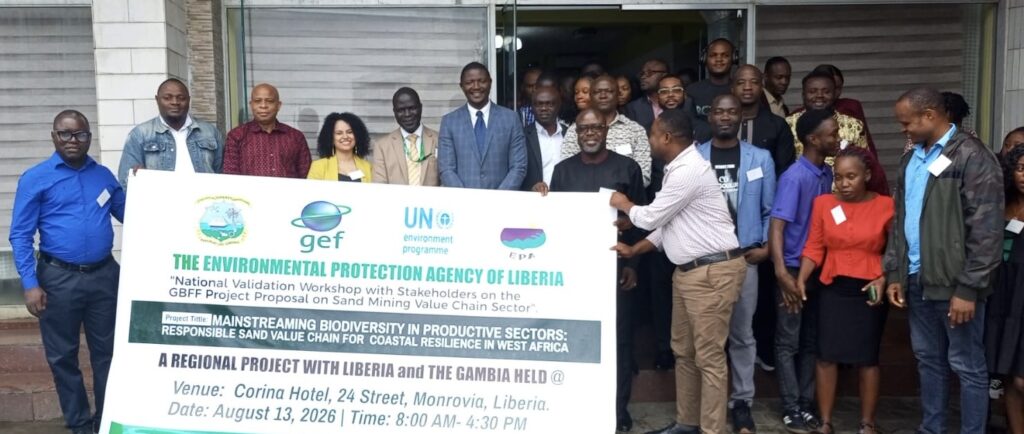
The Environmental Protection Agency (EPA) has convened a national validation workshop to review and secure stakeholder endorsement for a proposed project aimed at promoting responsible sand mining, protecting biodiversity, and strengthening coastal resilience in Liberia.
The workshop, held under the project titled “Mainstreaming Biodiversity in Productive Sectors: Responsible Sand Value Chain for Coastal Resilience in West Africa,” brought together representatives from government ministries and agencies, development partners, civil society, academia, the private sector, local communities, and the media.
The initiative is being developed through a partnership involving the United Nations Environment Programme (UNEP), the EPA of Liberia, and the National Environment Agency of The Gambia, with support under the Global Biodiversity Framework Fund of the Global Environment Facility (GEF).
Speaking at the opening of the workshop, EPA Executive Director Dr. Emmanuel Urey Yarkpawolo stressed the need for stronger environmental safeguards in the management and extraction of sand resources.
He said the initiative goes beyond environmental protection, noting that it seeks to support Liberia’s development while safeguarding natural resources and ecosystems. The EPA also acknowledged the contributions of UNDP, the Government of Liberia, GEF, national institutions, consultants, private-sector actors, and civil society organizations.
According to the EPA, uncontrolled sand extraction can contribute to coastal erosion, ecosystem degradation, pollution, and the loss of critical habitats. The agency said weak monitoring, fragmented institutional responsibilities, and inadequate regulation have contributed to harmful practices within the sector.
Assistant Minister for Planning at the Ministry of Mines and Energy, Emmanuel Vaye, described sand as more than a construction material, calling it a strategic resource that supports infrastructure and national development.
He warned, however, that unsustainable extraction could accelerate coastal erosion, damage ecosystems, and create other environmental challenges. He urged stakeholders to use the validation workshop to provide constructive input and ensure that the proposed project responds to Liberia’s development and environmental priorities.
The Assistant Minister said the Ministry of Mines and Energy remains committed to working with the EPA and other stakeholders throughout the project development process, particularly in strengthening data, planning, regulatory oversight, enforcement, and institutional coordination.
Providing an overview of the project, Klubosumo Johnson Borh, Director of Projects at the EPA, said the workshop represents the final stage of the national consultation process before the full proposal is submitted to the Global Environment Facility for review and approval.
He said the consultation is intended to validate the project’s proposed interventions, results framework, indicators, implementation strategy, and institutional arrangements, while ensuring that recommendations from previous stakeholder consultations are incorporated into the final proposal.
Borh emphasized that sustainable sand management requires an integrated approach combining biodiversity conservation, policy reform, improved governance, market transformation, scientific knowledge, and sustainable livelihood opportunities. He also called on stakeholders to provide practical and technical recommendations.
For his part, Emmanuel Massaquoi, UNDP Project Manager, described the proposed project as timely, citing growing threats to Liberia’s coastal and biodiversity ecosystems from environmental pressures, resource use, and climate change.
He said UNDP supports integrated solutions that combine biodiversity conservation, sustainable economic opportunities, and responsible management of sand resources to strengthen ecosystems and climate resilience.
The project is also expected to promote sustainable alternatives and opportunities for women, youth, and vulnerable communities, while strengthening scientific capacity and evidence-based policymaking.
The EPA said successful implementation will depend on continued collaboration among government institutions, development partners, the private sector, civil society, and communities. The national validation process is expected to strengthen national ownership of the proposal and pave the way for its submission to the GEF, with the broader goal of ensuring responsible sand resource management, biodiversity protection, and more resilient coastal communities in Liberia.