

-Unity Party Ally Warns As LNP Summons Sen. Amara Konneh
By Jerromie S. Walters
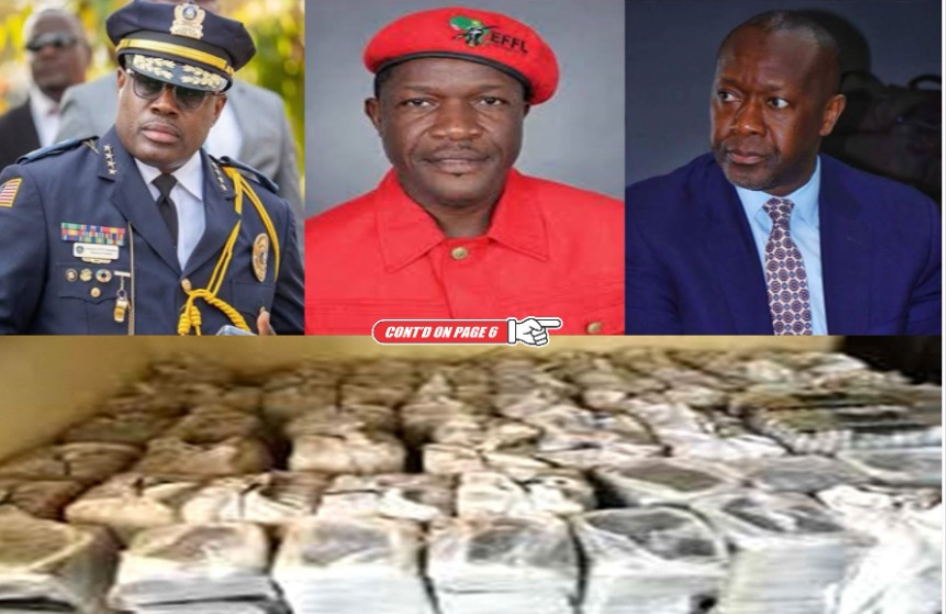
Monrovia, Liberia – Emmanuel D. Gonquoi, President and Commander-in-Chief (CIC) of the Economic Freedom Fighters of Liberia (EFFL), has alarmed over what he describes as a looming “political calamity” within the ruling Unity Party (UP) Alliance, following the disclosure that the Liberia National Police formally summoned Gbarpolu County Senator Amara Konneh to provide evidence supporting his public statements regarding the ongoing cocaine investigations.
Gonquoi disseminated the warning in a Facebook post on Tuesday, August 18, 2026. “Your destroying President Boakai Government gradually with attacks on people like Senator Konneh,” Gonquoi wrote. “This lack of political leadership and maturity is fast-growing, and I don’t think this is what we voted for. Call for stakeholders’ meeting as UP Alliance now and prevent the political calamity looming.”
The EFFL leader’s intervention comes at a critical juncture for the ruling coalition, which has been grappling with internal tensions since Senator Konneh publicly accused the government of shielding senior officials implicated in the country’s record-breaking cocaine trafficking networks.
The immediate trigger for Gonquoi’s warning was the formal letter sent to Senator Konneh by Liberia Police Inspector General Gregory O.W. Coleman, demanding that he provide concrete evidence to support his public statements regarding the ongoing cocaine investigations.
On Tuesday, Senator Konneh confirmed receipt of the Police IG’s request and stated that the Senate Committee on Security has reviewed it and turned the matter over to his legal team to coordinate a formal response.
“I can confirm that I received a letter from the IG of LNP requesting evidence of my public statements about the cocaine case,” Konneh wrote via his official Facebook page. “The Senate Committee on Security has reviewed it & I’ve asked my lawyers to acknowledge receipt to the IG.”
Coleman’s Statement on Public Duty
Inspector General Coleman had earlier taken to Facebook on Monday to issue a detailed statement titled “When Public Commentary Becomes a Public Duty,” in which he outlined the distinction between legitimate oversight and allegations of criminal wrongdoing.
“There is a fundamental difference between raising questions and claiming that state institutions are protecting a drug cartel,” Coleman wrote. “The first is legitimate oversight. The second is an allegation of serious criminal wrongdoing that must be supported by evidence.”
Coleman further emphasized that when such a claim comes from a sitting senator, it carries greater weight and creates a corresponding responsibility. He argued that if Senator Konneh possesses credible information, he should place it before the appropriate authorities so that it can be tested, investigated, and, where justified, prosecuted.
The Police IG also addressed what he described as matters of public service ethics. “Duty requires officials to report wrongdoing. Good judgment requires them to consider whether public disclosures could alert suspects, compromise witnesses, expose sources, or disrupt an active investigation,” Coleman wrote. “Integrity requires courage to produce facts, not merely suspicions. Fairness requires that no one, senior or junior, be condemned without evidence and due process.”
Coleman warned that serious accusations made without supporting facts can prejudice investigations, damage innocent people, and ultimately help the criminal networks that authorities are seeking to dismantle.
Senator Konneh’s Accusations
Senator Konneh has been locked in a heated political exchange with senior Liberian government officials over the administration’s handling of the anti-drug campaign and high-profile cocaine investigations. He has accused President Joseph Boakai’s administration of selective justice, administrative failure, and protecting what he has described as a “cartel” operating within the security sector.
Konneh publicly condemned the government for punishing junior security officers while shielding senior officials suspected of involvement in large-scale illicit drug trafficking. He argued that quiet suspensions and administrative sackings within the Liberia Drug Enforcement Agency (LDEA) reduce the administration’s “Kush Must Go” campaign to a mere slogan.
The Gbarpolu County Senator criticized the repeated dismissals of LDEA officials within 18 months, calling the leadership situation a “mess” driven by strategic retreats, political interference, and cartel infiltration. He has called for President Boakai to personally take control of the LDEA, establish a non-political vetting system, and appoint an independent counsel to work with foreign investigators.
Following Konneh’s public declarations that the security sector has been compromised by drug cartels, the government took formal steps to challenge his claims, culminating in Inspector General Coleman’s formal letter demanding evidence.
Mo Ali Challenges Senator Konneh
The public exchanges drew in other senior officials, including Mo Ali, the Managing Director of the Liberia Water & Sewer Corporation (LWSC), who accused Senator Amara Konneh of double standards and political theatrics. In a Facebook post, Ali wrote: “Senator, I have never before responded to your posts beyond friendly remarks. However, your continual insinuations and innuendos surrounding the recent cocaine bust compel a response.”
Ali directly challenged Konneh’s allegation that the government is sacrificing “small officers” to shield “high-ranking officials.” He argued that to make such an allegation implies possessing compelling evidence sufficient to indict those officials, yet Konneh has chosen to withhold such evidence from law enforcement.
Ali further noted that Senator Konneh studied and lived in the United States, where it is well known that both junior and senior officers can be compromised by cartels. “But in every case, charges are brought only when evidence exists,” Ali wrote. “No one is indicted on insinuation alone. To claim otherwise in Liberia while applying a different standard abroad is the very definition of DOUBLE STANDARD.”
On the issue of government criticism, Ali argued that Konneh’s claim that the government is silencing critics collapses under its own weight. “Since the bust, you, Senator Edwin Snowe, Rodney Sieh, and CDC partisans have been the loudest voices across social media, radio, and television,” Ali wrote. “You have published countless articles without restriction. The truth is not that you are silenced, it is that you dislike being challenged when your insinuations lack facts.”
Ali also addressed what he called the “danger” of Konneh’s rhetoric, pointing out that FBI agents, American DEA experts, Homeland Security officers, and investigators from Morocco and the Netherlands are actively engaged in the case. “To ignore these facts and accuse government of dismissal is again DOUBLE STANDARD, revealing your intent to politicize rather than solve the problem,” he wrote.
Meanwhile, Sam Gaye, Head of the Executive Protection Service (EPS), also weighed in on the debate, siding with Ali and defending the integrity of the security forces. “I agree with Mo Ali,” Gaye said. “It is utterly disingenuous to suggest that the entire joint security is compromised. Like Mo rightly said, rogue officers fighting the drug war in the United States get compromised; they get caught and prosecuted. I worked with quite a few of them who are currently in jail for various narcotic-related offenses.”
Gaye noted that the United States is not winning the war on drugs, describing it as “a very difficult societal problem.” He concluded: “There is no time for empty-barrel political grandstanding.” Before his direct response to Senator Konneh, Ali had issued a statement calling on the Senate to formally invite Konneh to explain his allegations. In a Facebook post, Ali wrote: “There comes a point when political criticism must give way to institutional responsibility.”
Ali argued that Senator Konneh’s allegation that “small officers are sacrificed to create a false media spectacle, while the true architects walk free” is not an ordinary political statement but a serious allegation concerning an ongoing national-security investigation.
“Because it comes from a sitting Senator, the Senate has every legitimate reason to ask one simple question: What do you know?” Ali wrote. “That is not intimidation, a witch hunt, or partisan retaliation. It is accountability.”
Ali emphasized that if Senator Konneh’s statement is based on credible information, that information should be provided to the appropriate authorities. “If he has names, let the investigators have them. If he has documents, let them be examined. If he has witnesses, let them be interviewed,” Ali stated.
He warned that the Senate should not ignore such a serious allegation simply because it was made by one of its own. “Doing so could set a dangerous precedent in which public officials make consequential claims about national security matters without being required to substantiate them,” Ali wrote.
Ali concluded: “Senator Konneh has told the country what he believes. Now, given the seriousness of his allegations, the appropriate institutions should ask him what he knows.”
The Unity Party Alliance
The Unity Party Alliance that drove President Joseph Nyuma Boakai’s “Rescue Mission” campaign is anchored by a core ticket partnership with Jeremiah Kpan Koung of the Movement for Democracy and Reconstruction (MDR). Crucial political backing also came from the EFFL and a fraction of the Liberty Party (LP) and key opposition figures ahead of the decisive runoff in the 2023 Liberian general election. Senator Amara Konneh was among several other individuals who were hailed for protecting the Alliance’s votes during the elections.
The political crisis has been triggered by two massive cocaine seizures. In June 2026, authorities intercepted roughly 238 kilograms of cocaine valued at $19 million hidden inside commercial cargo, including seasoning cubes, at Roberts International Airport. In July 2026, security forces seized nearly 4 metric tons of cocaine worth approximately $317 million along the airport highway in Duazon.
This operation marked the largest drug bust in Liberia’s history. Law enforcement publicly burned approximately 4.2 metric tons of the recovered cocaine in a dramatic display of the government’s commitment to the anti-drug campaign.
In response to the record-breaking seizures, President Joseph Boakai dismissed approximately 12 government and law enforcement officials, including the airport’s deputy director for operations, the police criminal intelligence chief, and National Security Agency (NSA) deputy directors, for administrative negligence or direct indictment.
The President removed the former LDEA heads and nominated retired Major General Daniel Dee Ziankahn, a former Defense Minister and Chief of Staff, as the new Director General of the Liberia Drug Enforcement Agency to overhaul anti-narcotics enforcement. Indicted individuals and specific lower-level security employees were handed over to the Ministry of Justice for criminal prosecution.
Despite these actions, Senator Konneh has remained highly critical of the government’s approach. He has argued that the dismissals and prosecutions have disproportionately targeted lower-level officials while senior figures remain untouched.
Konneh has warned that the government’s handling of the investigation risks undermining public confidence in the fight against drug trafficking. He has called for the appointment of an independent counsel to work with foreign investigators, arguing that the current investigation lacks the credibility needed to root out the drug cartels operating within Liberia.
Following Senator Konneh’s disclosure of the LNP communication, River Gee County Senator Francis Saidy Dopoh II acknowledged the shared concern about drug cartels threatening the country while urging a more strategic approach to the investigation.
“As a member of the Senate Security Committee, your alarm about drug cartels threatening our country is one I share, and I respect your push for accountability,” Dopoh wrote. “But as a colleague, I want our efforts to end in convictions, not unintended setbacks.”
Dopoh warned that making hyperbolic statements about the courts or debating investigative details in public risks handing defense lawyers exactly the ammunition they need to claim political bias and get cases thrown out. He also cautioned that such public commentary risks pushing the Executive into a defensive corner instead of drawing them into cooperation.
The River Gee County Senator proposed refining the approach by closing legal loopholes in drug laws that defense teams exploit, pushing for formal committee briefings with security chiefs under oath, and keeping public commentary strictly procedural. “That way we protect our constitutional oversight, keep the moral high ground, and make sure the state actually wins in court,” Dopoh wrote.
Dopoh offered a historical perspective on the Executive’s apparent hesitation, suggesting that it may not necessarily indicate a cover-up but could be driven by the trauma of 2023, when rushing to court ended in an acquittal that made the country an international laughingstock. “If we push them to act prematurely in public, we risk repeating that exact disaster,” he warned.
Instead of demanding immediate public declarations, Dopoh urged using oversight to ensure that an airtight, legally bulletproof case is being built behind closed doors. “This is exactly what the security team conveyed during the public hearing at the Liberian Senate,” he noted.
Dopoh also reminded Senator Konneh of a significant precedent: under the very government Konneh served as Minister, those arrested in the Fumba-led drug bust did face a judge in the United States and were sentenced. “The process works when we let it run its course,” Dopoh concluded.