


By Jessica Cox
The Government of Liberia says the country recorded progress in economic growth, electricity access, infrastructure, education and health during the first phase of its National Development Plan, while acknowledging that unemployment and several gaps in rural services remain unresolved.
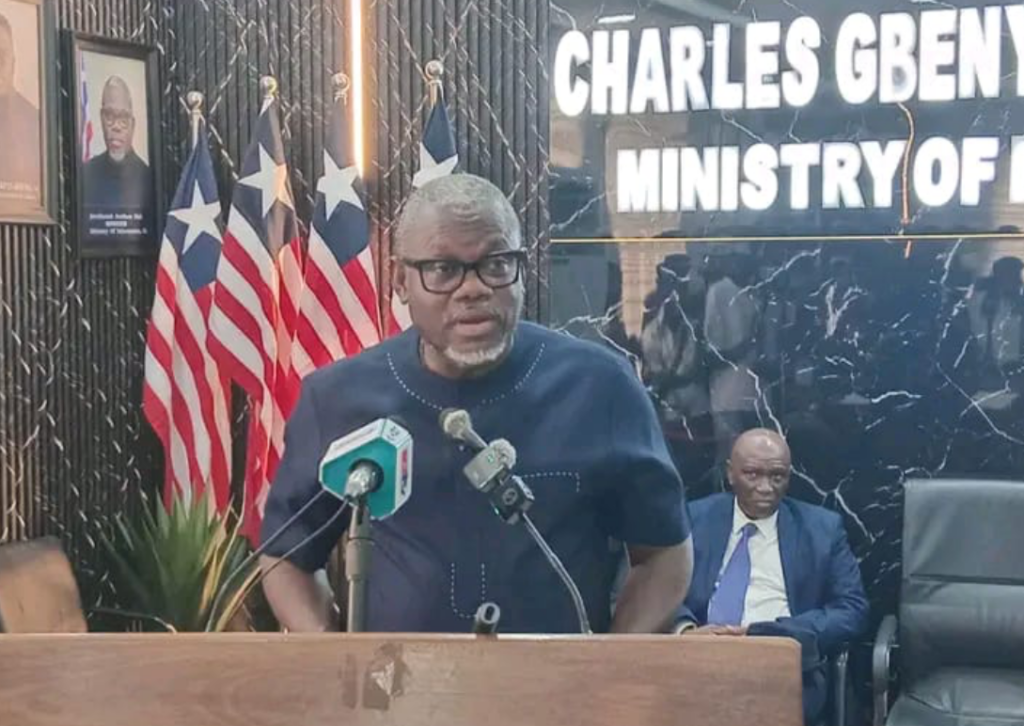
Information Minister Jerolinmek M. Piah made the disclosure Tuesday during the Ministry of Information’s regular press conference, presenting a summary of outcomes under the government’s ARREST Agenda for Inclusive Development, Liberia’s five-year national development plan for 2025–2029. The plan focuses on economic transformation, infrastructure, rule of law, governance, environmental sustainability and human capital development.
Piah said Liberia’s economic growth increased from 4.0 percent in 2024 to 5.1 percent in 2025, with growth projected at 5.5 percent in 2026.
The World Bank also reports that Liberia’s economy expanded by 5.1 percent in 2025, driven largely by a strong rebound in mining and continued gains in services and agriculture.
The minister further reported that inflation declined from 12.8 percent to 4.0 percent by the end of 2025.
Domestic revenue collection, he said, amounted to US$761.1 million, with the government projecting collection of approximately US$1.18 billion by the end of 2026.
Despite the reported economic growth, Piah acknowledged that unemployment remains a major challenge.
He said more than 6,000 permanent jobs and over 70,000 short- to medium-term jobs were created during the period under review.
However, the government acknowledged that short-term employment continues to dominate the labor market, while permanent jobs remain limited.
Piah also said broader economic diversification beyond agriculture and small and medium-sized enterprises remains at an early stage.
The challenge is significant because the ARREST Agenda identifies job creation, economic diversification and private-sector development as central objectives of the government’s five-year development strategy.
The government also reported an increase in electricity access, from 32 percent in 2022 to 38 percent in 2025 and 39 percent as of June 30, 2026.
Piah described the increase as significant, citing communities that had recently gained access to electricity after years without service.
The World Bank has similarly identified expanding electricity access and improving infrastructure as important components of Liberia’s development efforts.
On roads, Piah said 141.1 kilometers had been paved or rehabilitated, while 256.41 kilometers of secondary roads had been maintained.
He added that 336.24 kilometers of urban and community roads had been rehabilitated or maintained.
The government also procured 204 yellow machines in 2025, which Piah said are now being deployed for road works across the country.
While highlighting infrastructure progress, Piah acknowledged that some rural services remain inadequate.
He said rural electrification remains limited, while rural connectivity gaps persist.
The minister also reported operational challenges affecting rural water supply and said rural banking remains limited.
Agricultural mechanization is another area where implementation remains incomplete. Piah said most of the agricultural mechanization hubs are still under construction and will need to be accelerated.
The government also acknowledged that the National Rural Authority has not yet been established.
These shortcomings stand alongside the government’s reported agricultural gains, including increased agricultural production, farmer subsidies and the construction of mechanization hubs.
Piah said access to safe drinking water increased from 77 percent to 78.8 percent, reaching approximately 4.4 million people in 2025.
Water production reportedly increased from 700 million gallons to 846 million gallons.
In education, the government reported the recruitment and employment of 2,193 volunteer teachers, while 2,349 teachers, 6,051 school leaders and 68 education officers were trained.
More than 105,000 students were reportedly screened, with 1,351 eyeglasses distributed.
In the health sector, the government said medicine stock-outs had been reduced by 80 percent, while the availability of essential health products increased from 40 percent to 90 percent.
However, Piah acknowledged that capacity constraints at some health facilities mean patients are still sometimes turned away.
The development review therefore presents a mixed picture of Liberia’s progress under the ARREST Agenda.
The government is pointing to stronger economic growth, increased electricity access, road rehabilitation and improvements in some education and health indicators.
At the same time, it acknowledges that unemployment, permanent job creation, rural electrification, rural connectivity, rural banking, agricultural mechanization and housing investment remain unfinished areas of the development program.
The ARREST Agenda was launched in January 2025 as Liberia’s national development blueprint for 2025–2029, with the government targeting inclusive growth, stronger public services and improvements in human capital and infrastructure.
The latest review places emphasis not only on what the government says it has achieved, but also on what remains to be delivered.
For millions of Liberians, particularly those outside major urban centers, the effectiveness of the plan will ultimately be measured by whether improvements in national economic indicators translate into reliable electricity, roads, water, jobs, financial services and other basic services in their communities.


