By: Jessica Cox
MONROVIA, The Liberia Scout Association and Alpha Phi Alpha Fraternity, Inc. have called on young Liberians to take an active role in confronting drug abuse, unemployment and economic inequality, warning that the challenges threaten social stability and the country’s future.
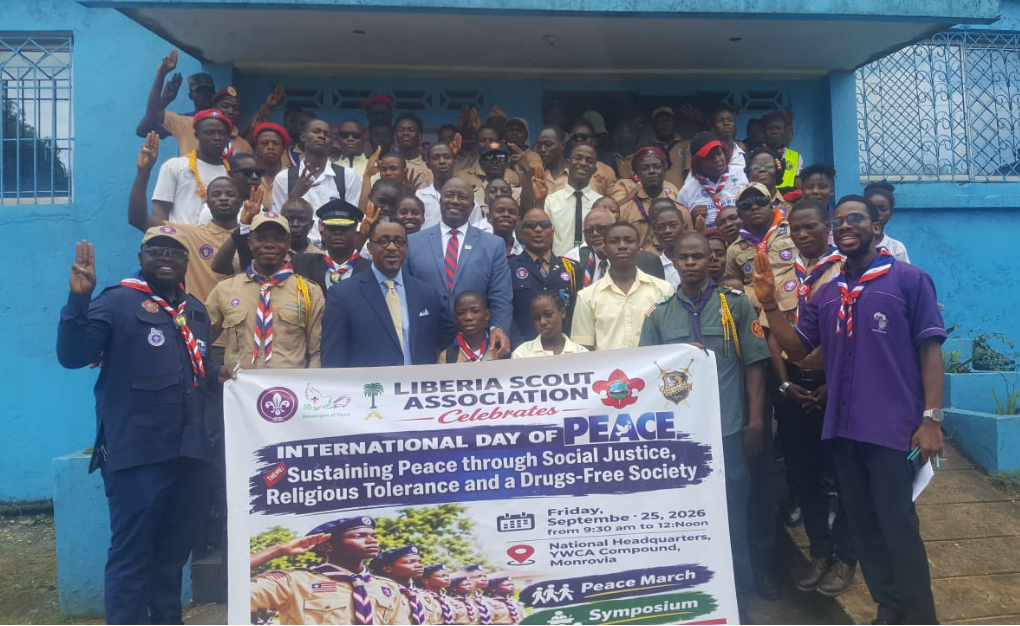
The call was made during observance of the International Day of Peace in Liberia under the theme, “Sustaining Peace Through Social Justice, Religious Tolerance and a Drug-Free Society.” The program was organized by the Liberia Scout Association in collaboration with Alpha Phi Alpha Fraternity, Inc., Liberia, with support from the Africa Support Center and the World Scout Bureau’s Messenger of Peace Project.
Speaking at the gathering, Hon. Michael Watterson, a member of Alpha Phi Alpha Fraternity, linked economic hardship and unemployment to social unrest, arguing that young people who lack opportunities can become vulnerable to crime, drug trafficking and conflict.
Watterson said economic inequality can create frustration when young people struggle to meet basic needs while observing others enjoying significantly greater economic opportunities. He referenced Liberia’s history of social unrest, including the 1979 rice riots and other periods of political and social tension, as examples of how economic grievances can contribute to instability.
According to Watterson, the challenge facing Liberia is therefore not only about employment but also about ensuring that young people have meaningful opportunities to participate in the economy. He urged members of the Scout Association to distinguish themselves through discipline, education and responsible leadership.
“You have a responsibility to remain focused and disciplined,” Watterson told the young people, urging them to study and understand the issues affecting the country. Watterson proposed the establishment of a national Liberian youth service corps through which young people could be mobilized to serve communities while gaining practical work experience.
He pointed to the United States Peace Corps and Nigeria’s National Youth Service Corps as examples of programs that engage young people in national and community service.
Under his proposed Liberian model, young people could be deployed to communities across the country to assist with development activities while receiving financial support.
He said such a program could help address unemployment while channeling the energy of young Liberians toward productive activities.
Watterson also urged young people to communicate policy proposals to government through organized and disciplined engagement rather than relying solely on street protests.
He said the Liberia Scout Association, because of its emphasis on discipline and service, could help lead discussions on policies that would benefit young people beyond the organization itself. Skills Training, Concession Jobs
The Alpha Phi Alpha speaker also called for greater investment in vocational and technical education.
He recalled Liberia’s former Opportunities Industrialization Centers (OIC), which provided young people with practical skills such as electrical work, plumbing and masonry.
Watterson proposed that the government consider requiring concessions and foreign investors operating in Liberia to contribute to the rehabilitation of vocational training centers and employ a percentage of Liberians in skilled and unskilled positions.
He argued that market-oriented skills could provide young people with alternatives to unemployment and criminal activity.
He specifically pointed to the large number of construction and development projects in Liberia, questioning why more Liberians could not be trained and employed to perform jobs currently being carried out by foreign workers.
The discussion also focused heavily on Liberia’s growing substance-abuse problem.
Hon. Nelson Williams II, Executive Director of Alpha Phi Alpha Fraternity, Inc., said the country’s drug challenge requires a comprehensive response involving government, communities, families, schools, religious institutions, businesses and the security sector.
Williams identified youth unemployment and poverty, school dropouts, limited educational opportunities, broken family structures, peer pressure, social isolation, trauma, inadequate youth programs, easy access to illicit drugs, cross-border trafficking and limited rehabilitation services among factors contributing to the crisis.
Liberia declared drug abuse and substance use a public health emergency in 2024 amid growing concern over the impact of illicit drugs, particularly on young people.
Williams also pointed to recent major cocaine seizures as evidence of the scale of Liberia’s trafficking problem.
Authorities seized approximately 237 kilograms of cocaine at Roberts International Airport in June 2026, while another major seizure in Duazon, Margibi County, in July involved approximately 3,971 kilograms of suspected cocaine, according to authorities.
Williams said Liberia’s response must therefore address both the supply of drugs and the vulnerability of people who become involved in their use or distribution.
Community Action Urged
Williams urged communities to identify drug-use hotspots, vulnerable young people and available treatment facilities.
He also called for mechanisms through which citizens could safely report drug-related activities and seek assistance.
He emphasized that anti-drug programs should be measured by results rather than simply by the number of activities conducted.
Among the indicators he suggested were drug prevalence, drug-use hotspots, trafficking arrests, successful prosecutions, seizures, confiscation of criminal assets, treatment and rehabilitation completion, relapse rates, school retention and employment after rehabilitation.
Williams cited an outreach activity in Kakata in 2025, when members of Alpha Phi Alpha visited a drug-affected community, provided food, counselled residents and encouraged them to seek help.
He said three people subsequently left the area and entered rehabilitation and support programs, with one later securing employment.
“We cannot give up on our young people. We need to go where they are,” Williams said.
Williams also called on Liberia’s private sector to participate more actively in addressing substance abuse.
He said businesses would ultimately be affected if the country fails to address the drug crisis and urged companies and business associations to support prevention and rehabilitation initiatives.
He proposed that businesses help create employment opportunities for people who have completed rehabilitation and are ready to return to productive lives.
Williams further called for expanded technical and vocational training, saying Liberia needs skilled workers including plumbers, electricians and other technicians.
Parents, Communities Have Role
The Alpha Phi Alpha executive director also appealed to parents to devote more time to their children despite demanding work schedules.
He said children learn from their parents first and urged families to provide guidance, protection and supervision.
For Williams, responsibility for young people extends beyond biological families.
He described fatherhood and community leadership as responsibilities that should extend to vulnerable young people across society.
He recounted how he funded the construction of a water well in a community after noticing a young girl repeatedly walking a long distance to fetch water.
According to Williams, the experience demonstrated how individual acts of community responsibility can address problems that might otherwise contribute to vulnerability and hardship.
Scouts Commit to Partnership
The Liberia Scout Association also pledged to strengthen collaboration with Alpha Phi Alpha and other organizations working with young people.
Chief Willis Allen Scott, identified as President and Arrowhead of the Liberia Scout Association, said the Association was prepared to work with Alpha Phi Alpha on programs targeting youth development and substance abuse.
He announced plans for a formal partnership, including discussions around a memorandum of understanding between the two organizations.
Scott also disclosed that the Scout Association was working toward establishing a vocational training program for young people who may have passed the traditional age for returning to formal education.
He said the program could provide practical training in areas such as plumbing and electrical work.
According to Scott, young people must be empowered to use their “hands, head and heart” to contribute to Liberia’s development.
Scott said maintaining peace in Liberia requires collective responsibility and cannot be left to government alone.
He urged young people to recognize their role in preserving the peace the country currently enjoys and to avoid being used solely to advance political interests.
Williams similarly referenced Liberia’s experience during the Ebola crisis, when communities, churches, businesses, traditional leaders, youth organizations and other groups joined efforts to contain the disease.
He said the same spirit of collective action could be applied to the country’s drug crisis.
“Government cannot do it alone,” Williams said, calling for cooperation among public institutions, private businesses, communities and families.
The speakers ultimately called for a national response centered on prevention, protection, treatment, rehabilitation, reintegration and prosecution.
Williams said Liberia has overcome major challenges, including civil wars, Ebola and COVID-19, and can confront the substance-abuse crisis through collective action.
He urged Liberians to protect their communities, strengthen institutions, support families and hold drug traffickers accountable while providing young people with alternatives to substance abuse.
“We must give our young people something more powerful than drugs — hope for the future, opportunities for the future, a purpose-driven life,” Williams said. He concluded with a call for immediate action, stressing that the responsibility to address Liberia’s drug crisis and economic challenges cannot be postponed.