

-At the United Nations (UN)
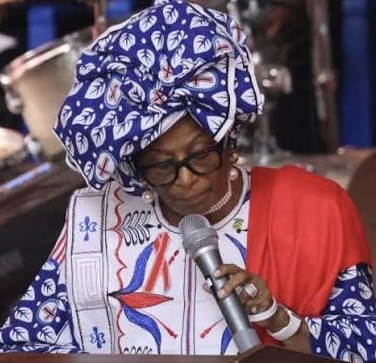
UNITED NATIONS — Cllr. Dr. Yvette Chesson-Gibson, Initiator of the Women’s Situation Room and Executive Director of the Angie Brooks International Centre (ABIC), has declared that peace must be deliberately built and sustained through inclusive leadership and timely intervention. She spoke at the United Nations on September 21, 2026.
In her address before an audience that included President Joseph Nyuma Boakai, Foreign Minister Sara Beysolow Nyanti, Gender Minister Gbeme Horace-Kollie, and other dignitaries, Chesson-Gibson challenged the global community to recognize women not merely as victims of conflict, but as essential leaders in preventing it.
“Peace does not happen by accident. It must be deliberately built, protected, and sustained,” she stated. “Just as violence is produced through human action, preventing violence also requires action: early warning, timely intervention, inclusive leadership, and the courage to address tensions before they become crises.”
Cllr. Chesson-Gibson presented the Women’s Situation Room as a dynamic, women-led mechanism that places women at the center of peacebuilding, civic engagement, and democratic governance. Initiated by ABIC, the mechanism is recognized as one of Africa’s most inclusive peace tools and serves as the practical actualization of United Nations Security Council Resolution 1325.
The Situation Room brings together a diverse coalition of women—from street sellers and farmers to university students and national leaders—to prevent electoral violence. At its core are the “Eminent Women,” influential leaders who engage the President, Legislature, Judiciary, security sector, media, and National Elections Commission to secure timely interventions when dangerous incidents occur.
“Young people are essential to this mechanism,” Chesson-Gibson noted, explaining that the initiative engages disadvantaged youth from vulnerable communities who are often targeted by politicians to instigate violence. “We train these young people in peacebuilding, mediation, civic responsibility, and nonviolence. They learn that their energy should be used to protect their homeland, not to destroy it.”
The Women’s Situation Room operates before, during, and after elections. Before elections, the “Talking Bus” travels into communities to establish temporary radio stations, empowering residents to identify issues they want candidates to address. During elections, an all-female team of observers, monitors, and call-center operators work together to identify risks and respond to incidents. After elections, the mechanism reduces tensions, promotes lawful dispute resolution, and supports reconciliation.
“It is a dynamic peace mechanism that requires physical intervention whenever necessary,” Chesson-Gibson said. “It is adapted to each country’s circumstances because the women of that country decide how their Situation Room should operate.”
The Women’s Situation Room has been implemented in Liberia, Senegal, Kenya, Sierra Leone, Ghana, Nigeria, Uganda, and other African countries. It has received recognition from the United Nations Security Council as a women-led mechanism that has helped prevent the eruption and escalation of electoral violence, and from the African Union as an important African mechanism for promoting peaceful elections.
Cllr. Chesson-Gibson expressed profound gratitude to Her Excellency Ellen Johnson Sirleaf, former President of Liberia, who serves as the Champion of the Women’s Situation Room, and to President Joseph Nyuma Boakai, who has supported the initiative since its founding.
She also thanked partners including the United Nations Development Programme, the United Nations Peacebuilding Fund, UNITAR, Sweden, Ireland, the African Women’s Development Fund, the United States Embassy, the Urgent Action Fund, and the European Union.
Cllr. Chesson-Gibson emphasized that the legacy of the Women’s Situation Room is the power of inclusion. “It brings together the farmer and the professional, the street seller and the university student, the disadvantaged youth and the national leader. Each has a role. Each has a voice. Each has a responsibility to protect the peace.”
She concluded with a powerful call to action: “Peace does not sustain itself. It survives because people choose dialogue over confrontation, mediation over violence, and collective responsibility over indifference. Women, unite to lift Africa and lift the world. THE PEACE IS IN OUR HANDS and sustaining it requires action from us all.”