

–Targets Smuggling and Trafficking
By: G Bennie Bravo Johnson
The International Organization for Migration (IOM) has strengthened Liberia’s border security capacity through an Integrated Border Management training program for security officers in Grand Cape Mount and Gbarpolu Counties.
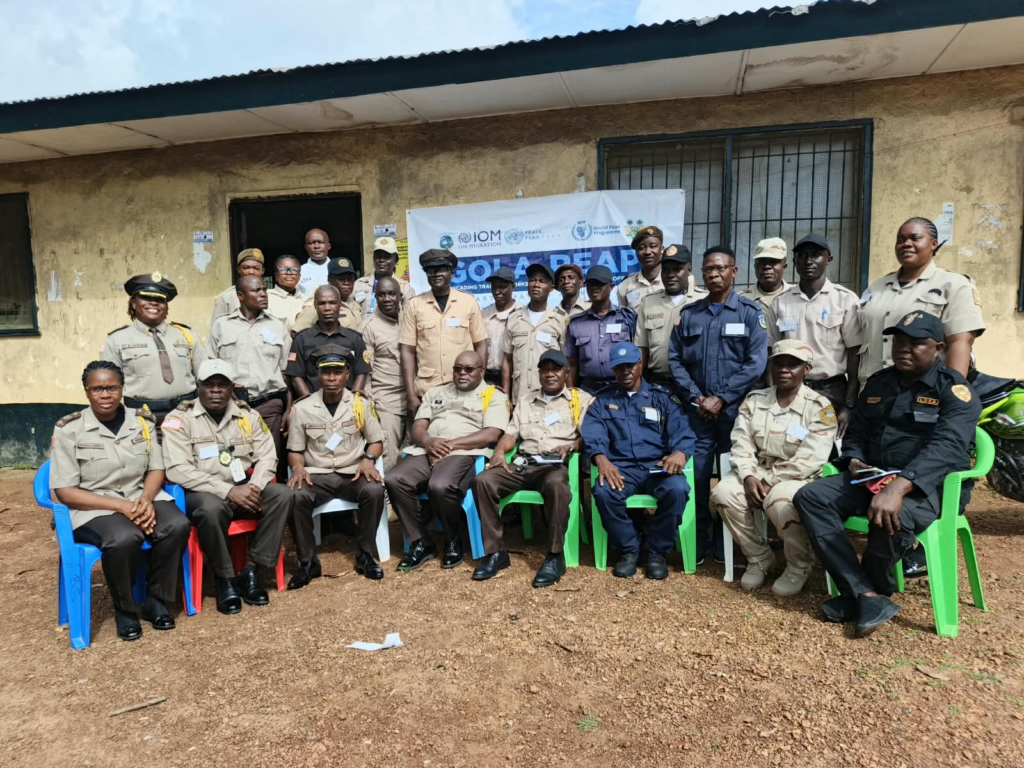
The five-day training sessions, organized by the International Organization for Migration (IOM) in partnership with the Office of the United Nations High Commissioner for Human Rights (OHCHR), Liberia Peacebuilding Office, and the Training Department of the Liberia Immigration Service (LIS), brought together about 40 officers from the LIS, Liberia National Police (LNP), and Liberia Drug Enforcement Agency (LDEA).
The first phase was held in Tiennie, Grand Cape Mount County, from September 21 to 25, 2026, while the second phase took place in Bopolu City, Gbarpolu County, from September 28 to October 2.
The officers represented official border crossing points and major checkpoints across the two counties, where they were trained to improve coordination, information-sharing and joint responses to emerging migration and security challenges.
The training formed part of the GOLA-REAP — Resilience, Empowerment, Access and Peacebuilding — project, a cross-border initiative jointly implemented by IOM and the World Food Programme with funding from the United Nations Peacebuilding Fund.
A major focus of the training was improving the ability of border officers to identify and respond to cases involving trafficking in persons and migrant smuggling while ensuring that border operations respect the rights and protection needs of vulnerable migrants.
Participants received practical training in interviewing, screening, communication and referral procedures, while also examining ways to improve inter-agency cooperation, cross-border coordination and migration governance.
The sessions further emphasized human rights-based border management, social cohesion and peacebuilding, recognizing the role of effective border governance in maintaining security and peaceful relations among communities along the Liberia-Sierra Leone border corridor.
Speaking during the opening of the training in Tiennie, the Director of Training and Manpower Development at the Liberia Immigration Service, Osborne Tate, welcomed the initiative and thanked IOM and the United Nations Peacebuilding Fund for supporting the capacity-building effort.
Tate stressed the importance of strengthening officers’ understanding of Integrated Border Management and urged participants to transfer the knowledge gained to colleagues at their respective duty stations.
For the Liberia Drug Enforcement Agency, the training also offered an opportunity to improve frontline responses to criminal activities along border communities.
Charles Cummings, Commander of the LDEA in Porkpa District, said the knowledge acquired would strengthen officers’ operational effectiveness and improve their ability to serve travelers and border communities while contributing to efforts to prevent and combat crime.
Participants similarly described the training as an important professional development opportunity.
Catherine Maneh, an LIS officer assigned to the Gbarma Checkpoint in Gbarpolu County, and Jackson Toe, an LNP Commander assigned to Kongbor Town in Kungba District, said the sessions expanded their understanding of border management and professional conduct.
They said the practical lessons would help officers better manage border crossings and checkpoints and carry out their responsibilities more effectively.
Closing the training in Bopolu City, IOM GOLA-REAP Project Focal Person Tamba Siaffa commended the participants for their commitment and active participation throughout the workshop.
Siaffa also praised the facilitators for their professionalism and encouraged the officers to put the knowledge acquired into practice and share it with colleagues within their institutions and at their respective duty stations.
The initiative comes as Liberia continues efforts to strengthen security and governance along its borders, where effective coordination among immigration, police and drug enforcement authorities remains critical to addressing cross-border crime, irregular migration, trafficking and other emerging threats.
Through the GOLA-REAP Project, the training seeks to leave border institutions with stronger coordination mechanisms and better-equipped personnel capable of responding to security and migration challenges while protecting the rights of people crossing Liberia’s borders.