–Visually Impaired AMEU Graduand Inspires Persons with Disabilities
By Jerromie S. Walters
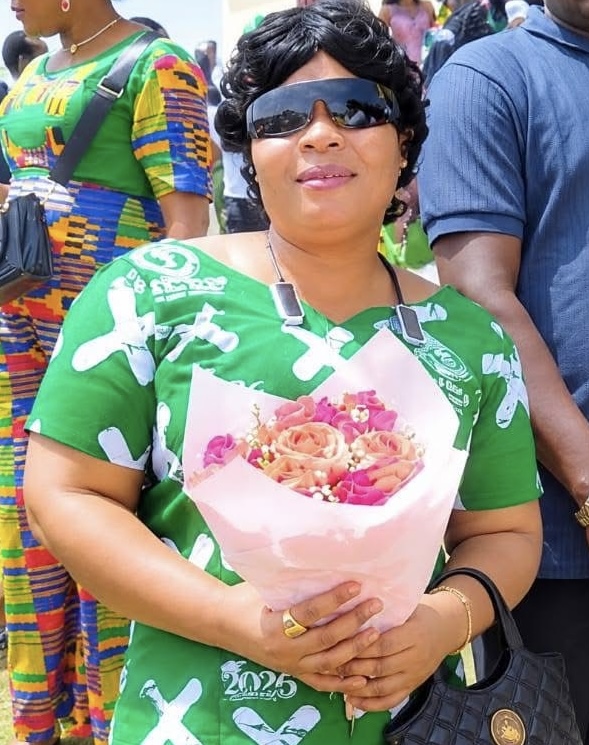
Monrovia: Chris M. Torbor, a visually impaired student, graduates today with a Bachelor of Arts in Primary Education from the African Methodist Episcopal University (AMEU), urging persons with disabilities to have confidence in themselves and trust in God. “In all you do, give it to God. Trust in God and secondly have confidence in yourself,” Chris tells this paper in an interview on Tuesday, November 10, 2026.
The AME University holds its 26th Commencement Convocation today, November 11, 2026, at its Royesville Campus in Montserrado County, conferring degrees on approximately 1,200 candidates across its undergraduate colleges and graduate programs. Torbor said walking out of AMEU had been one of her biggest dreams, but the dream met a serious financial challenge at the initial stage.
She recalled doubting whether she could pay for credits or find a scholarship at the expensive institution. “Walking out of AMEU has been one of my biggest dreams. Sometimes I would say AMEU is expensive. How am I going to pay for credits? How am I going to find scholarship?.” Her hunger for education, tested by doubt and fear, is now the reflection of a happy ending as she receives her undergraduate degree today.
A difficult journey for PWDs
For students with disabilities in Liberia, pursuing higher education remains marked by hardship and exclusion. A 2022 LIGIS thematic report indicates that 8 percent of the urban population with some disabilities have tertiary education, compared with 1.7 percent in rural areas, while only 7 percent of the urban population with severe disability have tertiary education, against 1.6 percent in rural areas.
This paper established in 2024 that most universities in Liberia had a disabled population of less than 10 percent of total enrollment. For instance, the Dean of Students Affairs at AME Zion University disclosed that the enrollment of disabled students stood at one student, confirmed through the office of admission. The situation was similar that semester at StarZ University, where the administration confirmed a disabled population of less than 2 percent of total enrollment.
On January 29, 2022, Torbor earned an associate degree in School Administration from the LICOSESS College of Education, climaxing a journey she started in 2020. A school scholarship that allowed students with disabilities to pay 5 percent of tuition made that achievement possible.
Upon her graduation, she embarked on a search for a scholarship to obtain her bachelor’s degree. She was accepted onto the USAID Scholarship, which enabled her to transfer to AMEU for her undergraduate studies. “I was happy. I was grateful to God, and I was even grateful to USAID,” she said.
Torbor anticipated spending less than three years at AMEU for the BSc, considering she already held an associate degree. However, the USAID scholarship offered its own curriculum for education students, and a smaller number of her LICOSESS credits were considered, extending her stay at AMEU longer than she expected. “My credits I brought from LICOSESS, all of them were not accepted,” she said.
The USAID scholarship proceeded well for some years until it officially ceased independent operations on July 1, 2025, after the second Trump administration ended 83 percent of its programs and transferred remaining functions to the U.S. Department of State. “We got stuck. Me and my guys we went from radio stations to radios. We went to ministries, and other government entities seeking scholarship,” she said.
According to her, those processes did not yield fruit, she added. Still hopeful, her team of two other visually impaired students engaged the president of AMEU, who agreed to find them a scholarship under the students with special needs program. “God will bless him, the entire AMEU and his family,” she proclaimed.
“We never paid five dollars for tuition, ID card, or any other fee. The scholarship was responsible for us until graduation. So I am happy and I am grateful to God for providing me especially with that opportunity because it had been my dream. I love education and I also love to impact knowledge. The scholarship was a great deal,” she added.
Her Hunger for Education
Torbor linked her hunger for education to motivation from immediate relatives who thought differently from how many perceive disabilities, especially in a Liberian society where relatives often think there is no longer hope for a better future for a disabled child. She considers determination a major key to success. “Before, when you are blind, they will feel that you are finished altogether… you will not become anything good in society,” she said.
Moreover, Chris encouraged employers in the private and public sectors to stop judging the abilities of persons living with disabilities by their condition and instead allow them to prove themselves on the job. She attributed questions such as “This place is an upstairs building, how will you manage to come to work?” to employers who doubt persons with disabilities.
“They will deny you the opportunity of getting a job and it’s bad for Liberia,” she said. She also flagged public perception around disabilities in acquiring education, recalling how she and others were rejected by many schools during her high school journey because the institutions claimed they never had the facilities or needed materials for them. For her, it is about giving them the space to try.
Chris’ Call
Chris Torbor rallied persons living with disabilities to trust in God, be determined in all that they do, and have confidence in themselves. She called on her friends to persevere by setting goals and hunting for scholarships, referencing the Ministry of Education and Leymah Gbowee scholarships, among others. “In all you do, give it to God. Trust in God and secondly have confidence in yourself,” she encouraged.
“There will come a time in Liberia when they will be looking for educated people, by that time you will say, ‘Had I known.’ We are preparing ourselves because this is the period of preparation. Things have not been easy with Liberia for a long time but I can see that it’s getting better. It will get better more than this and this is the time for preparation. Once you are prepared, when any opportunity comes, you will be part of those who will be chosen. But when you are not prepared, we are leaving you behind,” she said.
Torbor is anticipating seeking further studies after obtaining her undergraduate degree today. “I am going to search for a fully funded scholarship abroad to do my master. Once I get my master then I will think about the next step,” she told this paper on Tuesday.
Tracking Her Journey:
This paper interacted with Torbor during her junior year in 2024, when she complained about substantial financial and logistical hurdles. She appealed for a personal computer to help reduce their many challenges since some of them are now computer literate. “This is a computer lab, but it only has desktops, so if the teacher gives you an assignment, you have to carry it home to complete it. We are asking for laptops,” she said.
She added, “Some might ask why we need laptops when we have Braille. The Braille is for primary reading and writing, but for those of us who are computer literate, we use computers. The computer has a screen reader that speaks back to us, which helps us a lot, especially when taking tests.”
Torbor acknowledged the state of physical accessibility but said it was manageable. “For us, the visually impaired, it’s manageable. We can climb the stairs, but it’s not completely accessible. In other countries, room numbers are written in Braille. If it is room 49, they will write it in Braille and paste it on the door, so when you reach there, you can feel it and know the room number. But it’s not like that in Liberia,” she said.
Despite policy efforts and pledges for inclusivity, students with disabilities remain underserved by universities, which lack accessible infrastructure, specialized learning aids, and basic financial support. These challenges extend to getting the opportunity in the first place, navigating the complex enrollment process without preference, generating funds for transportation to attend classes, struggling with the lack of accessible physical structures, and lecturers who are often not literate in the tools and techniques that make learning easier for disabled students.
Article 24 of the Convention on the Rights of Persons with Disabilities specifies that countries must take steps to ensure that persons with disabilities access an inclusive, quality, and free primary and secondary education on an equal basis with others in the communities in which they live. At the 12th Session of the United Nations Conference of State Parties to the Convention on the Rights of Persons with Disabilities, Liberia announced that it adopted a National Action Plan for the Inclusion of Persons with Disabilities to promote their welfare and rights.
The experience on the ground today remains an irony of what it should be for persons with disabilities. However, this stance contrasts with Article 6 of Liberia’s Constitution, which calls for “equal access to educational opportunities.” In 2024, Liberia’s National Commission on Higher Education announced plans to launch its “Diversity Equity Education Policy,” promising long-awaited guidelines for inclusivity in higher education. The policy aims to address critical issues surrounding inclusivity, but its status remains unknown.