

By Jessica Cox
MARSHALL, Margibi County – President Joseph Nyuma Boakai has announced plans to place the protection of civilian seafarers affected by armed conflict at the center of Liberia’s December presidency of the United Nations Security Council, as the country moves to strengthen its role in global maritime security.
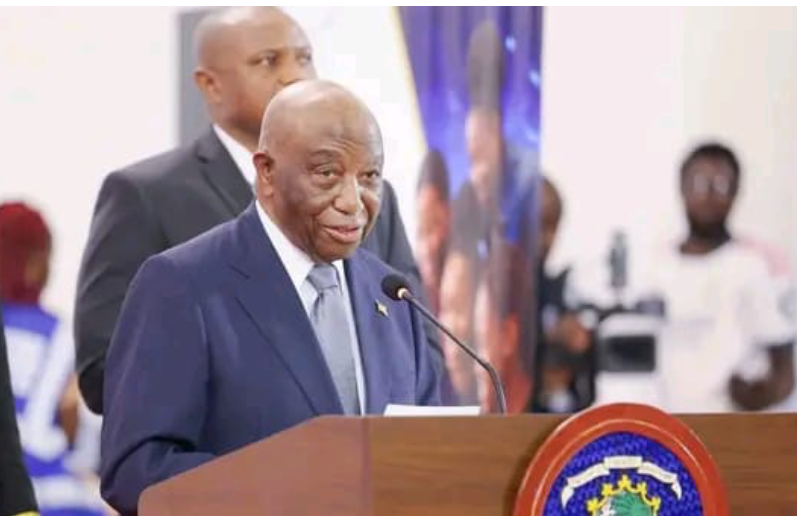
Speaking Thursday, November 19, at the Marshall High-Level Dialogue on Global Maritime Safety, Security and the Welfare of Seafarers at the Liberia Maritime Training Institute in Marshall City, President Boakai said Liberia would use its position on the Security Council to push for greater international attention to the safety and welfare of seafarers working in conflict-affected waters.
Liberia is scheduled to assume the rotating presidency of the 15-member Security Council on December 1, 2026, marking its first time holding the position in more than six decades.
Under the theme, “Lives and Lifelines at Sea: Protecting Civilian Seafarers Affected by Armed Conflict,” the President said he would chair a high-level open debate at the United Nations to advance discussions on protecting civilian maritime workers and maintaining the flow of essential goods during periods of conflict.
He stressed that seafarers are civilian workers who should not become casualties of wars and political disputes they have no part in.
“ They signed on to deliver cargo, not to go to war,” President Boakai said, referring to the cooks, engineers, deck cadets and captains who operate commercial vessels across international waters.
He called on all parties to armed conflicts to respect and protect civilian seafarers in accordance with applicable international humanitarian law.
The Liberian leader said attacks on commercial vessels not only endanger crews but also disrupt the transportation of food, fuel, medicine and humanitarian supplies, with consequences extending beyond the immediate areas of conflict.
He identified medical evacuation, crew changes and repatriation as practical areas where international cooperation could help address the challenges confronting seafarers.
President Boakai also called for stronger collaboration among states, the International Maritime Organization (IMO), the International Labour Organization (ILO) and other relevant international institutions, while emphasizing that such efforts must respect their respective mandates and applicable international law.
The President’s announcement comes as Liberia seeks to use its growing international diplomatic presence to contribute to discussions on global peace and security.
He recalled Liberia’s history as a country that once depended on international support to recover from years of conflict, saying the country’s experience gives it a responsibility to contribute constructively to international peace efforts.
He reaffirmed his administration’s commitment to multilateralism, diplomacy and cooperation as the foundation for addressing international security challenges.
Beyond the international agenda, President Boakai said Liberia must strengthen its domestic maritime institutions to address growing threats within its territorial waters and the wider Gulf of Guinea.
He identified piracy, transnational criminal networks, drug trafficking, illegal fishing and emerging cyberattacks against ships and port infrastructure as major threats to maritime safety and national security.
According to the President, illegal fishing by foreign trawlers deprives coastal communities of important food resources and undermines the livelihoods of people who depend on fishing.
He emphasized that Liberia’s responsibility to maritime security must begin at home, calling for continued strengthening of the Coast Guard, fisheries authority, ports and justice system to ensure that maritime offenders are apprehended and prosecuted.
The President also reaffirmed Liberia’s commitment to working with ECOWAS, neighboring countries and international partners under the Yaoundé Code of Conduct, stressing that maritime threats cannot be effectively addressed by individual countries acting alone.
Liberia, he said, must maintain a quality ship registry that prioritizes safety, security and seafarer welfare, strengthens cooperation with port states, shares information with international partners and maintains zero tolerance for fraudulent registration and substandard vessels.
The country operates the world’s largest ship registry, with more than 300 million gross tons, a position that President Boakai described as both a source of national pride and a significant responsibility.
He stressed that vessels carrying the Liberian flag also carry the country’s reputation and responsibility for the people working aboard them.
The President’s address was preceded by discussions involving maritime, national security and fisheries experts, who called for stronger institutional coordination, intelligence sharing and regional cooperation to address threats at sea.
One of the central issues raised was illegal, unreported and unregulated (IUU) fishing, which participants said requires coordinated action among countries because criminal operators often exploit weak enforcement systems and differences in national laws.
A panelist involved in fisheries enforcement recounted an operation conducted around 2013 or 2014 in which authorities identified a foreign fishing vessel operating illegally in Liberian waters.
Using a long-range camera, the team documented the vessel and subsequently engaged the neighboring country concerned, leading to prosecution and a fine of approximately US$500,000.
The experience, he said, demonstrated the importance of information sharing and regional collaboration in preventing fishing vessels from exploiting enforcement gaps between neighboring countries.
He proposed establishing subcommittees within existing fisheries post communities, training community members and providing them with equipment to report suspicious fishing activities.
He also called for intelligence-led investigations to identify the beneficial owners of vessels involved in illegal fishing and other maritime crimes, as well as the financial networks and individuals benefiting from such operations.
Participants further emphasized the need to translate existing international agreements and national laws into practical enforcement measures.
The discussion also highlighted the importance of establishing a maritime fusion center where relevant security institutions could share, analyze and coordinate intelligence to improve responses to maritime incidents.
Concerns were raised about bureaucratic delays, inadequate patrol equipment and limited response capacity among some institutions responsible for maritime security.
One participant argued that security information must reach the appropriate authorities quickly enough to allow timely intervention, warning that delays in communication could undermine the country’s ability to respond to threats.
The panelists also called for stronger Coast Guard capacity, improved patrol vessels, better equipment and sustained institutional training.
The welfare of seafarers also featured prominently during the audience interaction, with questions raised about how maritime authorities can protect workers against harassment, unfair treatment and other abuses while they are aboard vessels far from their home countries.
Responding to concerns about the absence of independent representatives aboard ships, a maritime official explained that the Maritime Labour Convention (MLC), 2006, provides mechanisms for protecting seafarers, including onboard complaint procedures.
He said complaint procedures are required to be accessible and visible to crew members, allowing them to report issues involving harassment, delayed salaries and other workplace concerns.
He added that Port State Control officers conduct inspections when vessels arrive at ports and can discreetly engage seafarers about their living and working conditions.
According to him, complaints are handled confidentially and can be investigated through established procedures, with relevant cases reported to the appropriate regional port state control framework, including the Abidjan Memorandum of Understanding.
The discussion also addressed technology transfer and capacity building, with reference to cooperation between Liberia and China in maritime inspections.
A maritime official said existing cooperation arrangements provide opportunities for Liberian inspectors to learn about technologies used by their Chinese counterparts, although financial limitations remain a challenge to acquiring the necessary equipment.
Meanwhile, Olivia Faitason, President of Women in Maritime for West and Central Africa, called for greater investment in women entering the maritime industry, including scholarships, mentorship and increased awareness among schoolgirls.
She stressed that encouraging women to enter the profession must be accompanied by efforts to create safe working environments that allow them to remain and advance in their careers.
Faitason raised concerns about harassment, discrimination, prolonged isolation and mental health challenges among seafarers, particularly women working aboard vessels for extended periods.
She called for confidential counseling services and stronger measures to eliminate harassment, abuse and discrimination on ships.
Her remarks brought attention to the need to treat seafarer welfare as more than a question of employment conditions, but also one involving mental health, dignity and equal opportunities.
At the conclusion of his address, President Boakai endorsed the dialogue as the inaugural event of Liberia Maritime Week, establishing it as an annual national tradition intended to celebrate the country’s maritime heritage and promote investment, economic growth and national development.
He said hosting the dialogue at the Liberia Maritime Training Institute was particularly significant because the institution is preparing young Liberians to participate in the global shipping industry.
Addressing the cadets, the President assured them that the government would continue advocating for their safety and welfare as they prepare for careers at sea.
He said the recommendations emerging from the dialogue would help inform Liberia’s engagement at the United Nations Security Council.
The President subsequently declared the Marshall High-Level Dialogue on Global Maritime Safety, Security and the Welfare of Seafarers formally open.
The event brought together government officials, diplomats, maritime regulators, security institutions, international partners, shipping industry representatives, seafarers, cadets and other stakeholders to examine ways of strengthening maritime security and protecting those who work at sea.