

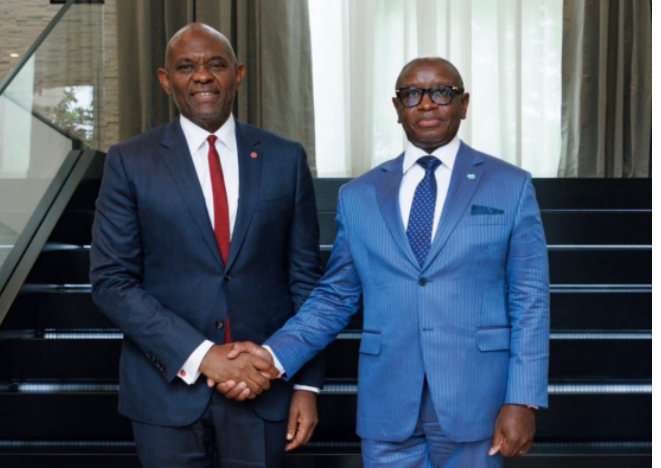
NEW YORK — Chairman of Heirs Holdings, Tony Elumelu, has challenged African leaders to abandon the continent’s longstanding dependence on foreign aid and embrace trade, investment, entrepreneurship, and private sector-led economic development.
Elumelu made the call during a fireside chat on the sidelines of the 2026 United Nations General Assembly (UNGA) in New York, where he argued that Africa’s economic future must be built on domestic capital, business innovation, and strategic international partnerships rather than continuous reliance on external assistance.
The discussion, titled the “Darryl G. Behrman Lecture on Africa Policy,” was moderated by Michael Froman, President of the Council on Foreign Relations (CFR).
The session examined Africa’s changing role in the global economy, entrepreneurship, energy security, private sector development, and the future of US-Africa relations.
Elumelu maintained that Africans must take greater responsibility for transforming their economies, while international investors must move beyond outdated perceptions that portray the continent primarily as an aid-dependent region.
He urged global investors to recognize Africa as a viable commercial destination with enormous opportunities for profitable investments, particularly through partnerships with credible local businesses.
According to him, treating Africa as one high-risk investment market overlooks the economic differences and investment potential of its 54 countries.
He argued that international investors could achieve stronger returns by partnering with established African entrepreneurs who understand local markets, business conditions, and investment opportunities.
Reaffirming his philosophy of Africapitalism, Elumelu emphasized that private sector investment must become a major force behind Africa’s economic transformation.
He warned that although foreign aid could provide immediate relief, it could not replace sustainable industries, create lasting economic opportunities, or address the continent’s structural development challenges.
He therefore called on foreign venture capital firms, pension funds, and development finance institutions to partner with African financial institutions to finance critical infrastructure and strengthen trade corridors.
Addressing Africa’s growing youth population, Elumelu described young entrepreneurs as central to the continent’s economic growth, security, and global stability.
He warned that failure to address youth unemployment could worsen irregular migration and increase social instability across African countries.
Drawing on the work of the Tony Elumelu Foundation, which has committed US$100 million to empowering young African entrepreneurs, he highlighted the importance of providing business training and US$5,000 in non-refundable seed capital to aspiring business owners.
He said such support could stimulate entrepreneurship, expand small businesses, and generate employment opportunities in rural and urban communities.
Elumelu called on international philanthropies, multinational corporations, and development agencies to increase their support for youth-led micro, small, and medium-sized enterprises.
On energy security and climate policy, Elumelu called for a practical and equitable approach to the global energy transition, stressing that Africa cannot achieve meaningful industrialization and digital transformation without reliable electricity.
He noted that more than 600 million Africans remain without access to electricity, describing the situation as a major barrier to economic development.
He advocated the responsible use of Africa’s natural gas resources as a transition fuel to power industries and stabilize electricity grids while countries continue investing in renewable energy infrastructure.
On US-Africa relations, Elumelu urged policymakers to move beyond traditional aid and concessionary arrangements toward stronger trade and investment partnerships.
While supporting the African Growth and Opportunity Act (AGOA), he called for greater attention to the cost of producing African goods and transporting them to American markets.
He also advocated bilateral trade arrangements that would promote supply-chain integration, strengthen domestic manufacturing, and remove regulatory barriers affecting trade among African countries.
His remarks come as the African Continental Free Trade Area (AfCFTA) seeks to deepen regional economic integration and expand opportunities for African businesses.
Elumelu concluded that Africa’s economic prosperity should be viewed as a global priority, warning that poverty in one part of the world could threaten economic peace and security elsewhere.
He stressed that building a prosperous Africa requires stronger investment partnerships, expanded entrepreneurship, reliable energy infrastructure, and a development model that places African businesses and capital at the center of economic transformation.