


–What Boakai’s MIDA Delivers for Liberians
By Jerromie S. Walters
MONROVIA, Liberia — The House of Representatives is expected to commence review of the $5.7 billion Master Infrastructure Development Agreement (MIDA), with President Joseph Nyuma Boakai urging Liberians to embrace a deal he says will deliver steady electricity, better roads, and new opportunities for ordinary citizens.
The House has mandated its Joint Committee on Concessions and Public Works to examine the agreement between the Government of Liberia and Bea Mountain Mining Corporation (BMMC) and report to Plenary within two weeks for further legislative consideration. The decision was taken Thursday, November 26, 2026, during the 13th day sitting of the Third Quarter of the Third Session of the 55th Legislature.
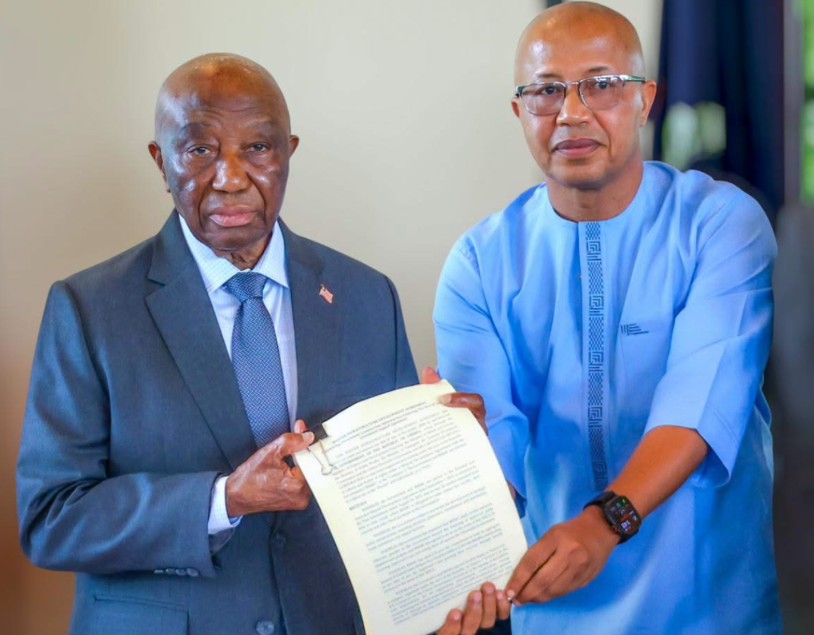
The legislative review follows the President’s signing ceremony at the Executive Mansion on November 25, where Boakai framed the agreement as a lifeline for households, clinics, farms, and small businesses. “This Agreement holds more for every Liberian,” Boakai said, describing benefits that reach beyond large-scale construction. He pledged to deliver the full program within five years, with the biomass plant and transmission lines completed in just two. “My promise is this: we will deliver within five years,” he added. “In short, MIDA will build the economic backbone of a modern Liberia.”
What the Deal Promises
According to the President, MIDA will bring steadier power to homes so children can study at night and families can store excess food; keep clinics and hospitals running their machines to render quality care; power the welder, the tailor, the barber and the shopkeeper without the daily cost of generator fuel; give farmers access to markets alongside thousands of new jobs and skills for young people; help businesses add value to and preserve food crops; and grow industries producing goods made in Liberia.
The agreement provides for 270 megawatts of new generating capacity through four power plants, with the ability to support over 1,000 megawatts down the road. Hydropower accounts for 210 megawatts — a 100-megawatt plant on the Via River, 100-megawatt SP3 and 10-megawatt SP4 plants on the St. Paul River, and a 60-megawatt biomass plant near the Via dam that will diversify the electricity sources feeding the grid.
The Via and SP-4 dams will serve as the nation’s water reservoirs, holding about 10 billion cubic meters of water to keep the lights on year-round, even in the dry season.
New transmission lines and grid reinforcement — backed by US$230 million — will carry power beyond Monrovia, including a 150-kilometer main line to the Mount Coffee substation, a 150-kilometer line linking the Via plant to Nimba County, and a 5-kilometer line serving Bong County, each with substations.
Fourteen major road and bridge projects are earmarked for support, anchored by the 146-kilometer Liberia Development Road and backed by a further US$1 billion for road networks that will connect all regions of the country. Addressing debt concerns, Boakai said the government has arranged with BMMC to ring-fence new revenue streams beginning in 2027 to pay for all projects under the agreement, leveraging the rise in gold prices.
BMMC has also agreed to set up a $500 million bridge financing facility to keep projects from stalling during construction, while continuing its regular contributions to the Consolidated Account. Construction and operation of the projects are expected to create jobs and give Liberians opportunities to develop skills in engineering, construction and power operations.
President Boakai submitted the agreement to the Legislature for consideration and ratification, describing it as a framework for financing and implementing major infrastructure projects across Liberia. Under the proposed arrangement, BMMC would finance approved development projects, with the costs offset against the company’s eligible entitlements under the agreement — an arrangement that would constitute payment and discharge of the corresponding entitlements, subject to the agreement’s provisions.
The proposed projects include the three hydropower plants on the Via and St. Paul Rivers, with combined installed capacity of 210 megawatts, and the 60-megawatt biomass power plant. The agreement also provides for high-voltage transmission lines connecting the power facilities to the Mt. Coffee substation, with additional connections to Nimba and Bong Counties. It further includes upgrades to substations, transformers, and the national electricity distribution network.
Road infrastructure projects outlined in the agreement cover several counties and include the Liberia Development Road, Bomi-to-Gbarpolu Road, Brewerville-Bopolu Road, Cestos Road, Coastal Road, and Gbarnga-Kokoyah-Compound 3-Buchanan Road.
Other proposed road projects include the Lofa Road, Nimba Road, Pleebo-Big Suehn Junction Road, Greenville-Klowne Town Road, Sengeh-to-Bandela Road, Monrovia Paved Road, and Tubman Boulevard Road and Bridge.
The agreement also includes the construction of the Kesselly Boulevard Bridge, connecting 12th Street to Bardnesville Junction. President Boakai told the Legislature that the proposed agreement is intended to address Liberia’s infrastructure deficit and create opportunities for inclusive economic growth and national development.
With the President’s signature secured and legislative review set to begin, MIDA now stands as Liberia’s most ambitious infrastructure endeavor — one the government says will deliver power, roads, and opportunity to every corner of the nation.