


-In Peacekeeping Missions
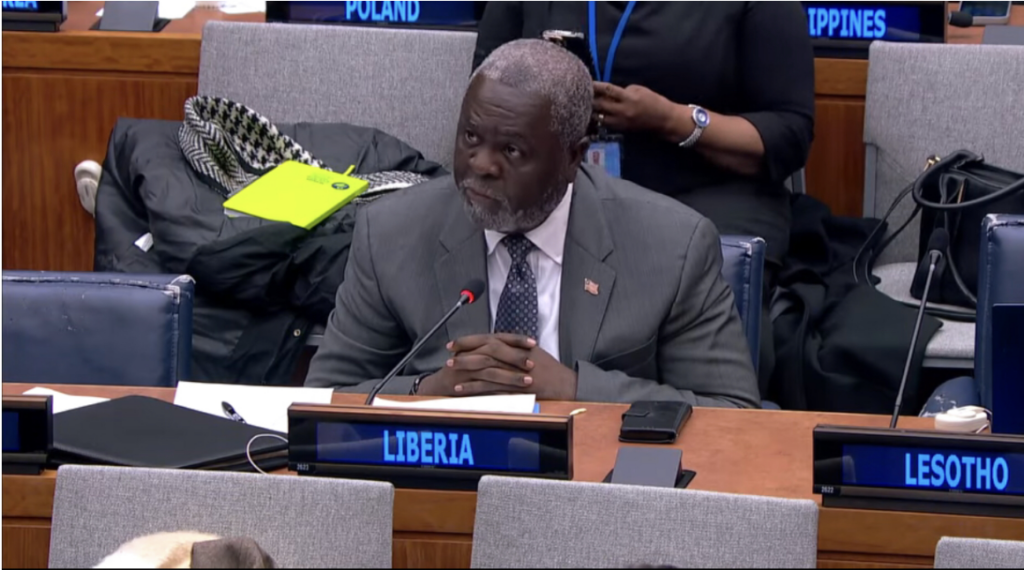
New York, USA – The African Three (A3), comprising the Democratic Republic of the Congo, Somalia, and Liberia, has delivered a powerful and far-reaching statement at the United Nations Security Council, calling for a fundamental shift in how UN Police (UNPOL) operate within peacekeeping missions worldwide.
The statement was delivered by Liberia’s Permanent Representative to the United Nations, Ambassador Lewis Garsedeeh Brown II, at the 10,102nd meeting of the UN Security Council at UN Headquarters in New York.
Speaking on behalf of the A3, Ambassador Brown began by expressing appreciation to senior UN officials who briefed the Council, including Under-Secretary-General for Peace Operations Jean-Pierre Lacroix and senior UN Police Commissioners serving in South Sudan and the Democratic Republic of the Congo.
He paid solemn tribute to fallen peacekeepers, noting that since 1948, more than 4,300 UN personnel—police, military, and civilians—have lost their lives in peace operations. “These are not statistics,” the A3 emphasized, “but men and women who gave their lives protecting communities they barely knew, in pursuit of peace they would never live to see.”
The A3 underscored Africa’s unique position in global peacekeeping, stressing that the continent hosts the largest number of UN missions and contributes a significant share of police personnel. This dual responsibility, the group said, gives Africa both credibility and clarity on what works—and what does not.
According to the A3, UN policing succeeds best when it strengthens national institutions rather than replacing them. The group laid out a clear position: support must be requested, not imposed; assistance must be based on partnership, not parallel structures; and capacity must be transferred, not temporarily “rented.”
Drawing from Liberia’s own experience with UNMIL, Ambassador Brown highlighted nationally led police reform as a lasting success story. While UNMIL did not “perform miracles,” it helped build a police service rooted in community trust and national ownership. “Peace imposed fades,” the statement warned, “but peace that is owned endures.”
Looking ahead, the A3 called for real capacity-building, stressing that classroom training alone is insufficient. Instead, it advocated for joint patrols, investigations, leadership mentoring, and reforms anchored in national strategies to build resilient—not dependent—police institutions.
The statement also urged the Security Council to match mandates with resources, warning that under-resourced mandates create dangerous gaps between ambition and reality, putting both civilians and peacekeepers at risk. The A3 further cautioned against mandates shaped by the interests of Council members rather than the needs of host countries.
On modernization, the group called for responsible use of technology, warning against replacing traditional dependency with digital dependency. While UNPOL must adapt to modern threats, host nations must ultimately own and sustain these tools.
The A3 also strongly advocated for the increased deployment and leadership of women in policing, describing their role as an operational necessity rather than symbolic inclusion, particularly in building trust and improving intelligence in conflict-affected communities.
Strengthening AU–UN partnerships was highlighted as critical, with the A3 emphasizing that African peace and security frameworks are living systems grounded in continental legitimacy and experience.
In conclusion, the A3 outlined a bold vision for the future of peace operations—anchored on Partnership, Empowerment, and Sovereignty—and declared that Africa is not merely asking for better missions but actively shaping the next generation of global peacekeeping.
“When a UN police mission ends,” the statement concluded, “success should be measured not by what is left behind, but by the strength, legitimacy, and trust of the national police service that remains.”