


Author: Joel Maybury
Joel Maybury served as the Deputy Chief of Mission at the U.S. Embassy in Monrovia from 2021 to 2023. He has an abiding interest in the history of Liberia and its deep connection to the United States.
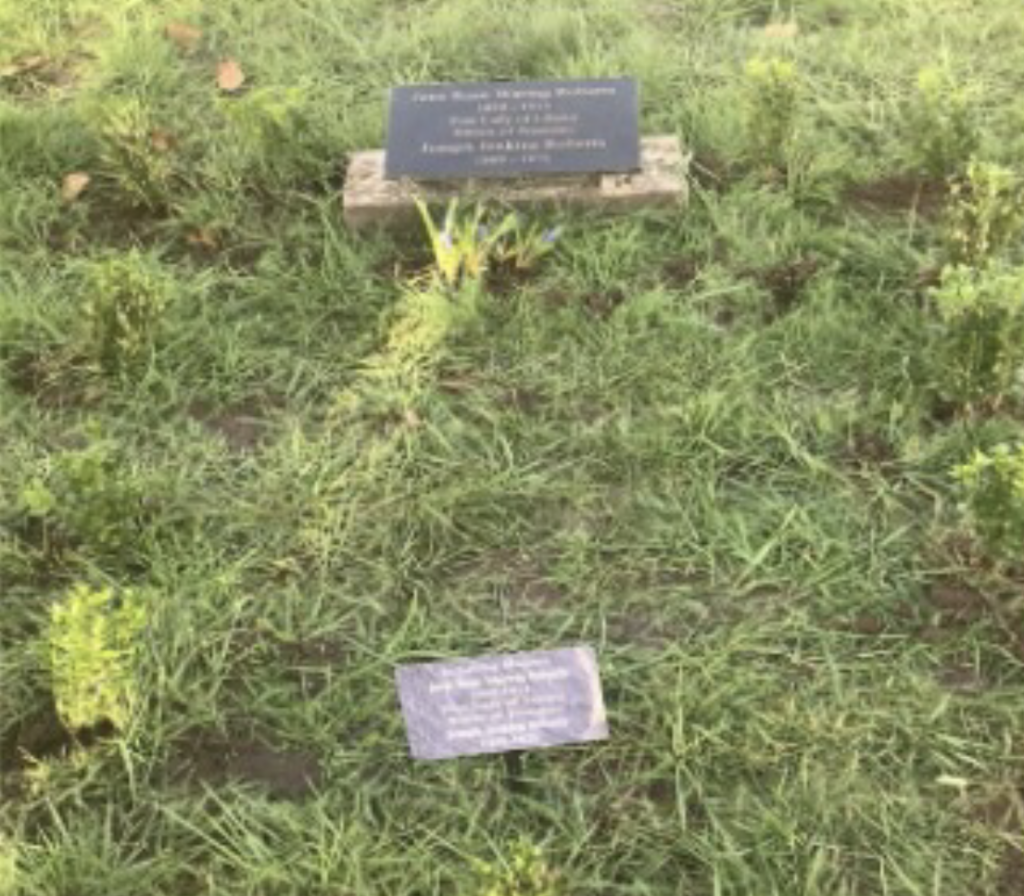
There is a patch of green grass in the Streatham Cemetery in London that deserves a lot more attention than it has gotten over the past 112 years. Lying beneath the emerald turf is the coffin containing the remains of Jane Rose Waring Roberts, Liberia’s very first First Lady, who died in London and was buried at that location in January 1914.
Unlike her famous husband, President Joseph Jenkins Roberts, a household name in Liberia, few Liberians remember Jane, her origins and accomplishments, and her final resting place.
That should change.
Virginia Roots
Jane was born in 1819 or 1820 in Petersburg, Virginia, to Colston McGiven Waring and Harriet D. Graves, free people of color. Her father was a businessman and a deacon in the Gillfield Baptist Church. He traveled to Liberia in 1823 to gauge the progress of the new colony that had been established a year earlier with funding from the American Colonization Society, then returned to Petersburg to persuade other free people of color to emigrate. He and his family emigrated to Liberia in 1824 on the ship Cyrus. The Warings sent Jane to school in neighboring Sierra Leone.
Joseph Jenkins Roberts was elected Liberia’s first president in 1847. Queen Victoria received them on her royal yacht when President Roberts had gone to England to lobby for recognition of the new Republic of Liberia. Britain was the first country to recognize Liberia’s independence in 1848. France and a host of other European countries followed it.
It took the United States government until September 23, 1862, to recognize Liberia. This happened during the Civil War after southern opposition in Congress was removed. President Lincoln extended this recognition, and formal diplomatic relations were established with a treaty of commerce and navigation later that year. The United States established an American Legation in Liberia in 1864, which was elevated to an Embassy in 1949.
A Rose in London
In the years after President Roberts died in office on February 24, 1876, Jane divided her time between life in Monrovia and travel to the United States and England.
In 1887, a decade after her husband’s death, she traveled to the United States to raise money for a free hospital in Monrovia. She had already collected $700, including $50 from President Grover Cleveland, who met with her at the White House, the only Black woman to have done so at that point in history. President Cleveland also gave her a letter that read: “Liberia is so distinctly the outgrowth of the kindly and generous sentiments of the people of the United States that everything which pertains to that young Republic should appeal to our sympathy and benevolence. The hospital which it is proposed to erect seems to me to be such an important instrumentality in well-directed charity that I desire the acceptance of the enclosed contribution to the enterprise.” There is no record of her hospital project becoming a reality.
In 1891, she returned to the United States again to speak at the Pennsylvania Colonization Society, which had been one of the state societies supporting the settlement in Liberia. During her travels, she promoted causes including health and women’s education.
Jane would have a second audience with Queen Victoria at Windsor Castle on July 16, 1892, when she accompanied Martha Rickes from Liberia to present the queen with Rickes’ quilt depicting a complete coffee tree. By Queen Victoria’s command, Jane and Martha returned to Liberia on a special ship with royal escort.
Joseph and Jane Tie the Knot
From all available historical accounts, Joseph married Jane in Monrovia in 1836, when he was about 27 and she was about 17. Their union produced a daughter, Sarah Ann, in 1838. Her parents sent her to England for much of her education.
In 1839, the American Colonization Society appointed Joseph lieutenant governor of the colony, and when Governor Thomas Buchanan died in 1842, Roberts became the first Black Governor of Liberia. In that capacity he began pushing for Liberia to become an independent country, a vision that became a reality on July 26, 1847, when the Liberian settlers voted to declare independence from the American Colonization Society. In September, they voted Joseph Jenkins Roberts as the country’s first president, and he took office in January 1848.
Liberia’s First Lady: A Woman of Distinction
The best description of Jane Roberts as First Lady is found in the book “Homespun Heroines and Other Women of Distinction” compiled and edited by Hallie Q. Brown in 1926. “Mrs. Roberts graced the Executive Mansion with ease and dignity. She spoke English and French fluently and in all respects was well-bred and refined. She accompanied her husband on many of his visits and was the recipient of great attention wherever she appeared.” London was not an unfamiliar place to the Roberts’s. They had visited on a few occasions after
In July 1900, Jane attended the Pan-African Conference in London. It was there that she met John Archer, the son of a Barbados sailor and an Irish woman. By 1906, she settled in the home of John Archer and his wife Margaret Archers in London’s Battersea Park. John Archer was elected Mayor of Battersea in 1913, becoming the first Black mayor of a borough in London.
On January 17, 1914, Archer wrote to a contact in the United States to inform him that Jane Roberts had died on January 9. “She was very dear to us. She had wanted to be buried in Liberia, had changed her mind, and was duly buried in plot 252 class H block F in Garratt Lane Cemetery.”
A recognition Gap
Unlike her famous husband, Jane is not widely remembered in Liberia, or anywhere else for that matter. In Monrovia, there is a majestic monument of President Roberts atop Ducor Hill, but no mention of his spouse there. Passersby will see her name etched in stone on a more modest monument honoring President Roberts in the center of Broad Street on Crown Hill. The inscription there reads, “Erected as a tribute of sorrow and affection by his deeply afflicted widow Jane Rose.”
President Roberts is honored in many more ways across Liberia: the town of Robertsport is named after him, the country’s main airport is called Roberts International Airport (it was Roberts Field during World War II), there is a Roberts Street in Monrovia, and various Liberian bills and coins, and postage stamps, have carried his image over the years.
In the state of Virginia, the recognition is also limited to Joseph. In his native Norfolk, there had been, until relatively recently, a Roberts Park housing community and a Roberts Park Elementary School, and there is still a Roberts Road. At Norfolk State University, you will find the Joseph Jenkins Roberts Center, a center of excellence for the study of the African Diaspora.
In Petersburg, the city erected a stone monument in his honor in June 1977, and it added a Joseph Jenkins Roberts Street next to the Appomattox River. In 1978, the Virginia Department of Historic Resources placed a historical marker a few steps from the stone monument. Again, there is no visible memorial honoring Jane. The Historic Petersburg Foundation has found an engraving that shows a portion of the house in town where Jane was born, but the house no longer exists.
A Missing Memorial
This brings us back to the grassy area in Streatham Cemetery. In the 112 years since Jane’s burial, how many Liberians, let alone Londoners, have known of this hallowed site?
The Lambeth Bereavement Service that administers the cemetery has confirmed that there is no marker at the grave site. Jane Roberts’ grave plot was initially owned by Margaret Archer. To transfer ownership of the grave plot would require permission from Margaret Archer’s descendants. No descendants have been identified so the matter has been appealed to the Chief Executive Officer of Lambeth Council to be able to install a proper headstone.
In the meantime, an admirer of Jane’s in London, Jeanne Rathbone, has decided not to wait for official permission to do something that probably should have been done many years ago. Jeanne has had a temporary granite marker made and placed it on Jane’s grave and planted a little hedge of box plants to surround it so that it is easy to identify the site. She believes a movable marker seemed like a sensible memorial for a historical grave.
Jeanne has separately campaigned to have a commemorative plaque honoring Jane installed on the exterior of the Archer residence at 55 Brynmear Road in Battersea. Jeanne was the force behind the London Borough of Wandsworth adding an English Heritage Blue Plaque on the residence. That inscription reads, “Mayor of Battersea who fought social and racial injustice lived here.” A Wandsworth Green Plaque is designed to honor famous people or places in the borough that are not covered by the Blue Plaque scheme. For a Green Plaque to be approved, the Wandsworth Council would need the consent of the current property owner, an American who purchased the property in 2017 but does not live in it.
Whether through the placement of a proper marker in London, a memorial in Monrovia and in Petersburg, will this and future generations find appropriate ways to honor Jane Rose Waring Roberts’ place in history?