

-Naymote Reports Only 0.8% of Key Interventions Completed
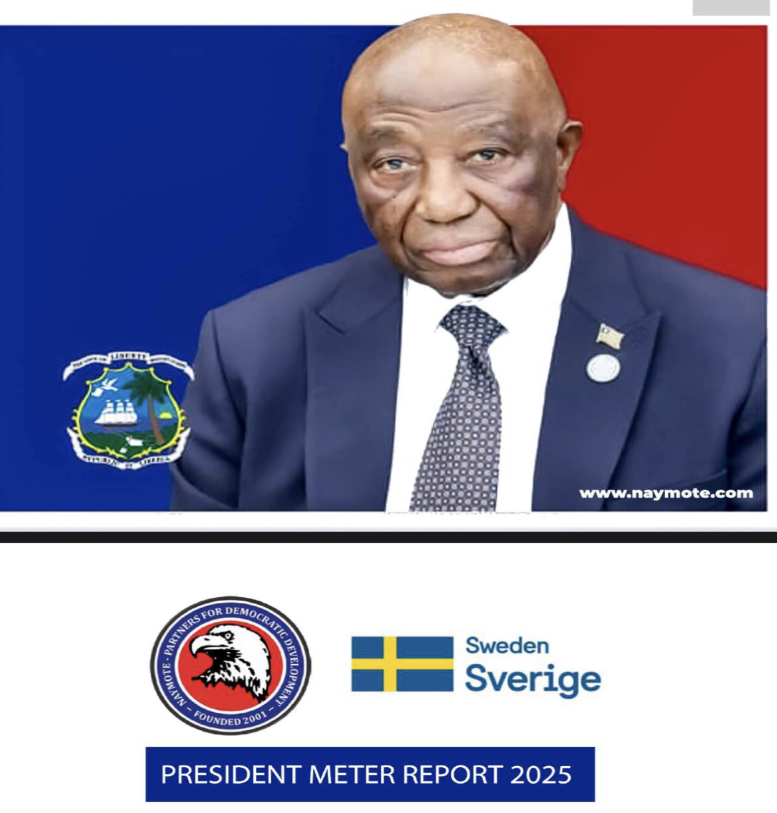
MONROVIA – One year after President Joseph Nyuma Boakai launched the ambitious ARREST Agenda for Inclusive Development (AAID), a landmark independent audit reveals a plan in peril. The inaugural “President Meter” report by Naymote Partners for Democratic Development, Liberia’s leading governance watchdog, paints a stark picture of stalled promises, systemic failures, and a devastating gap between political rhetoric and tangible progress for ordinary citizens.
After twelve months, the report says only 3 out of 378 specific interventions (0.8%) across the national development blueprint have been fully completed. While 43.7% are ongoing, a staggering 55.5%—comprising 20.1% not started and 35.4% impossible to rate due to a lack of government reporting—remain in limbo. At this pace, the report warns, the government will miss most of its 2029 targets, requiring a 31-fold acceleration in completion rates.
“The ARREST Agenda can arrest underdevelopment, but only if collective action is considered over apathy, transparency over secrecy, and results over rhetoric,” writes Naymote Executive Director Eddie D. Jarwolo in a foreword that balances critique with a call to action.
Perhaps the most sensitive and revealing data concerns the lived experience of citizens seeking basic services. Naymote’s field assessments of County Service Centers in Bong, Grand Bassa, and Margibi uncover a system that actively disenfranchises the population it is meant to serve.
A shocking 60.7% of 28 core government services—including business registration, driver’s licenses, and marriage certificates—are entirely unavailable at the county level. Furthermore, 85.7% of services still require citizens to travel to Monrovia for processing, a costly and prohibitive barrier for most. A follow-up assessment in late November 2025 showed no improvement, with 89.3% of services still requiring in-person signatures from heads of ministries in the capital**, perpetuating paper-based bottlenecks.
“This is the most critical evidence,” the report states. “Decentralization remains a rhetoric, and not reality.” This centralization, the report argues, imposes an unofficial tax of time and travel costs on the poor, excluding them from the very services needed for better livelihoods and reinforcing a system where opportunity is geographically determined.
The report also highlights major achievements which include: The establishment of the War and Economic Crimes Court office and a fully operational Ombudsman. The enrollment of 710,000 citizens (14% of the population) in a national biometric ID system.
Piloting of e-procurement in six ministries.
Passage of the National Tourism Act and the Ministry of Local Government Act (awaiting concurrence).
However, these successes are overshadowed by profound structural failures. The report identifies a “coordination breakdown” with no empowered central body to drive the AAID, leaving ministries to operate in silos. A “transparency crisis” sees over one-third of interventions unrated due to ministries not publishing progress reports, coupled with weak implementation of the Freedom of Information Act.
Resource allocation is also deeply inequitable. While Human Capital Development (encompassing health and education) contains 33.9% of all interventions, it is severely underfunded and is the worst-performing pillar, with 63.3% of its commitments not started or not rated. The health sector budget remains far below the continentally recommended 15%, and education below 20% of the national budget.
The report positions 2025 as a “foundation-building year” that has exposed critical fault lines. It concludes that the AAID’s survival requires “decisive and systemic shifts,” not incremental tweaks.
Naymote calls on the government to prioritize
Establishing a powerful AAID Coordination Secretariat reporting directly to the President, launching a mandatory, quarterly public reporting framework for all ministries, immediately decentralizing service delivery by delegating signature authority to counties and installing biometric ID card printers outside Monrovia, fully operationalizing Revenue Sharing Regulations to fund counties, and dramatically accelerating high-impact, visible projects in infrastructure, school feeding, and healthcare.
“The choice is clear: incremental adjustments will not suffice,” the report warns. “Transformative action is required.” The President Meter Project represents Naymote’s flagship initiative for monitoring, tracking, documenting, and reporting on government performance. This initiative aims to provide an independent assessment of the implementation of the ARREST Agenda for Inclusive Development (AAID), launched by President Joseph Nyuma Boakai, Sr., in January 2025 to fulfill the social contract between the President and voters.
Previously tracking presidential campaign promises, the President Meter Project transitioned in 2025, after extraction and revision of interventions, to comprehensively monitor and track the AAID Liberia’s primary development framework. This evidence-based monitoring program has developed mechanisms and seeks to: systematically track all 378 interventions across 52 core programs and 6 pillars, promote transparency through a public dashboard and quarterly reporting, amplify citizen voices using community feedback integration, and provide actionable recommendations for accelerating implementation (Naymote,2025).
Implemented under the Democracy Advancement Program (DAP), its overarching goal is to enhance democratic governance for inclusive development in Liberia, with a strategic objective of increasing demand on the government to deliver on its political, development, and campaign promises and/or interventions. The program operates based on a Theory of Change that posits: IF a government is accountable, THEN the quality of democracy is improved, and THEN citizens benefit from their participation in democratic processes. The 2025 report evaluates the performance of the government’s national development plan, during the second year of President Joseph Nyuma Boakai, Sr., as part of Naymote’s Democracy Advancement Program.