


By Jerromie S. Walters
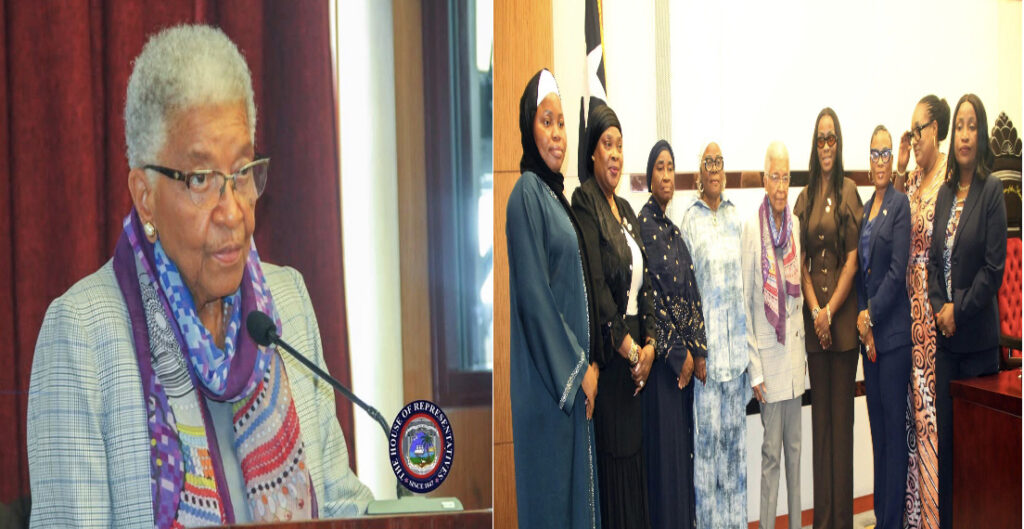
Monrovia: Liberia’s former President Madam Ellen Johnson Sirleaf delivered an address to the House of Representatives on Thursday, challenging the 55th Legislature to confront critical national issues with courage and conviction. The Nobel Peace Prize laureate and Africa’s first democratically elected female head of state appeared before lawmakers during a plenary session, offering a sweeping critique of Liberia’s current trajectory while urging legislative action on matters ranging from constitutional reform to environmental protection.
Madam Sirleaf opened her address by expressing profound concern about the alarming underrepresentation of women in Liberia’s legislative branch, a issue she described as deeply troubling for the nation’s democratic health. She noted with disappointment that the House of Representatives currently contains only eight women among its seventy-three members, while the Senate counts merely three women within its thirty-member body.
These statistics, she argued, represent not just numerical imbalance but a fundamental failure to harness the full potential of Liberia’s human capital in national decision-making. The former president emphasized that women’s voices remain essential to crafting policies that address the diverse needs of Liberian society, from healthcare and education to economic empowerment and post-conflict reconciliation.
Drawing from her own historic journey to the presidency and her decades of advocacy for gender equality, Madam Sirleaf encouraged lawmakers to explore both legal and political mechanisms that would institutionalize greater female participation in national leadership. She pointed to successful models from other African nations that have implemented gender quotas and special seats for women, achieving more representative governance as a result.
The former president stressed that without deliberate intervention, the pace of progress toward gender parity would remain unacceptably slow, leaving Liberia lagging behind regional peers in women’s political empowerment. She called upon male lawmakers in the legislature to recognize that inclusive governance strengthens democracy rather than diminishes their own representation.
Beyond the issue of gender representation, Madam Sirleaf ventured into more controversial constitutional territory by addressing Article 27(b) of the 1986 Constitution, a provision she characterized as fundamentally problematic for Liberia’s future. The constitutional clause restricts Liberian citizenship exclusively to individuals who are Negro or of Negro descent, creating what the former president described as a “racist provision”.
According to her, this contradicts the nation’s founding principles and international human rights standards. She urged lawmakers to reconsider this restriction through comprehensive constitutional reform, arguing that Liberia must adapt its legal framework to remain competitive in an increasingly interconnected global community. The former president emphasized that citizenship laws should reflect inclusive values that welcome contributions from all who genuinely embrace Liberia’s national identity.
Madam Sirleaf contextualized her call for citizenship reform within the broader imperative of regional competitiveness, warning that Liberia risks falling behind emerging African nations that have modernized their citizenship and investment laws to attract global talent and capital. She argued that structural adjustments to the constitution would signal Liberia’s readiness to engage with the world on equal terms, removing barriers that currently discourage diaspora engagement and foreign investment.
The former president reminded lawmakers that Liberia’s historic role as Africa’s oldest republic carries with it the responsibility to lead by example, demonstrating that sovereignty and openness need not exist in opposition to one another. She encouraged the legislature to initiate a national dialogue on citizenship that would prepare Liberia for the challenges and opportunities of the twenty-first century.
Turning her attention to domestic challenges, Madam Sirleaf highlighted the escalating land disputes that continue to plague communities across Liberia, creating significant legal and social tensions that threaten stability and development. She painted a vivid picture of the current land crisis, describing how institutions and individuals hold vast tracts of undeveloped land while others occupy properties that do not rightfully belong to them.
This situation, she explained, generates countless legal conflicts that the judiciary and other state structures appear either unable or unwilling to resolve effectively. The former president stressed that unresolved land disputes undermine investment, fuel social conflict, and perpetuate cycles of poverty that trap ordinary Liberians in uncertainty.
Her words: “Institutions, organizations, and individuals are holding large tracts of unused and undeveloped lands which must be put to work. On the other hand, people are occupying and sitting on lands that don’t belong to them, causing serious legal issues that the judiciary and other state structures seem unable or unwilling to resolve.” Madam Sirleaf called for stronger policies and legal interventions to address this imbalance.
She proposed that this include effective zoning regulations and responsible land management practices that would clarify ownership, encourage productive use, and protect the rights of all citizens. She urged the legislature to prioritize comprehensive land reform that would establish clear procedures for dispute resolution and create mechanisms for bringing unused land into productive service for national development.
The condition of Monrovia and other urban centers emerged as another pressing concern in the former president’s address, as she expressed dismay at the deteriorating state of the capital city she once led with such pride. Madam Sirleaf recalled a time when Monrovia was admired for its historic landmarks and orderly structure, a city that reflected the dignity and aspirations of its people.
Today, she observed with evident sorrow, the capital has fallen into neglect, its infrastructure crumbling and its public spaces degraded in ways that diminish the quality of life for residents and the impression formed by visitors. She called for decisive legislative support for government actions aimed at restoring the dignity and development of the capital, emphasizing that urban renewal must become a national priority.
Madam Sirleaf connected the physical condition of Monrovia to broader questions of national pride and identity, arguing that how Liberians treat their capital city reflects their collective commitment to progress and self-respect. She challenged lawmakers to envision what kind of capital Liberia deserves and to allocate resources and attention accordingly, recognizing that urban development cannot succeed without consistent legislative backing and oversight.
The former president noted that other African nations have successfully transformed their capitals into engines of economic growth and symbols of national achievement, and she expressed confidence that Liberia could accomplish similar results with sustained commitment and proper planning.
The issue of Liberianization also featured prominently in Madam Sirleaf’s address, as she called for strengthened enforcement of policies designed to protect Liberian participation in the national economy. She warned against the unchecked exploitation of Liberia’s natural resources by non-citizens, particularly along beaches and waterways where environmental damage has become increasingly visible and concerning.
The former president argued that Liberianization policies must be more than symbolic gestures; they require robust implementation mechanisms that ensure Liberian businesses and entrepreneurs can compete fairly and benefit from the nation’s resource wealth. She encouraged lawmakers to review existing legislation and identify gaps that allow foreign interests to dominate sectors that should provide opportunities for local economic development.
Environmental protection emerged as a related concern, with Madam Sirleaf highlighting the serious risks posed by unregulated resource extraction along Liberia’s coastline and waterways. She described scenes of environmental degradation that threaten not only ecological health but also the livelihoods of communities dependent on fishing, tourism, and other marine resources.
The former president called for legislative action to strengthen environmental protections and ensure that economic development does not come at the cost of irreversible damage to Liberia’s natural heritage. She reminded lawmakers that environmental stewardship is not a luxury but a necessity for sustainable development, and that future generations will judge this legislature by its willingness to protect the resources they will inherit.
Madam Sirleaf also emphasized the importance of strengthening Liberia’s political party system, calling for clearer laws and stronger enforcement mechanisms to ensure that political organizations operate in a structured and accountable manner. She argued that healthy democracies depend on robust political parties capable of articulating clear platforms, recruiting qualified candidates, and engaging citizens in meaningful political discourse.
The former president expressed concern that Liberia’s party system remains underdeveloped, with organizations often lacking internal democracy, transparent financing, and sustained connections to grassroots constituencies. She urged lawmakers to consider reforms that would incentivize party development and discourage the proliferation of opportunistic political vehicles that dissolve as quickly as they emerge.
On the other hand, Madam Sirleaf acknowledged that some might question why many of these reforms were not implemented during her own twelve-year presidency from 2006 to 2018. She addressed this potential criticism directly, stating that she served the nation with dedication under challenging circumstances and remains confident that history will judge her record fairly.
The former president did not offer excuses but rather framed her remarks as part of an ongoing national journey toward progress, one that requires contributions from successive generations of leaders. She expressed hope that her address would spark action rather than debate about past failures, emphasizing that Liberia’s future depends on what lawmakers do today rather than what previous administrations did or failed to do.
Following the address, House Speaker Richard Nagbe Koon rose to express profound appreciation to the former president for her presence and contributions, describing the moment as one of reflection, learning, and national pride for the Legislature. Speaker Koon noted that Madam Sirleaf’s remarks on issues such as Liberianization policy, citizenship, land governance, and urban development address matters that go to the heart of Liberia’s national identity and future development.
He acknowledged the gravity of the subjects she raised and committed the House to serious consideration of her recommendations, recognizing that the former president’s perspective carries unique weight given her historic role in Liberia’s democratic development. The Speaker assured Madam Sirleaf that the House of Representatives remains committed to addressing these national concerns through thoughtful legislation, oversight, and collaboration with the Senate and other stakeholders
He emphasized that while the path forward may be challenging, the legislature recognizes its responsibility to engage with difficult questions and seek solutions that serve the Liberian people. Speaker Koon encouraged his colleagues to study the former president’s address carefully and to approach the issues she raised with the seriousness they deserve, setting aside partisan considerations in favor of national interest.
In recognition of her historic leadership and contributions to Liberia and the global community, Speaker Koon, on behalf of the House of Representatives and the 55th Legislature of Liberia, conferred upon Madam Ellen Johnson Sirleaf a Special Legislative Citation of Distinguished Honor. The citation acknowledged her pathbreaking role as Africa’s first elected female head of state, her leadership during Liberia’s post-conflict reconstruction, her global advocacy for democracy and women’s empowerment, and her continued dedication to the nation’s progress.