

By Jessica Cox
Monrovia, Liberia’s Minister of Mines and Energy, minister P Matenokay Tingbah has outlined an ambitious reform agenda aimed at expanding mineral production, strengthening governance, attracting foreign investment, and increasing local participation in the country’s extractive sector.
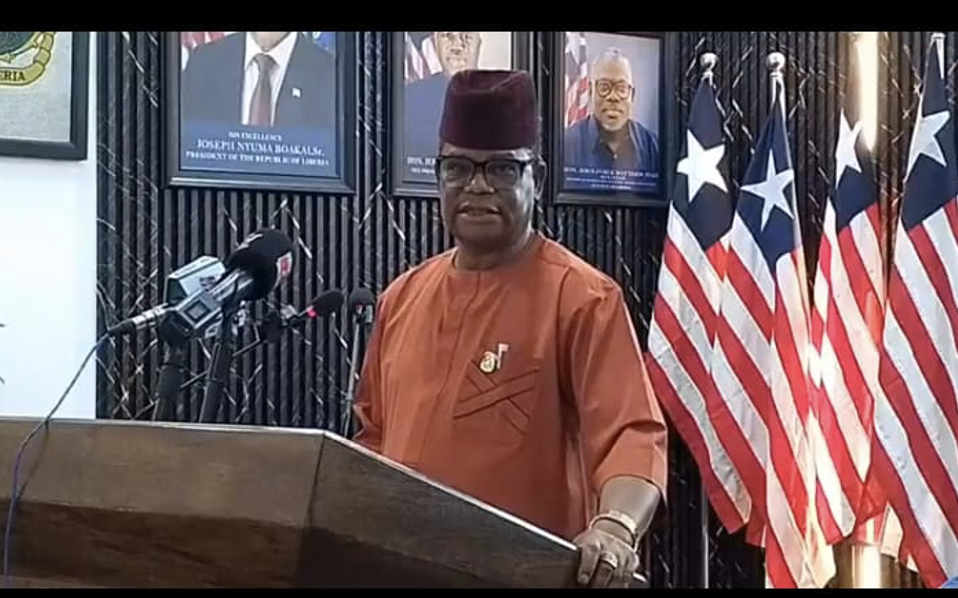
Speaking at the Ministry of Information’s regular press briefing in Monrovia, the Minister detailed outcomes from recent international engagements and provided updates on mining, energy, regulatory reforms, and major infrastructure developments.
The Minister disclosed that he recently represented Liberia at a major mining investment conference in Cape Town, South Africa, where discussions focused on strengthening partnerships and attracting capital into Liberia’s mineral sector.
Engagements were also held in India and at the Future Minerals Forum in Saudi Arabia, with particular emphasis on value addition including discussions surrounding the possible construction of a gold refinery in Liberia.
He stressed that Liberia must move beyond exporting raw minerals and instead develop in-country processing capacity to maximize national benefit.
A key policy proposal now under review by President Joseph Nyuma Boakai is the establishment of a National Mining Company.
According to the Minister, the proposed entity would:
Secure equity participation for Liberia in mining ventures.
Coordinate national geological research.
Strategically participate in mining operations.
If approved, the initiative would mark a significant shift toward increasing direct state benefit from mineral extraction.
One of the most significant announcements was the ratification of the Third Amendment to the Mineral Development Agreement with ArcelorMittal. The revised agreement secures approximately US$3.5 billion in total investment and extends operations through 2050.
The Minister noted that iron ore production is projected to expand significantly under the new framework, with long-term targets reaching up to 30 million tons annually.
Additionally, the government reaffirmed that the Yekepa-to-Buchanan rail corridor remains sovereign property of Liberia. The corridor is now being positioned as a multi-user infrastructure system under a regulated operational framework to allow access for other qualified mining investors.
According to figures provided during the briefing:
The mining sector generated approximately US$152 million in 2025, exceeding projections.
Iron ore exports reached nearly 10 million tons, the highest in Liberia’s recent history.
Gold exports exceeded 362,000 troy ounces.
Artisanal diamond exports were valued at approximately US$7.9 million.
The Minister described the mining sector as one of Liberia’s primary economic growth drivers.
The Ministry also acknowledged that illegal mining and mineral smuggling remain serious concerns, particularly within artisanal and small-scale operations. Operators using heavy equipment without authorization were warned to comply with regulations or face equipment seizure under existing laws.
Authorities are strengthening traceability measures, reporting requirements, and collaboration with national security institutions to address the issue.
Digital Reform and Decentralization
As part of governance modernization, the Ministry has transitioned from a paper-based licensing system to a digital platform, allowing applicants to submit applications and make payments electronically.
The Ministry also announced the recruitment and training of technical professionals including geologists and mining engineers who will be deployed across Liberia’s 15 counties to decentralize services and reduce the burden on citizens traveling to Monrovia for licensing matters.
Beyond mining, the Minister highlighted reforms in the energy sector, including:
Review of Liberia’s 2015 Electricity Law
Development of a new National Energy Policy
Introduction of a net-metering framework to encourage renewable energy
Institutional coordination aimed at achieving broader electricity access.
The Ministry is also advancing solar and hydro power initiatives, including feasibility studies for expanded hydropower generation.
Under revised mining agreements, community development funds have reportedly increased, and stronger “Liberianization” provisions are being introduced. The Minister stated that management roles within major mining companies will gradually transition toward majority Liberian leadership over time.
“The transformation of Liberia’s mineral sector is not simply about enforcement,” the Minister said. “It is about reform and modernization.”
Observers say the success of the government’s reform agenda will depend on effective implementation, transparency, environmental safeguards, and sustained investor confidence.
As Liberia positions its mineral and energy sectors as pillars of national development, the coming years will test whether ambitious policy shifts translate into tangible improvements in jobs, infrastructure, and community well-being.