

By Tina S. Mehnpaine
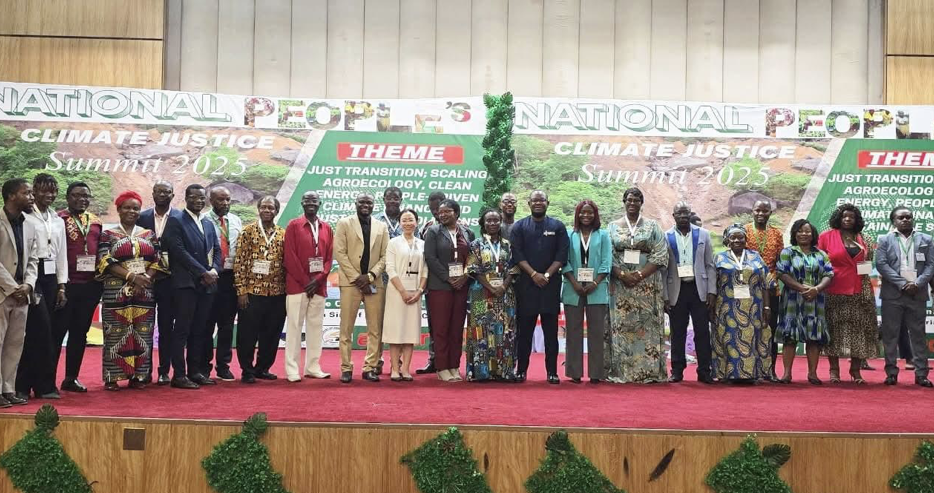
Over one thousand participants at the recently concluded Climate Justice Summit, organized by ActionAid Liberia, have issued a strong call to the government to transform its agricultural sector and economic approach to address the escalating climate crisis.
The two-day gathering, which follows the inaugural summit last year, centered on the theme: “Just Transition: Scaling Agroecology, Clean Energy, People-Driven Climate Finance and Sustainable Solutions for Liberia.”
The summit’s Communiqué urges a national shift toward agroecology—a comprehensive farming approach that combines environmental science with social principles to create sustainable and equitable food systems.
“We call for a decisive shift toward agroecology as a cornerstone of Liberia’s agricultural transformation, climate adaptation, and food sovereignty agenda,” the Communiqué read by Loretta Aletha Pope-Kai, chairperson of the National Civil Society Council of Liberia and the Foundation for Community Initiatives – FCI.
The communique called for recognizing agroecology as a national development priority embedded within all relevant policies including agriculture, climate, nutrition, and land. It also called for increasing public investment and budgetary allocations for agroecological practices. This includes funding farmer-led research, soil regeneration, diversified cropping systems, and locally adapted seed systems, with special support for women and youth smallholder farmers.
During the summit, participants engaged in a series of panel discussions and breakout sessions focused on addressing the country’s most critical climate and development challenges. These sessions covered “Just Transition and Green Solutions, and climate finance. Discussions highlighted the nation’s progress and existing gaps in shifting towards clean energy. A major focus was the crucial comparison between Agroecology vs. Synthetic Fertilizers, examining how to move towards sustainable practices.
Other discussions focused on key issues included aligning climate funds with the specific needs of communities and ensuring youth access and engagement in climate finance. Sessions addressed the complex challenge of Balancing Productivity and Sustainability in agriculture amid a worsening climate crisis.
Participants called on the government to recognize that climate justice requires equitable financing, demanding reforms to ensure climate funding is accessible and transparent at the community level. They also called for establishing inclusive climate finance mechanisms that channel resources directly to frontline communities, women-led organizations, youth-driven enterprises, and grassroots adaptation initiatives. Improving coordination and accountability in climate finance governance, including better tracking of public budgets and effective utilization of international funds.
Ensuring climate funds are aligned with priorities like agroecology, renewable energy, disaster risk reduction, and green job creation, responding to needs identified by communities.
To combat energy poverty and accelerate climate mitigation, the summit committed to advancing a just and inclusive energy transition. Scaling up renewable energy, focusing on decentralized, off-grid, and community-based solutions to expand access for rural and underserved areas. Investing heavily in skills development and green jobs for women and youth across sectors, including climate-resilient agriculture, renewable energy, waste management, and ecosystem restoration.
The gathering specifically called for reforms within the Comprehensive Africa Agriculture Development Program (CAADP), a pan-African initiative that aims to help African countries end hunger and reduce poverty by raising economic growth through agriculture-led development. Through the program, African governments agreed to allocate at least 10% of national budgets to agriculture and rural development, and to achieve agricultural growth rates of at least 6% per annum.
The communique called for a comprehensive reform of the CAADP Biennial Review Process to incorporate gender-responsive, youth-specific, and climate-sensitive indicators. Institutionalizing meaningful participation of civil society organizations, women’s movements, youth networks, and farmer associations in all CAADP planning and monitoring processes.
Ensuring the domestication and operationalization of future global commitments, like COP30 outcomes, particularly by prioritizing adaptation, loss and damage, and guaranteeing the participation of frontline communities.
The Communiqué concludes by affirming the collective commitment to sustaining this multi-stakeholder dialogue and using the Communiqué as a shared advocacy tool at national and international levels.
In her opening address, ActionAid Liberia, Country Director Madam Elizabeth Gbah Johnson underscored the urgency of confronting structural inequalities that leave communities disproportionately affected by climate change.
Underpinning the Summit’s work Madam Johnson added are two major strategic initiatives which she named are all geared toward establishing Strategic Partnership for Agroecology and Climate Justice in West Africa (SPAC-WA); and the Strategic Partnership Agreement II that aims to transform societies to be just, green, resilient, and inclusive.
Delivering a keynote address on behalf of Finance and Development Planning Minister Hon. Augustine Kpehe Ngafuan, Deputy Finance Minister for Administration Bill McGill Jones said climate change has evolved beyond an environmental concern into a macro-fiscal and development challenge with direct implications for agriculture, infrastructure, revenue generation, and the success of Liberia’s ARREST Agenda for Inclusive Development.
He disclosed that the MFDP has established and launched the Climate Integration and Financing Office (CIFO), a dedicated unit designed to mainstream climate considerations into national planning and budgeting while mobilizing resources for climate-resilient interventions.