

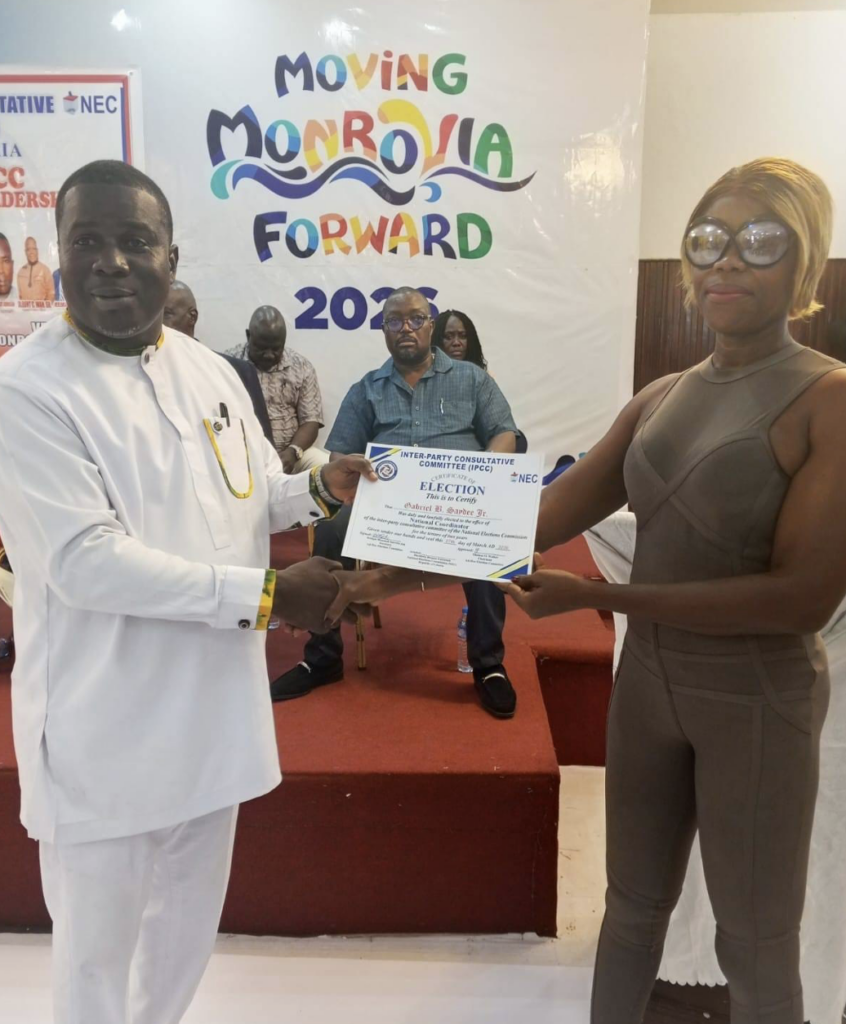
Monrovia, Liberia: Liberia has taken a major step toward deepening democratic governance and political cohesion with the formal inauguration of the Secretariat of the Inter-Party Consultative Committee (IPCC) on Friday, 27 March 2026, in Monrovia.
The event marked a renewed commitment to structured political dialogue and collaboration among political parties.
Representatives from political parties, the National Elections Commission (NEC), government institutions, civil society, and development partners attended the ceremony, underscoring a collective resolve to sustain peace and foster inclusive political processes.
Speaking at the event, Gabriel B. Saydee, Jr., National Coordinator of the IPCC Secretariat, emphasized the historic responsibility of political actors to prioritize national unity over individual party interests.
“We must stand not as representatives of individual parties, but as stewards of the collective democratic interest. This is not a competition with government; it is a complement to Liberia’s democratic process,” he stated.
Saydee outlined three key priorities for the newly inaugurated Secretariat:
1. Fostering constructive political engagement
2. Strengthening electoral processes
3. Building institutional resilience
He stressed that dialogue remains central to preventing conflict. “If we can resolve issues here,” he noted, “we will not need to fight them in the streets.”
The ceremony also featured a keynote address by Dr. Nathaniel Blama, former Executive Director of the Environmental Protection Agency, who reflected on structural weaknesses within Liberia’s political landscape and the critical need for stronger collaboration among political actors.
“Weak political systems produce weak governments. The IPCC offers a pathway to strengthen institutions through cooperation, shared resources, and collective accountability,” Dr. Blama stated.
He emphasized the need for political parties to evolve into policy-driven institutions anchored in research, dialogue, and constructive engagement.
Speaking on behalf of the United Nations Development Programme (UNDP), Louis Kuukpen, Deputy Resident Representative, reaffirmed UNDP’s continued support for democratic institutions and inclusive politics in Liberia.
Kuukpen highlighted that sustained dialogue among political stakeholders is essential to preserving peace and ensuring that democratic processes deliver meaningful outcomes for all Liberians.
Representing the National Elections Commission, Counselor Teplah Reeves, Co-Chairperson, underscored the importance of cooperation between the NEC and political parties in fostering credible, transparent, and inclusive elections.
Participants hailed the inauguration as a milestone in Liberia’s democratic evolution—one that reinforces the role of political parties not only as competitors during elections but also as key partners in governance, stability, and accountability.
The IPCC was established by political parties in collaboration with the NEC as a platform for dialogue, coordination, and consensus-building to reduce political tensions and address electoral concerns.
Initially formalized through a 2005 Memorandum of Understanding that designated the NEC as Secretariat, the framework underwent significant revisions in 2016 and again in July 2025 to enhance its independence and strengthen political party ownership.
This transition builds on agreements reached during a two-day meeting in Gbarnga in December 2025, where political parties adopted the IPCC constitution and bylaws and elected members of the Secretariat—marking a decisive shift toward a fully-led structure aimed at promoting cooperation, inclusivity, and sustained dialogue.
The initiative forms part of ongoing UNDP and partner support through the Liberia Electoral Support Project, aimed at ensuring that Liberia’s democracy remains peaceful, inclusive, and resilient.
The Liberia Electoral Support Project is managed by UNDP and implemented in partnership with UN Women, the Netherlands Institute for Multiparty Democracy, and the NEC, with support from the European Union, Ireland, and Sweden.