


By: Sampat JMB Kpakimah
The Government of Liberia has launched a five-year Corporate Strategic Plan aimed at repositioning agriculture as the primary engine of economic transformation. This comes amid fluctuation in food prices, youth unemployment rising, and the country continuing to spend millions of dollars annually on imported staples.
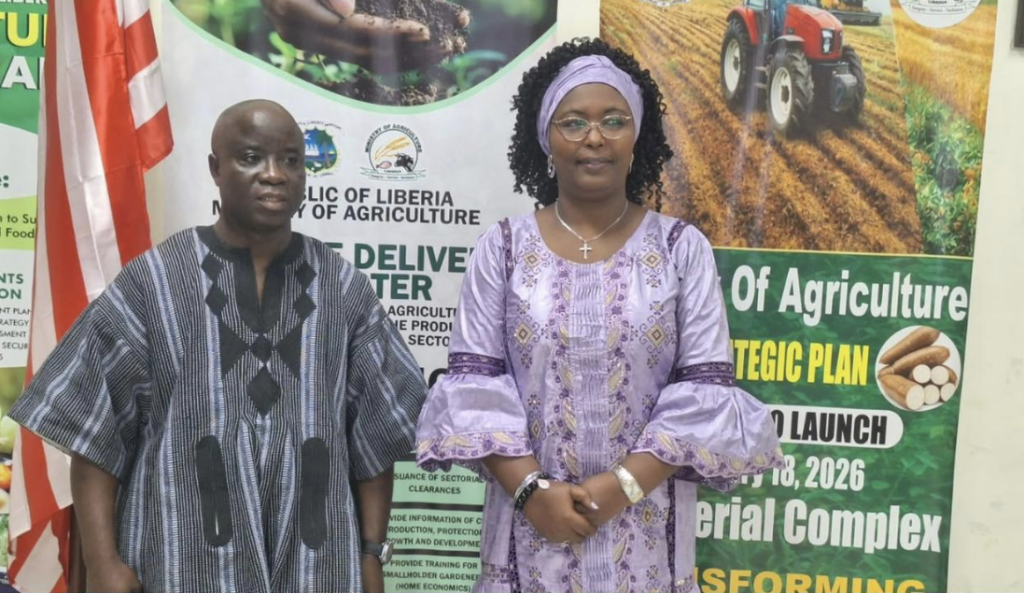
At the unveiling ceremony yesterday, February 18, of the five-year Strategic Plan (2025–2030) which was launched by the Ministry of Agriculture signals what officials describe as a shift from policy pronouncements to performance-driven implementation.
At the launch ceremony, Agriculture Minister Alexander Nuetah framed the strategy as more than an administrative document calling it a national economic recovery blueprint.
“This launch represents a turning point for agriculture in Liberia,” Minister Nuetah declared. “It is about moving decisively from planning to implementation, from intentions to impact.
Liberia must feed itself, create wealth through agriculture, and build a resilient agricultural economy for future generations.”
Agriculture remains one of Liberia’s most critical sectors, employing a significant portion of the rural population and contributing substantially to livelihoods across the country.
Yet despite vast arable land, favorable climatic conditions, and abundant water resources, productivity levels have remained low.
Experts have long argued that the sector’s stagnation is not due to a lack of potential but to structural weaknesses limited mechanization, inadequate rural infrastructure, weak extension services, financing gaps, and inconsistent policy execution.
Minister Nuetah acknowledged these long-standing constraints. “Our challenge is not potential,” he said. “Our challenge is implementation, coordination, investment, and accountability. Resources committed to agriculture must produce measurable results that improve farmers’ incomes, strengthen food security, and grow our economy.”
His remarks appeared to subtly recognize a pattern in Liberia’s development history ambitious plans that often struggle during execution phases.
The newly launched Strategic Plan outlines a comprehensive roadmap to transition Liberia from subsistence-based agriculture to a competitive, market-driven, and climate-resilient sector.
Meanwhile, Minister Nuetah said the 2025–2030 Plan Promises to improve several areas including increasing domestic food production, expanding mechanization to boost yields, strengthening agribusiness and value chains to attract private-sector investment, empowering youth and women as drivers of agricultural innovation, promoting climate resilience and sustainable land management among others.
The Strategic Plan was developed with financial and technical support from the International Fund for Agricultural Development(IFAD) which reflects continued international engagement in Liberia’s rural development agenda.
Speaking at the launch, IFAD Country Director, Pascaline Barankeba reaffirmed the institution’s commitment to inclusive agricultural transformation.
“IFAD is proud to have supported the development of this Strategic Plan,” she said. “We remain fully committed to working with the Government of Liberia to ensure that smallholder farmers, women, and youth benefit from sustainable agricultural transformation.”
Other development partners, including the Food and Agriculture Organization and the European Union, also promised support for implementation efforts.
However, development analysts caution that while international backing is critical, sustained domestic ownership and budgetary commitment will determine long-term success.
Liberia’s heavy reliance on food imports has long been viewed as both an economic and national security concern. Imported rice and other staples place pressure on foreign exchange reserves and expose the country to global market volatility.
At the same time, thousands of young Liberians remain unemployed or underemployed a demographic reality that government officials believe agriculture could help address.
By prioritizing mechanization, agribusiness development, and value addition, the Ministry hopes to attract private investment and stimulate job creation across farming, processing, storage, and distribution chains.
“Agriculture is not just a sector,” Minister Nuetah emphasized. “It is the foundation of Liberia’s economic prosperity.”
While the Strategic Plan outlines ambitious reforms, the true measure of success will be tangible improvements in rural communities: higher crop yields, increased farmer incomes, better access to markets, improved storage facilities, and expanded processing capacity.
Historically, implementation gaps have undermined similar initiatives.
Observers say the introduction of stronger performance management systems as outlined in the new plan could represent a significant institutional shift if enforced consistently.
The coming months will reveal whether the Ministry can translate policy into practice, particularly in mobilizing funding, coordinating with county-level structures, and engaging the private sector.
The five-year plans are expected to establish what is unpredictable for Liberia’s agricultural future. With global food systems under strain and domestic economic pressures mounting, the stakes have rarely been higher.