

By Jessica Cox
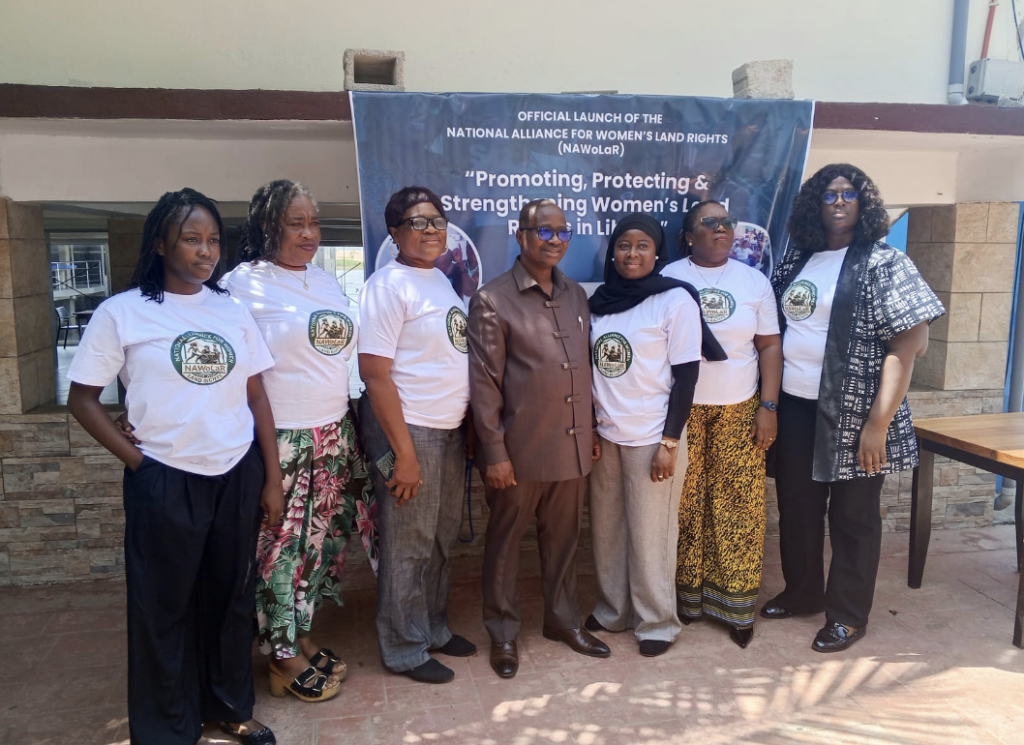
Monrovia – Liberian women and their allies have officially launched the National Alliance for Women’s Land Rights (NAWoLaR), a new national platform dedicated to turning the promise of land ownership into a reality for women across the country.
The launch marks a pivotal moment in the decades-long fight for gender equity in land governance. While the landmark Land Rights Act of 2018 provides a legal framework for recognizing the land rights of all Liberians, a significant gap remains between the law on paper and the lived experience of women, particularly in rural communities.
NAWoLaR is the direct response to this challenge. Born from years of advocacy dating back to 2009 and solidified through national consultations like the Rural Women’s Land Rights Day, the alliance will serve as a unified and powerful voice to dismantle the barriers that keep women from securing and controlling land.
“For too long, our efforts have been fragmented, allowing systemic barriers to persist,” said Florence M. Dorley, a representative of the alliance. “NAWoLaR is the mechanism to change that. We are building a coordinated front to bridge the critical gap between policy commitments and tangible change on the ground.”
Despite playing a vital role in agriculture and ensuring family food security, countless Liberian women continue to face discriminatory customary practices, a lack of legal awareness, and weak enforcement of their rights. The alliance argues that secure land rights are not just a matter of justice, but an economic imperative. Evidence shows that when women control land, they invest more in their farms, better support their families’ nutrition, and drive local economic growth.
NAWoLaR’s strategy is built on action. Its immediate priorities include:
– Formalizing its structure to ensure strong and effective collaboration among member organizations.
– Launching a nationwide baseline assessment to gather critical data on women’s land ownership. This evidence will be used to guide advocacy and inform future policy reforms.
– Taking the law to the people through public awareness campaigns that simplify the Land Rights Act and translate it into local languages, empowering women in even the most remote communities to understand and claim their rights.
– Building a robust legal advocacy pillar, connecting women facing land disputes with legal institutions and support mechanisms for mediation and resolution.
The launch event drew strong support from government partners. Edward K. Mulbah, Deputy Minister Designate at the Ministry of Internal Affairs, attended and reaffirmed the government’s commitment. “Secure land rights for women are essential for building strong families and communities,” he stated. “The Ministry is committed to working with NAWoLaR to ensure our decentralization and land reform initiatives are truly gender-inclusive.”
Alliance leaders were clear that the launch is not an end, but a beginning. They issued a call to action for all stakeholders—government, civil society, traditional leaders, and development partners—to join this coordinated effort.
Gov’t Increases Fuel Oil Price
MONROVIA — The Ministry of Commerce and Industry, in close consultation with the management of the Liberia Petroleum Refining Company (LPRC), has announced an upward adjustment in the price of fuel oil (AGO) effective today, while prices for gasoline (PMS) remain unchanged.
According to the new monthly price circular issued by the Ministry, the wholesale and retail prices of AGO have increased by fifty-five United States cents (US$0.55). As a result, the wholesale selling price for fuel oil now stands at US$4.60, with the retail pump price set at US$4.88, equivalent to L$910.00 at the current exchange rate.
Meanwhile, the price of gasoline (PMS) remains stable, with a wholesale selling price of US$3.74 and a retail pump price of US$4.02, or L$750.00.
The new pricing structure is based on the Central Bank of Liberia (CBL) exchange rate of L$187.00 to US$1.00, as recorded on February 13, 2026.
In a joint statement, Minister of Commerce and Industry Hoa Magdalenes Ellen Dagoseh and LPRC Managing Director Amos B. Iweha emphasized that the Inspectorate Team of the Ministry will closely monitor compliance with the approved ceiling prices to prevent arbitrary hikes at the pump. The Ministry also vowed to ensure that importers do not engage in anti-competitive practices such as undercutting fellow competitors or hoarding products on the local market.
“This adjustment reflects the government’s commitment to maintaining a balanced and transparent petroleum pricing mechanism while protecting consumers from unjustified price increases,” the statement noted. The new prices take effect immediately across all retail outlets in Liberia.