

–Liberian Women Welcome Samuel Jackson’s Indictment, Demand Impartial Prosecution
By Jerromie S. Walters
MONROVIA — Women’s rights advocates have welcomed the legal charges against Samuel P. Jackson in connection with the death of his wife, South African national Toni Jackson, while emphasizing that charges remain allegations and that due process must be fully respected. The Liberia National Police formally charged Mr. Jackson on Thursday, April 2, 2026, with manslaughter, negligent homicide, reckless endangerment of another person’s life, and aggravated assault.
According to the LNP, the charges stem from a full‑scale, multi‑disciplinary investigation conducted by the Crime Against Persons Unit, the Forensic Section, medical authorities, and the Montserrado County Coroner, all of which were guided by evidence, professional standards, and the legal framework of the Republic of Liberia. Like many other women, Naomi Tulay Solanke, a prominent feminist and human rights activist, acknowledged that the charges represent a necessary and important step that acknowledges the seriousness of Mrs. Jackson’s death and the possibility that domestic violence was involved.
Speaking in an interview with this paper following the Liberia National Police announcement on Thursday, April 2, 2026, Ms. Solanke, however, cautioned that the primary concern of the women of Liberia is that the investigation and any prosecution that follows be professional, forensic‑led, impartial, and transparent, without political interference or victim‑blaming. She noted that initial public statements, the livestreaming of scenes, and shifting explanations from authorities have heightened the need for careful, evidence‑based work, and she stressed that activists will be watching closely to ensure the process does not become compromised.
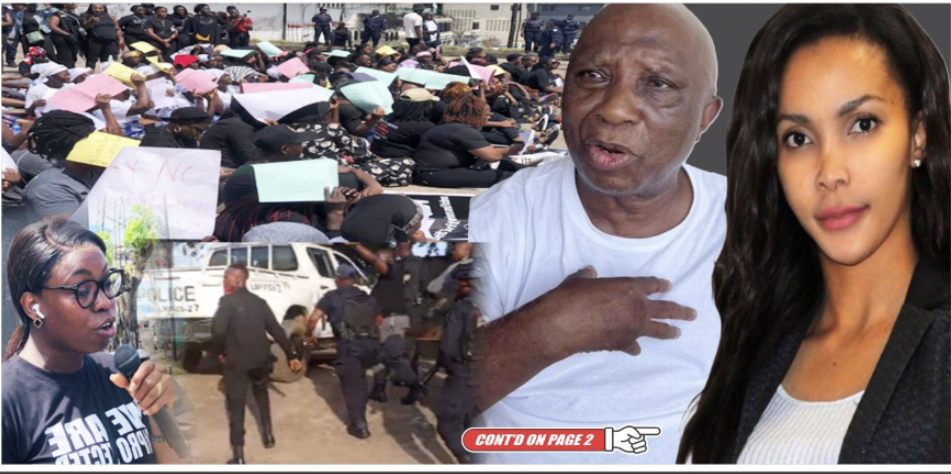
Mrs. Solanke was among scores of women, survivors, and concerned citizens who gathered at the headquarters of the Liberia National Police on Capitol Hill on Monday, March 16, 2026, demanding justice and an end to gender‑based violence following the suspicious death of Mrs. Jackson. The group presented a petition statement to the Inspector General of the Liberia National Police that specifically called for justice for Mrs. Toni Jackson, whose body was discovered with a deep laceration to the head and multiple bruises and injuries that initially led the LNP to name Mr. Jackson as a person of interest in a suspected homicide investigation.
Mrs. Jackson died at the John F. Kennedy Memorial Hospital in Monrovia after being transferred from Catholic Hospital, where she was initially rushed for emergency brain surgery. On Saturday, March 14, 2026, the Liberia National Police named her husband, Liberian economist and political figure Mr. Samuel P. Jackson, as the prime suspect in the case, a designation that preceded the formal charges filed this week.
When asked whether the filing of charges satisfies the demands made by women’s advocacy groups, Mrs. Solanke responded that the action partially but not fully meets their calls for accountability. She explained that charging a suspect responds to calls for action, but it does not by itself satisfy the group’s demands for systemic reform or guarantee justice, adding that what remains urgently needed includes continued transparent updates on the investigation, rigorous forensic work, protection for witnesses and any survivors, and timely prosecution if the evidence supports it.
She further outlined that her organization will continue pressing for implementation of the Domestic Violence provisions, the establishment and resourcing of the Family Court, expanded survivor services, and strengthened, trauma‑informed gender‑based violence units within the Liberia National Police. The human rights activist vowed that activists will monitor the case to ensure it does not stall or become a symbolic gesture without meaningful follow‑through, and she reaffirmed that the group remains ready to support lawful, transparent investigations while pushing for the structural changes needed to prevent and respond to gender‑based violence in Liberia.
Addressing the message that the charges send to survivors of gender‑based violence across Liberia, Ms. Solanke said the charges can be a cautiously hopeful signal that serious allegations of gender‑based violence will be investigated and that perpetrators may face consequences, a message that could encourage reporting and build some public confidence. She warned, however, that this hope will quickly be undermined if the process is opaque, slow, or mishandled, or if survivors are retraumatized or left without support, emphasizing that for survivors to truly feel protected, charges must be followed by credible investigation, survivor‑centered services, witness protection, and fair, timely adjudication.
For survivors of gender based violence, Mrs. Solanke stated that they deserve justice and support and that her organization will keep demanding a thorough, transparent process and the systemic reforms necessary so that every survivor can access protection and accountability. She reiterated that activists will continue to push for lawful processes while demanding the broader changes required to end impunity for gender‑based violence in Liberia.
Inspector General of Police Gregory Coleman, in a formal address announcing the charges, confirmed that the investigation had established credible and corroborated evidence indicating that Mrs. Jackson had been subjected to repeated physical violence over time, supported by witness accounts, photographic evidence, and documented communications. He also revealed that Mr. Jackson was the last known person with the victim inside a secured residence and was also the first person who entered the secured room and discovered the victim unconscious and in a pool of blood, with both entry and exit restricted, effectively isolating the victim.
The police chief detailed medical and forensic findings that now establish a clear and compelling trauma profile, including contusions to the left forehead, the back of the head, and the middle and right chest wall, as well as a laceration and hemorrhage to the back of the head and bruising on the upper limbs with pinpoint puncture marks suggestive of possible restraint or defensive injury. He explained that the injuries support a probable sequence of events in which a blunt force impact to the chest caused a backward fall, resulting in severe head trauma, and that this was not a random or isolated injury but rather linked to a chain of previous traumatic occurrences.
Inspector General Coleman further stated that evidence established that the victim had a known medical vulnerability that occasionally resulted in seizures, yet the suspect continued to supply a stimulant, and that the victim was left alone in a locked environment without supervision, constituting a serious breach of duty of care with foreseeable risk to life. The investigation also identified a failure to promptly notify law enforcement and indicators that the scene was altered before police arrival, actions that the inspector general said are legally significant and form part of the evidentiary record.
The inspector general confirmed that a full autopsy report will further clarify the extent of internal injuries and that toxicology analysis is ongoing, with results expected within two weeks or possibly sooner. Based on the totality of evidence, the Liberia National Police formally charged Mr. Jackson with violations of Chapter 14, sub‑chapters A and B, Sections 2, 3, 20, and 23 of the Revised Penal Code of the Republic of Liberia, and the matter will be immediately forwarded to the court for adjudication.
Inspector General Coleman was unequivocal in stating that the Liberia National Police does not determine guilt and does not substitute public opinion for judicial process, emphasizing that the police act only when the evidence meets the legal threshold and that the accused remains presumed innocent until proven guilty in a court of law. He said the case speaks to broader issues that Liberian society must confront, including the principle that violence within private spaces is not beyond the reach of the law, that vulnerability does not diminish rights but rather heightens protection under the law, and that neglect, when it leads to harm or death, carries criminal responsibility.
Following the incident that led to his wife’s death, Mr. Samuel Jackson had dismissed suggestions of wrongdoing, telling reporters that marital conflicts are routine and should not be viewed as suspicious amid mounting allegations that his wife’s death resulted from domestic violence. Speaking to journalists at his residence, Mr. Jackson asked rhetorically whether husbands and wives do not typically have altercations, describing such conflicts as routine, especially in a deep love relationship involving jealousy, and he sought to characterize their marriage as passionate but ultimately ordinary, acknowledging that conflict can exist alongside deep affection while also stating that their last disagreement had occurred more than two years ago.
The Domestic Violence Act of 2019, which criminalizes physical, sexual, emotional, and economic abuse within domestic relationships and mandates prompt law enforcement response, forms part of the legal framework under which this case is being pursued. Beyond domestic law, Liberia bears obligations under several international instruments it has ratified, including the Maputo Protocol, the African Charter on Human and Peoples’ Rights, and the Convention on the Elimination of All Forms of Discrimination Against Women, all of which require the state to prevent, investigate, and punish violence against women.
Graphic images allegedly showing lacerations on Mrs. Jackson’s body circulated widely on social media following her death, intensifying public demand for answers and prompting women’s advocacy groups to call for transparency and justice. Mrs. Jackson, a South African national, died at the John F. Kennedy Memorial Hospital in Monrovia after being transferred from Catholic Hospital, where she was initially rushed for emergency brain surgery, and according to Mr. Jackson’s account, he discovered his wife unconscious in their bedroom upon returning home and acted promptly by taking her to the hospital, though details surrounding how she sustained injuries requiring brain surgery remain under investigation.
The Liberia National Police assured the government and people of South Africa, the family of the deceased, and the Liberian public that the case has been handled with professional integrity, transparency, and respect for international standards of investigation. Inspector General Coleman urged all parties to respect the judicial process and let the court do its work, stating that justice requires discipline, careful speech, lawful action, and that the evidence has now been placed where it belongs, before the judiciary.