

-In Liberia’s Local Governance
By Jerromie S. Walters
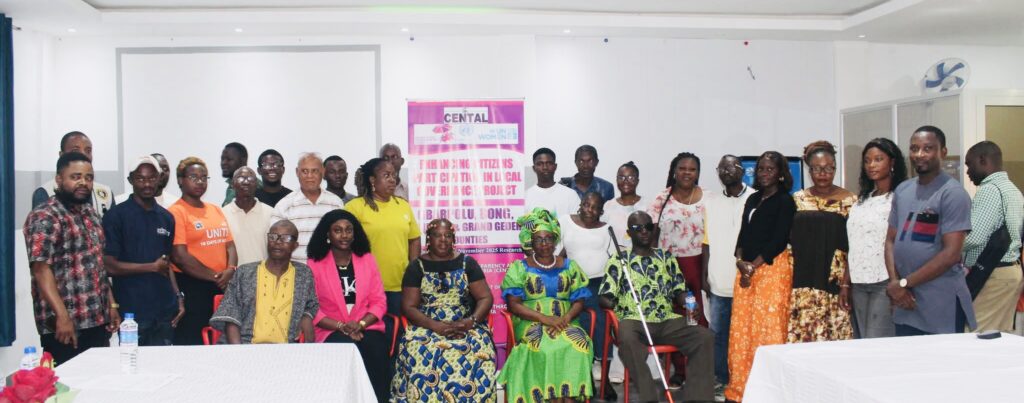
MONROVIA, Liberia – The Center for Transparency and Accountability in Liberia (CENTAL), in partnership with the Women NGOs Secretariat (WONGOSOL) and with support from UN Women Liberia, on Friday, December 5, 2025, launched a research report on the state of local governance and service delivery. The event, held at A’La Lagune in Congo Town, presented critical findings to an assembly of government, civil society, and international stakeholders, aiming to mobilize urgent action for reform and accountability.
The qualitative research, titled “Qualitative Research Report on Local Governance and Service Delivery in Liberia,” examined the effectiveness of local government structures, captured citizen perceptions, and outlined pathways for enhancing civic participation and institutional capacity. The project was implemented across four counties: Gbapolu, Bong, Nimba, and Grand Gedeh, with a focus on bridging the gap between citizens and local authorities to improve service delivery and ensure accountability.
The Methodology and Findings:
Presenting a summary of the report findings, CENTAL’s Project Lead, C. Rogget Chea, noted that the study employed a quantitative survey design to generate evidence on citizens’ perceptions of local governance and service delivery in Liberia, ensuring inclusivity, representativeness, and reliability. Data was collected from a total of 385 respondents across four target counties—Bong, Gbarpolu, Grand Gedeh, and Nimba—to ensure geographic and demographic diversity. The sample comprised 183 females (48%) and 202 males (52%), with 54% of respondents aged 35 years or below and 46% above 35 years, capturing balanced gender and generational perspectives.
According to the report, respondents were drawn from diverse social categories, including private citizens (30%), youth groups (17%), women’s groups (13%), business persons (14%), civil servants (9%), public officials (6%), CSO/CBO representatives (4%), persons with disabilities (4%), and others (3%). A structured questionnaire was developed using the KoBo Collect digital survey platform to standardize data entry and enable real-time monitoring, capturing information on awareness of governance structures, participation in development meetings, perceptions of transparency, access to services, and the inclusion of marginalized groups.
The research reveals a significant transparency crisis in local governance, with only 26% of citizens rating County Councils as transparent or very transparent, and just 25% giving the same rating to County Service Centers. Furthermore, only 26% of respondents rated these Service Centers as effective or very effective, while nearly half (48%) found them only “somewhat effective,” reflecting limited public confidence in institutional openness and accountability.
A stark gap exists between citizen awareness and participation: while 79% are aware of County Councils, only 42% have participated in county development meetings. Key barriers to engagement include not being invited (106 respondents), not being informed (88 respondents), and reports that no meetings were held (17 respondents), highlighting systemic communication failures.
The study also found that marginalized voices remain largely excluded from decision-making processes. Only 25% of respondents rated women as having high or very high involvement in county decisions, and a mere 8% gave the same rating for persons with disabilities. A significant 22% rated women’s involvement as very low, and 32% gave the same low rating for persons with disabilities.
Additionally, the research reveals a widespread perception of limited citizen influence over local development resources, as more than half of respondents felt they had minimal say in the use of County Social Development Funds (CSDF). Specifically, 27% rated their influence as very low, 26% as low, and 32% as moderate, indicating a significant disconnect between communities and the allocation of key funds.
Efforts to build citizen capacity and empowerment were found to be inconsistent and insufficient. While 47% of respondents stated such initiatives happen only “sometimes,” a concerning 22% reported they “never happen” or are uncommon. These irregular efforts fall short of community needs, highlighting an urgent requirement for sustained, frequent investment in leadership development programs, particularly for women and youth.
Despite these governance challenges, the study identified a strong foundation of civic readiness and untapped potential for engagement. A significant 69% of citizens rated their own capacity for advocacy as strong or very strong, and 87% were aware of the presence of Civil Society Organizations (CSOs) in their areas, with 56% having attended CSO-organized meetings. However, confidence in the effectiveness of these CSOs remains tentative, with only 14% being “very convinced” of their advocacy impact.
A comparative analysis across the four counties showed distinct local realities with Nimba County emerging as the leader in engagement, with the highest proportion of respondents (41%), strong awareness (95%), more positive council ratings, and relatively better involvement of women and youth.
Bong County represents 31% of the sample, showing moderate progress with high awareness but citizens reported limited influence over funds and perceived transparency as only “somewhat transparent.”
Grand Gedeh County faced the most critical gaps, with very low citizen participation (2%), weak council ratings, and poor transparency, where involvement of women and youth was overwhelmingly rated as very low. Also, Gbarpolu County has the smallest sample (9%), showing emerging potential with modest improvements and mixed ratings, including weak inclusion of women and youth but some reported positive development outcomes.
The report concludes that a persistent gap remains between the promise of decentralization and the lived experiences of citizens. To bridge this divide, it offers county-specific recommendations, including strengthening systematic communication and outreach to invite and inform citizens; enhancing transparency by publishing council decisions and budgets in accessible formats and launching public campaigns; prioritizing the inclusion of marginalized groups by creating designated seats in forums and implementing mentorship programs; and building consistent capacity through sustained empowerment initiatives, moving beyond the current irregular approach.
In her welcome statement initially at the event, Clara Mallah, Gender Officer at CENTAL, emphasized the importance of the research in promoting inclusive governance. “This endeavor seeks to enhance citizens’ participation in local governance and strengthen the capacities of local structures to deliver essential services effectively,” she stated.
Delivering special remarks, Mr. D. Emmanuel Wheinyue, Assistant Minister for Research and Planning at the Ministry of Local Government, commended CENTAL and WONGOSOL for producing what he termed an “evidence-based report.” He acknowledged significant strides in decentralizing governance, referencing the establishment of county councils, county planning units, and other institutional reforms.
“The government is committed to improving local governance and is taking steps, including digitizing services, to ensure everyone can access basic services,” Minister Wheinyue said. He praised civil society organizations for their supportive role and stressed the ministry’s strong partnership with both CENTAL and WONGOSOL. However, he noted that while the report focused on documented services, the government is also working to enhance non-documented services to fully realize its potential.
He encouraged closer collaboration in the future, suggesting that sharing draft reports with the ministry could improve alignment and impact. UN Women Liberia reaffirmed its commitment to supporting initiatives that promote gender-responsive governance and accountability. A representative highlighted the alignment of the research with ongoing efforts to empower women and marginalized groups in decision-making processes.
The Center for Democratic Governance, in a special statement, noted that the research complements its own projects aimed at strengthening local governance through capacity building and citizen engagement. “We are consistently engaging local partners and providing training for local authorities to improve transparency and service delivery,” their representative added.
The launch was graced by a wide array of stakeholders, including representatives from UN Women, the Ministry of Gender, Children, and Social Protection, the Liberia National Students Union, Liberia Crusaders for Peace, the Federation of Liberian Youth, SOS Children’s Villages, and the Governance Commission, among others.
The Center for Transparency and Accountability in Liberia (CENTAL) is a non-governmental, and non-profit Advocacy and Research Organization in Liberia.
On the other hand, the Women’s NGO Secretariat of Liberia (WONGOSOL) was established as an organ for coordinating the activities of women’s organisations in Liberia in 1998. It coordinates the activities of women’s organisations in Liberia and brings women together to formulate and present their independent views on government issues directly affecting women of Liberia.