

Margibi County: The 13th Judicial Circuit Court in Margibi County has convicted Nigerian national Prince Okeke in a significant heroin trafficking case. The verdict, based on strong circumstantial evidence, marks a decisive step in Liberia’s effort to combat international drug networks using the country as a transit point.
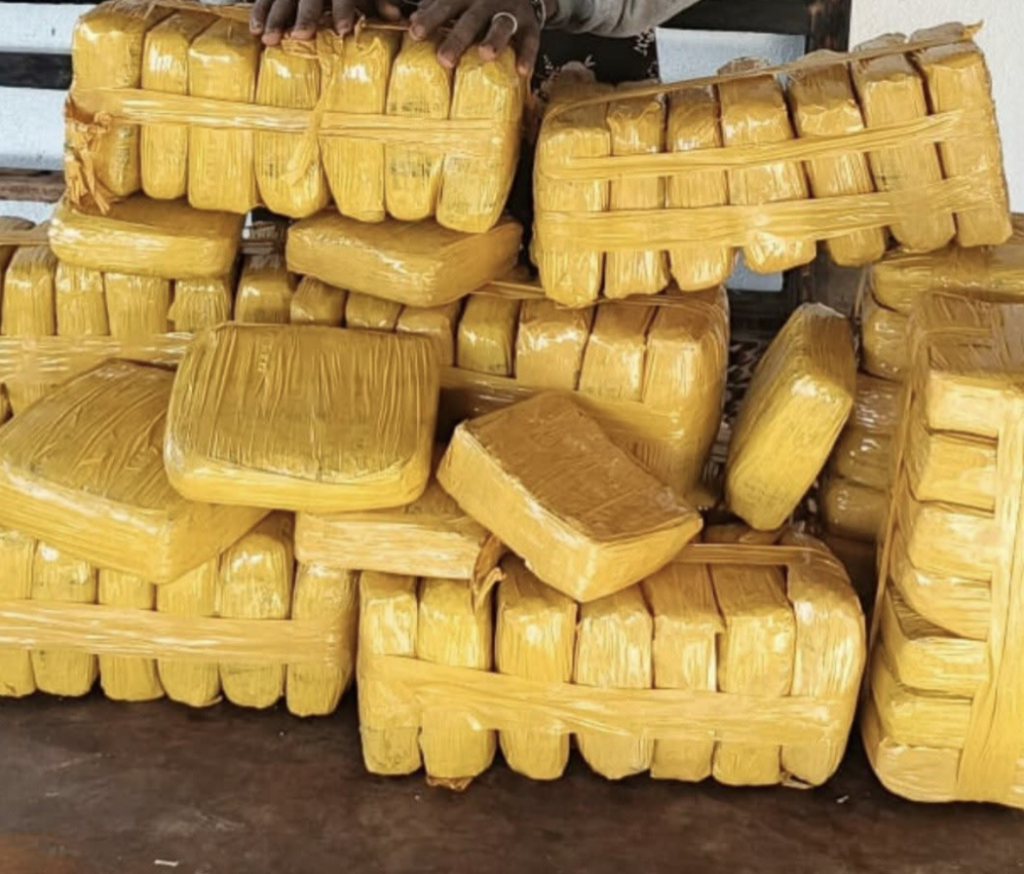
At the heart of the case was the importation of more than eight kilograms of raw heroin through Roberts International Airport (RIA), valued at nearly US$389,000. Prosecutors detailed how the operation involved multiple actors, covert coordination, and deliberate evasion of law enforcement, with Okeke identified as the local linchpin assigned to receive and facilitate couriers arriving from abroad.
In her final ruling, Resident Circuit Judge Victoria Worlobah Duncan adjudged Prince Okeke guilty of Unlicensed Importation, Illicit Trafficking of Controlled Drugs, Criminal Conspiracy, and Criminal Facilitation, declaring: “Wherefore and in view of the foregoing facts and circumstances, the Defendant, Prince Okeke, is hereby adjudged guilty of the crimes of Unlicensed Importation, Illicit Trafficking or Controlled Drug or Substance, Criminal Conspiracy and Criminal Facilitation.”
The judge ruled that Okeke’s prolonged flight after being summoned by the Liberia Drug Enforcement Agency (LDEA), his decision to switch off his phone for more than four months, and his inconsistent, uncorroborated statements constituted strong circumstantial evidence of guilt.
Citing Supreme Court precedent, the court held that “flight by a defendant is treated as strong circumstantial evidence of guilt and carries with it a presumption of consciousness of guilt,” making it admissible to sustain a criminal conviction.
Judge Duncan reasoned that the evidence against Okeke went far beyond suspicion. Two co-accused—Arondo L. Bonancy and Abel S. Gbedia—were arrested at RIA with 8.642 kilograms of raw heroin concealed in luggage.
Both provided voluntary statements consistently naming Okeke as the individual who coordinated their airport reception and facilitated the movement of the drugs. The court found that Okeke’s own admissions—acknowledging his relationship with Abel, providing financial assistance after the arrest, and failing to offer any credible explanation for ignoring law enforcement—reinforced the prosecution’s case.
The ruling placed significant weight on the doctrine that drug cartels rarely leave direct evidence linking coordinators to narcotics. Instead, courts must assess patterns of conduct, corroborated testimonies, evasive behavior, and role allocation within the criminal enterprise.
Judge Duncan drew parallels with prior Liberian cases, including Jusu v. Republic and Republic of Liberia v. George Obi, affirming that “circumstantial evidence, when corroborated, is as strong and probative as direct evidence.” Further damaging to Okeke’s defense was the court’s finding that his explanations lacked credibility.
He claimed to be an herbal drink seller without producing any proof of such a business, denied links to airport operations despite evidence to the contrary, and failed to explain why his registered GSM number bore a different name. These inconsistencies, the court held, were not minor contradictions but deliberate attempts to obscure his true role.
Having found the prosecution’s evidence sufficient and the defense’s version implausible, the court concluded that Okeke was an active participant in a criminal conspiracy designed to move heroin through Liberia. Sentencing has been scheduled for January 23, 2026, pending the filing of a presentence investigation report by the Probation Office. Okeke has since noted an appeal to the Supreme Court of Liberia, suspending further proceedings pending appellate review.