


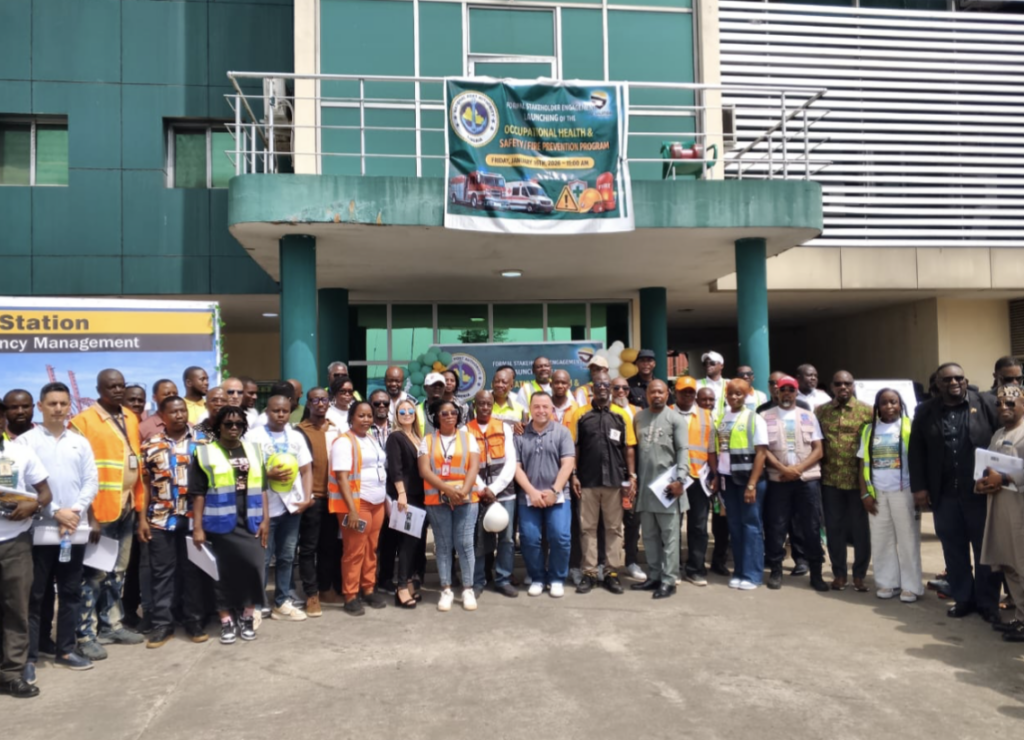
The National Port Authority on Friday, January 16, 2026, formally convened a high-level stakeholder engagement and launched its Occupational Health and Safety and Fire Prevention Program at the Authority’s headquarters on Bushrod Island, marking a decisive shift toward institutionalized safety, operational readiness, and regulatory compliance across Liberia’s principal maritime gateway.
Speaking on behalf of Managing Director Hon. Sekou Hussein Dukuly, Deputy Managing Director for Operations Hon. Emmanuel Horton described the launch as more than a ceremonial event, emphasizing that the program reflects a deep-rooted leadership commitment to protecting lives and strengthening institutional accountability within port operations. He said the Managing Director’s “vision and leadership are embedded in every aspect of this program,” underscoring that safety at the NPA is now a foundational principle rather than a procedural formality.
Horton stressed that the NPA, as the country’s economic gateway, is “a living system of people, processes, and purpose,” adding that safety remains “non-negotiable.” He noted that the Occupational Health and Safety and Fire Prevention Program directly affirms the Authority’s resolve to ensure that “every employee, contractor, and visitor deserves a safe working environment,” while aligning port operations with national regulations and international maritime safety protocols.
According to Horton, the program signals a strategic transition from reactive responses to preventive and integrated safety management. “Compliance is not a formality; it is a foundation,” he declared, adding that the NPA leadership is investing in systems, training, and oversight to ensure that safety practices are not only enforced but internalized across all operational levels.
He further linked the initiative to President Joseph Nyuma Boakai Sr.’s ARREST Agenda, describing the program as part of a broader national drive toward institutional reform, sustainability, and operational readiness.
He explained that the initiative is guided by three operational benchmarks, beginning with the integration of health and safety protocols into everyday workflows, from cargo handling to vessel berthing and gate operations.
He disclosed that the Authority is also upgrading infrastructure through modern fire suppression systems and equipment, while ensuring facilities meet the highest safety standards. In addition, Horton said the NPA is prioritizing preparedness through scenario-based training and the strengthening of emergency response units, noting that “operational readiness means we don’t wait for incidents to test our systems.”
Highlighting the practical intent of the program, Horton stated that fire trucks, sirens, and safety officers are now subject to strict readiness protocols, adding that safety officers are “not just trained, they are empowered.” He told stakeholders that the engagement was a reminder that safety is a shared responsibility and invited partners to hold the NPA accountable, collaborate, and champion safety across all layers of port operations. “This is not the end; it is the beginning of a new operational ethos,” he said.
Providing a technical overview of the program, Erickson Trocon Brown introduced the Occupational Health and Safety and Fire Prevention framework as an institutional system covering shipping lines, contractors, and service providers operating within the NPA footprint. He stressed that the implementation framework is anchored in governance and policy, drawing authority from Liberia’s Decent Work Act and the recently adopted Regulation 19 supporting occupational safety.
Brown emphasized that the program strengthens, rather than replaces, national emergency institutions, noting that the NPA is working in partnership with the Liberia National Fire Service to enhance first response capacity at the port. He said the objective is to safeguard the port from destruction, describing it as “the gateway to Liberia’s sustainability capacity.” He further assured that through training and capacity-building, personnel operating within the port would gain internationally recognized competencies.
He revealed that international partners with decades of experience are supporting the program through ISO-based systems, including ISO 45001 and international fire safety standards, while confirming the involvement of the Ministry of Labor, the Environmental Protection Agency, and other regulatory bodies. Brown described the Environmental Protection Agency as “one of the monumental institutions for which this program will be built on,” citing its role in environmental compliance and risk management.
The Occupational Health, Safety, and Security Management Plan unveiled at the launch establishes a structured framework designed to protect personnel, contractors, visitors, and assets throughout all NPA operations.
The plan outlines clear policies, procedures, and responsibilities aimed at promoting a proactive safety culture, minimizing operational risks, and ensuring preparedness for fire, spill, and security incidents. It aligns NPA operations with national laws, including the Decent Work Act and EPA environmental requirements, as well as international standards such as ISO 45001, the International Ship and Port Facility Security Code, and International Fire Safety Standards.
Covering all administrative and operational areas under NPA authority, including port facilities, terminals, navigational waters, concession areas, and third-party contractors, the plan seeks to achieve zero harm, maintain operational continuity, and enforce consistent safety and security standards across every functional dimension of the port.
At the core of the initiative is the NPA’s Occupational Health, Safety, and Security Policy, approved by the Board of Directors and signed by Managing Director Hon. Sekou Hussein Dukuly, affirming top-level commitment to safety, security, and operational excellence. The policy commits the Authority to full compliance with Liberian labor and safety laws, adherence to international standards, proactive hazard identification and risk mitigation, and robust fire prevention and emergency response measures.