

-Liberia-Guinea Border Residents Fear for Safety
By Jerromie S. Walters
FOYA, Lofa County — Residents of border communities along the Makona River in northern Liberia remain in a state of heightened fear and uncertainty, despite assurances from visiting lawmakers that no armed conflict exists in the area. Families have fled their homes, abandoned their farms, and now describe their situation as a humanitarian emergency, calling on the national government to intervene before lives are lost.
Lawmakers, headed by House Speaker Richard N. Koon, traveled to Foya District over the weekend to engage with residents along the Liberia-Guinea border, urging calm and encouraging those who had fled to return to their communities. The delegation assured citizens that there is no active conflict in the area and that diplomatic efforts were underway to resolve the tensions peacefully. However, for residents who have witnessed armed soldiers occupy their land, the message offered little comfort.
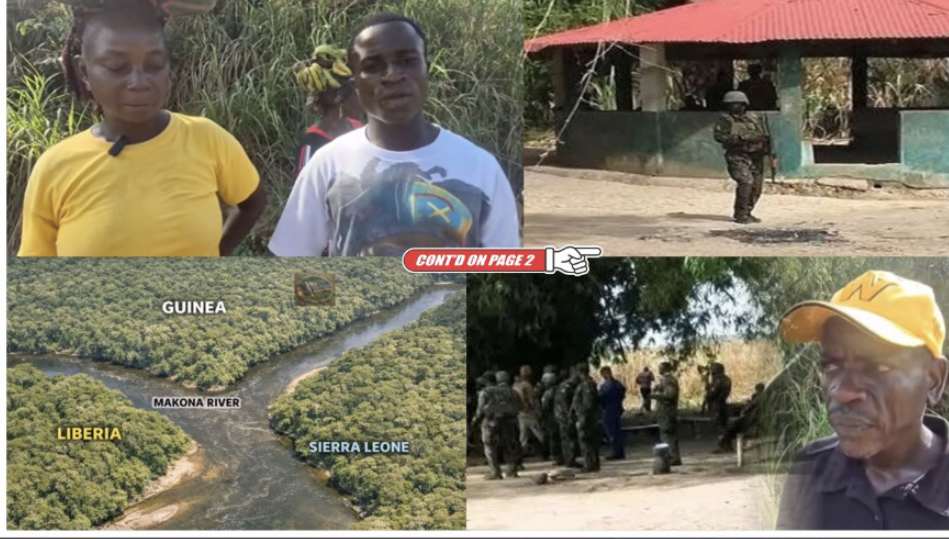
Marcus B. T. Taylor, a resident of Balahdu, a community adjacent to the Liberia-Guinea border, said the comments from the lawmakers were not enough to make them feel at peace. “Those guys are with arms, for us to be among them, it’s a risk for us. Our lives are at risk,” he said. “We want for the government to come to our aid. Let them find means for this problem to be solved,” Taylor added.
He further described the environment as an emergency area noting, “Now the area that we are in, it is an area of emergency. You don’t know anything can happen. Those guys (Guinean soldiers) are surrounded all over and we gat crossing points all over so we are in terrible zone.” As the government has been handling the matter diplomatically, the citizens urged the President to ensure that the matter is addressed before the end of next month.
“The land that’s being occupied by those guys there where we can do our farming, if those guys don’t draw back then it means this year, this area, so so hunger will be here because there is no land for us to do our farming activities,” Taylor said. He expressed shock over the Guinea government’s disclosure of the Makona River being theirs, when it is the river that divides the two countries. “The boundary [water] needs to be divided into two parts, the center of the water, they gat half, we gat half but they are trying to claim the whole river and claiming our land.”
However, the residents vowed to vacate the disputed areas if the Government of Liberia allows the Guinean government to take over the land. Marcus B. T. Taylor, vowed to relocate his family to the president’s house in the county. Like Taylor, other residents including women say the situation is not just affecting their peace, but their agricultural activities. They rallied the president to act swiftly, noting that they are tired of war. Mid Sunday, it was reported that the Guinean soldiers had occupied Kondadu, a border town in Lofa.
Liberian residents in that area were reportedly not allowed in the area. What began as a cross-border incursion by Guinean soldiers earlier this month rapidly escalated into a full-blown humanitarian and security crisis in northern Liberia, with residents of Foya District now fleeing their homes and abandoning their farms. As diplomatic efforts scramble to catch up with events on the ground, citizens urged the government to take swift action to prevent a catastrophe.
The dispute, centered in the Sorlumba Clan along the Makona River, entered its second week on Tuesday, March 17, 2026, with internal displacement reported across multiple communities. Despite a high-level emergency summit between the presidents of Liberia, Guinea, and Sierra Leone on Monday aimed at de-escalation, Guinean troops remained present in the contested area on Tuesday, leaving border communities in a state of fear and uncertainty.
Residents reported last week that the threat of further violence has emptied entire villages. A resident at the border on Tuesday named four communities that have been virtually abandoned. “Our people are displaced. Ma, nobody is there. Baladu, nobody. Solunma is almost empty. Lepalu is almost empty. This will cause real hunger in the next few weeks,” the resident said. According to local journalists, each of these areas is home to dozens of individuals.
The dispute was ignited earlier this month when Guinean soldiers crossed the Makona River—the acknowledged natural boundary—and seized equipment from a Liberian sand-mining operation. The troops raised a Guinean flag on Liberian soil, claiming the area for their country. While local citizens bravely confronted the intruders and re-hoisted the Liberian flag, the situation turned violent days later when Guinean forces returned and opened fire on residents, wounding a Liberian man.
Lofa County Superintendent J. Lavelah Massaquoi, who has been on the ground assessing the situation, confirmed the dire consequences for the civilian population on Tuesday as indicated by the residents. He stressed that the impact extends far beyond the immediate security threat, crippling the very foundations of daily life. “Nobody is going to make farm this year. No school will be there,” Superintendent Massaquoi said. “We gat to take into consideration all of these issues right now.”
The developments in Lofa stand in contrast to the message of unity and reconciliation provided by President Joseph Nyuma Boakai upon his return to Monrovia on Monday evening. Following an emergency summit in Conakry with Guinea’s transitional leader President Mamadi Doumbouya and Sierra Leone’s President Julius Maada Bio, President Boakai struck an optimistic tone. “We all realized that we are the same people… we have been working together for years and we have nothing to gain from war and that we shouldn’t waste time on war,” President Boakai stated upon his arrival at Roberts International Airport.
The trilateral meeting, held under the Mano River Union (MRU), resulted in a joint communiqué outlining a 12-point roadmap for peace. This includes a commitment to maintain the status quo ante along the borders, bolster security cooperation through joint patrols, and engage in dialogue to prevent future incidents. However, the sight of Guinean soldiers on the same disputed ground on Tuesday, less than 24 hours after the summit’s conclusion, left Liberians questioning the efficacy of the diplomatic breakthrough.
A key concern among citizens in Lofa, and now the broader public, is the lack of clarity on the fundamental issue of land ownership along the border. Residents have long understood the Makona River to serve as the natural dividing line between Liberia and Guinea, with each nation holding territory up to the median line of the waterway. The current encroachment, they say, represents a unilateral attempt by Guinean authorities to redraw that boundary.
It has also been established that at the Sefudu Border in Quardu Gbondi District, Guinean security ordered their Liberian counterparts to move the Liberian flag upward, about half a kilometer from the swampy borderline in 2025. This was the first area where Guinea began its attempted encroachment of Liberian territory, indicating that the current crisis may be part of a broader pattern of gradual territorial expansion by Guinean forces along the shared frontier.
In an address to the nation last week Wednesday, President Joseph Nyuma Boakai, Sr., reassured Liberians that his administration is managing the sensitive security situation along the border with Guinea through “peaceful and diplomatic means,” emphasizing that the nation’s hard-won stability will not be jeopardized. Delivering a “Message to the Nation” from the Executive Mansion, the President confirmed recent developments near the border in the Sorlumba area of Foyah District, Lofa County.
While acknowledging that the situation has “understandably attracted the attention” of the public, he sought to project calm, stating that the government is “fully engaged” and acting with “determination.” “Let me be clear to every Liberian: Our pursuit of a peaceful resolution is not a sign of weakness, but rather a demonstration of strength,” President Boakai said. “It is easy to fight, break down, and destroy. As our own journey has taught us, it is more difficult to recover and build.”
The President, in his capacity as Commander in Chief, detailed the immediate steps taken by his administration to de-escalate the matter. He confirmed that direct diplomatic engagement with Conakry had been initiated, and that Liberia had worked closely with its sister republic, Sierra Leone, under the framework of the Mano River Union to foster dialogue. He framed the current approach not as a concession, but as a necessary measure to protect the peace that was forged through “sacrifice, reconciliation, and the determination to reverse the past after many years of hardship.”
“That peace is precious, and this government will do everything within its power to protect and preserve it,” he affirmed. To ensure stability on the Liberian side, President Boakai assured the nation that security institutions—including the Armed Forces of Liberia and the Liberia National Police—remain “vigilant and professional,” working in concert with local authorities in the border regions to maintain calm.
He also extended gratitude to regional and international partners, including the Economic Community of West African States (ECOWAS) and the African Union (AU), for their messages of support and encouragement, noting that their solidarity “reaffirms Liberia’s standing in the community of nations.” Concluding his address, the President appealed directly to the patriotism of Liberians, urging citizens, particularly those in border communities, to remain calm and law-abiding.
The Makona River (also known as the Moa) is an international waterway shared by Liberia, Guinea, and Sierra Leone. International watercourse laws generally treat such rivers as shared resources, but specific colonial-era treaties and regional principles have led to conflicting claims of sovereignty. Guinean authorities argue that the river belongs entirely to Guinea. They cite the 1907 Franco-Liberian Convention (and a 1911 refinement), which they interpret as placing the border along the Liberian bank of the river rather than the middle (the thalweg).
They also point to a regional principle—historically associated with the Organization of African Unity—suggesting that a border river belongs to the country where it originates (which is Guinea). However, Liberian local leaders and many residents maintain that the river has historically served as a recognized shared boundary. Under this view, Liberian territory and rights extend to at least the middle of the river.