

-Pres. Boakai Flags Tangible Progress in His 3rd SONA
By Jerromie S. Walters
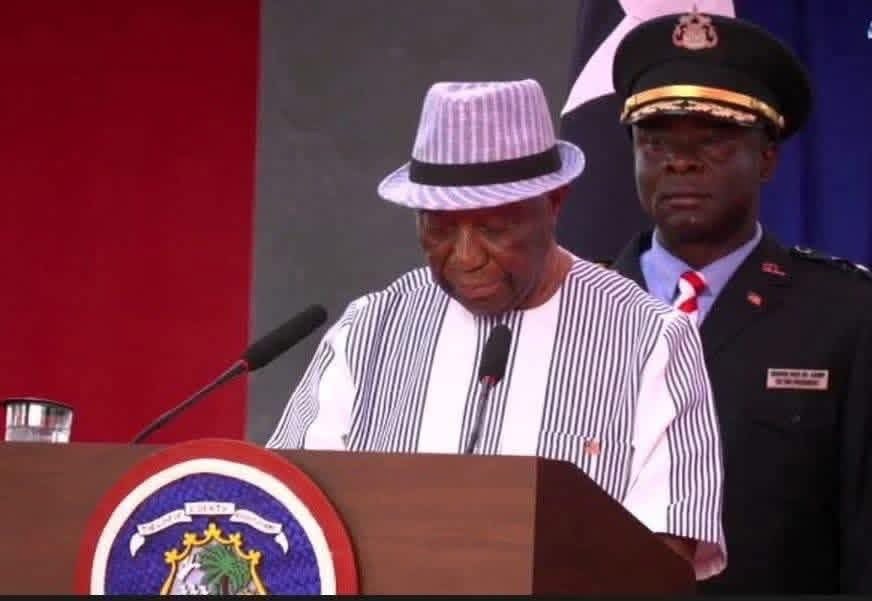
MONROVIA — Delivering his third State of the Nation Address on January 26, 2026, President Boakai asserted that Liberia is in a better state than it was a year ago, with tangible progress made despite inherited challenges and limited resources. He framed the address as a review of milestones achieved under his administration’s ARREST Agenda and a blueprint for accelerated delivery in 2026, focusing on economic stability, legislative action, and nationwide development.
agenda, commending the Legislature for passing key bills in the past year, including the Ministry of Local Government Act and the Liberia National Tourism Authority Act. He urgently called for action on pending critical legislation, such as the Presidential Transition Act, the Civil Service Commission bill, and amendments to the Mineral Development Agreement with ArcelorMittal, warning that delays would impede economic and institutional reforms.
To further combat corruption, President Boakai disclosed he had submitted four amendments to existing anti-corruption laws, including measures to address illicit enrichment and remove the statute of limitations on graft cases. He announced forthcoming bills for 2026, including legislation to establish a National Planning Commission, a specialized court for property disputes, a National Road Authority, and a universal health insurance program.
On the economy, the President reported significant macroeconomic gains, announcing a growth rate of 5.1% in 2025, exceeding forecasts. He highlighted declining inflation, now at 4%—the lowest in over two decades—and a surge in gross international reserves to $576 million. Exports grew by 31.5%, driven by a 17% expansion in the mining sector, while the Liberian dollar appreciated by at least 3% against the US dollar.
President Boakai addressed a major challenge from 2025: an abrupt slash in donor support that disrupted social projects. His administration responded with tighter fiscal controls, protected social spending, and intensified domestic revenue mobilization. This effort yielded a historic achievement: domestic revenue collection reached a record $847.7 million, funding over 96% of the national budget and enabling the planned submission of a supplemental budget—the first in many years.
The President outlined strategic investment drives, highlighting approximately $4 billion in committed investments from agreements with Ivanhoe for the Yekepa–Buchanan rail corridor and an amended deal with ArcelorMittal Liberia. He also announced the reactivation of the Putu Iron Ore Mine and the signing of eight new petroleum agreements, which are expected to bring in about $800 million.
On affordability, President Boakai reported measurable relief for citizens, with the price of a 25kg bag of rice falling to $14.50 and fuel stabilizing at about $4 per gallon. He credited completed infrastructure, like a new fuel storage tank and testing laboratory, for improving national energy security and warned businesses against price exploitation.
Infrastructure development was a centerpiece of the address. The administration increased Liberia’s paved roads from under 12% to at least 20%, maintaining over 780 km of major routes. Key projects like the Ganta-Saclepea and Sanniquellie-Logatuo roads are advancing, while 285 procured maintenance machines are en route to county hubs. The President also announced the imminent groundbreaking for the Pavifort concession roads.
In the energy sector, over 63,000 new electricity connections were established in 2025, bringing power for the first time to 17,000 households and 124 villages. Tariffs were reduced, and Mount Coffee Hydropower saw a 24% rise in sales. Ambitious plans for 2026 include 100,000 new connections and major projects like a 250MW gas-to-power plant, aiming to add over 700MW of generation capacity.
Social sector achievements were extensively documented. In agriculture, support for over 198,000 farmers and 166 km of new feeder roads helped move 33,755 Liberians from food insecurity to security. In education, over 1,000 “ghost” workers were removed from the payroll, 2,000 qualified teachers were hired, and 26,000 desks were supplied through the “One Child, One Chair” initiative.
The health sector saw maternal deaths drop and childhood immunization coverage reach 88%. The government also launched Liberia’s first National Anti-Drug Action Plan, enrolling over 800 at-risk youth in recovery programs. Significant construction progress was reported on hospitals in Bensonville and Bong County.
President Boakai emphasized his administration’s commitment to transparency and accountability, citing 11 indictments and two convictions secured by the Liberia Anti-Corruption Commission. The General Auditing Commission completed 94 audits, rejecting over $704 million in unsupported debt claims. Compliance with audit recommendations rose from 13% to 37%.
On governance, the President highlighted the operationalization of County Service Centers across all 15 counties, serving over 32,000 citizens, and the convening of a National Assembly of Chiefs. He noted the lifting of the public land sale moratorium after establishing a fair, standardized national deeding system.
Liberia’s restored international standing was a point of pride, underscored by its election to a non-permanent seat on the UN Security Council for 2026–2027 with 181 votes. President Boakai linked this to a foreign policy shift from aid dependence to trade and investment, engaging over 50 foreign and diaspora investors.
The President renewed his call for national reconciliation, citing the dignified reburial of former Presidents Tolbert and Doe and a formal state apology as necessary steps. He reported that the Office for the War and Economic Crimes Court has completed draft laws for legislative review, affirming that “true reconciliation must include justice.”
Meanwhile, President Joseph Nyuma Boakai also declared that his administration had created “more than 70,000 short and medium-term jobs” across infrastructure, agriculture, social protection, and small business sectors.
But rather than inspiring confidence, the claim has unleashed a wave of public skepticism, accusations of misinformation, and calls for hard evidence from citizens, political figures, and analysts alike.
Under the job creation section of his speech, President Boakai emphasized that employment remains a top priority. “Our job creation strategy has focused on addressing the binding and structural constraints to growth, including investments in roads, energy, etc.,” he said. “In this connection, we have created more than 70,000 short and medium-term jobs.”
While some have cautiously welcomed the announcement, many Liberians are questioning its accuracy. Critics argue that the figure appears disconnected from lived realities in a country where informal, vulnerable employment remains the norm for most.
Prominent voices within and outside the government have openly challenged the claim.
Martin K. N. Kollie, a former supporter of the administration, did not mince words on social media:
“The person who put 70,000 jobs in Pres. Boakai’s speech didn’t do well. That is a LIE. No 70,000 jobs were created. Be honest and open to the citizens.”
Nimba County Representative Taa Wongbe went further, accusing speechwriters of including “factually untrue” statements, thereby implicating the President.
Social media has become a forum for heated debate. User Joel W. Doe speculated, “It might be a typographical error, if not then it is purported…” while Promise Kamara attempted to parse the phrasing: “Create doesn’t mean all Liberians are working… You want to work but the question you should ask yourself is whether you qualify.”
Questions about evidence are central to the growing controversy. Philip Gaye echoed a widespread sentiment: “How and where, President JNB? This SONA is not clear; the truth is hidden from the world and Liberians. People are suffering and there’s no job.”
Others, like Hussein Kamara, urged caution but insisted on transparency: “While I have some doubts because I still want to see the specifics, how did you conclude that it’s a lie? Where is your data and the source?”
Critics point to recent official statements that appear to contradict the jobs narrative. Just weeks ago, Vice President Jeremiah Koung acknowledged that job creation remains a “significant challenge,” citing structural and economic constraints.
Meanwhile, Labor Minister Cooper Kruah cited ArcelorMittal Liberia’s hiring of 463 Liberians between February and September 2025 — a figure far below the tens of thousands claimed.
The World Bank reports that Liberia’s job market is dominated by informal and low-paying work, with roughly 78% of Liberians in vulnerable employment lacking social protection or stable income.
Analyst Dave Urey noted, “The claim of 70,000 jobs created by the government isn’t supported by available data.” He referenced the Vice President’s recent admission of persistent unemployment and the absence of large-scale hiring records.
Opponents of the administration see the announcement as a political maneuver. Patrick M’bayo accused the government of relying on propaganda: “They are governing through propaganda rather than tangible results. This is the same deceptive strategy that led to the CDC’s defeat in 2023. The UP hasn’t learned anything from history.”